


Navigating the narrow lanes of Curzon Road, one soon arrives at the quaint gates of Welham Girls’ School in Dehradun. At first glance, the campus appears modest, tucked between family homes, homestays, and a sprinkling of new cafes. Yet today, the lanes are unusually crowded — twice as busy as usual — for it is Founders’ Day. Former students, many proudly wearing white T-shirts emblazoned with ‘Welhamite’, and parents make their way toward a day steeped in nostalgia and celebration. Beyond the black gates stands the grey-stone institution that has, for 68 years, nurtured generations of women.
Walking over thebajri(grey pebble), through winding corridors and archways, one reaches the heart of the campus — Nasreen. As Renu Arora Basu from the batch of 1975 walked into the school, surrounded by a mix of the new and familiar, it was the museum in Nasreen that stood out the most. Located on the top floor, the former staffroom has been transformed into a three-section archive. Inside, letters from the school’s early years, its prospectus, Miss Linnell’s belongings, awards and accolades, and hundreds of student testimonials together tell the story of the institution’s rich legacy.

“I’m very impressed with the way the museum has turned out!” said Basu, adding, “I spent hours there because I’m passionate about every line recorded, every document displayed. They have truly brought the heritage and legacy of Welham to life.”
Reflecting on the inspiration behind the project, principal Vibha Kapoor said: “When I became the principal, I realised I was sitting on a wealth of history — but that history was scattered in bits and pieces. So we just wanted to consolidate everything. It was an effort to preserve our history, our growth, and our collective memories.” One may wonder: Why is the preservation of institutional history important, and how does heritage management continue to hold meaning today?
Humble beginnings
One chilly morning in February 1957, 10 students and a leader — a European woman standing six feet tall — gathered for their first assembly. The woman, Miss Grace Mary Linnell, began with a prayer, introduced the staff to the girls, and outlined the daily routine. With this simple ceremony, Welham Girls’ School was formally inaugurated in Dehradun. The vision for Welham Girls’, however, was not of Miss Linnell alone.
The story begins with Miss Hersilia Susie Oliphant, who arrived in India in 1920 to work as a companion to the Maharani of Cooch Behar. After she left Cooch Behar, she took on a few roles across schools in Kanpur and later, Delhi. From Delhi, she moved to Dehradun. In 1937, she first set up the Welham Preparatory Boys’ School (now the Welham Boys’ School) in the hill town. But her bigger dream was to open an institution for girls.
In 1954, she set her eye on the neglected estate of Nasreen, No. 12, Circular Road, overcoming every obstacle to make it hers. The only other house rented to make the school was No. 19, Municipal Road. Biographer Khatija Akbar notes in her bookA Teacher’s Tale(2007), “A dismal sum of 11,000 to launch a boarding school. It was a very insignificant amount even for those days… Doon School, for instance, had Rs 14 lakh as initial funds”.
Story continues below this ad
Funding was limited for several reasons, chief among them being that this was a girls’ institution that was coming up in a newly independent nation. While the town already had a few well-established boys’ boarding schools, Welham was distinctive in its mission to educate only women.
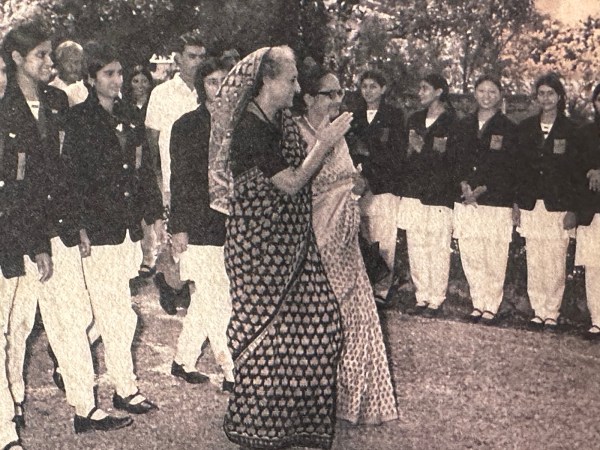 Indira Gandhi at Welham Girls’ School (Express photo)
On the Founders’ Day of Welham Boys’ in 1955, Oliphant revealed her vision of a girls’ school. It was upon her invitation that Miss Linnell came to Dehradun. Akbar writes: “In a happy conspiracy of fate, Miss Oliphant’s new venture and the end of Miss Linnell’s teaching career in Hyderabad happened at the same time”.
With the mottoArtha shanti phala vidya,“The aim of knowledge is to bring peace”, Welham Girls’ opened its doors in January 1957 with a batch of 10 girls, later fondly known as the First Ten. As the founder principal at Welham Girls’, Miss Linnell was extraordinarily committed to the institution. She was known for rarely taking time off work, except to visit her family in England. A wall in the museum bears the words, “To her it never seemed off that she drew no salary from the school: it was a natural extension of her belief that the others’ need trumped her own.” What she took instead was a token of Re. 1, in deference to the rules.
The First Ten
Among the First Ten was an intellectually challenged girl. “No one other than Miss Linnell would have taken her… Even today, integrated education remains more discussed than practised,” writes Akbar. If the choice of Sanskrit in the motto was surprising for a British principal to make, the decision regarding the school uniform was even more striking. Respecting Indian roots, she chose the traditional salwar-kurta and dupatta.
Story continues below this ad
From 10 girls, the number rose to 30 at the end of 1957, and by 1961 it had grown to 250. As the number of students grew, more space was required and acquired. The Senior Cambridge syllabus was decided as the curriculum. Madhu Trehan (then Puri), among the early batch of students, says the freedom offered at Welham was unheard of. “Where every school decides the subjects they would offer and teach, we were handed over the complete Senior Cambridge syllabus to choose whatever suited us. When a group of us chose shorthand typing and commerce, in lieu of the sciences, she [Miss Linnell] organised the teachers for us…”
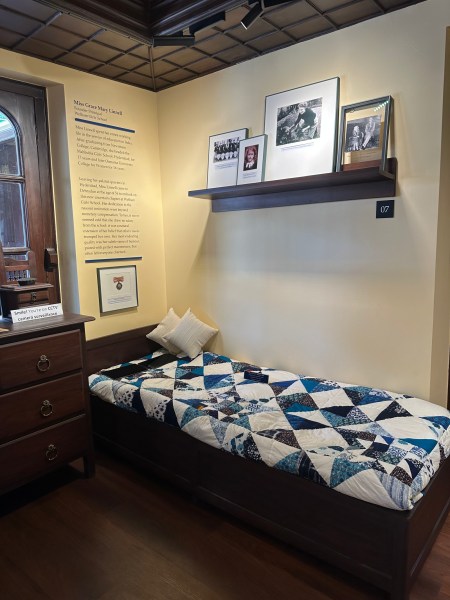 The belongings of Miss Linnell at the museum (Express photo)
When Miss Linnell picked her teachers, she relied more on her intuition and judgement of a person rather than their qualifications. “Fortunately and invariably her instincts did not let her down,” says Akbar. Principal Kapoor adds that her association with the school, as a French teacher, also began with the instinctive trust of the administration at the time. The stories of other faculty members are similar.
In March 1970, however,Miss Linnell was diagnosed with cancer. She was unable to take class or leave her room. On May 8, she breathed her last.Akbar writes, “She died on a day that caused least inconvenience to the school; it was as if she planned it that way. The next day, the school was to close for summer vacation and the children were going home, but at the same time they were there to say farewell to her…”
Preserving memories, Indira Gandhi’s letter and more
Much of this history, and more, is preserved in the museum: inside pamphlets, old magazines, personal belongings, through coin collections and other memorabilia. The museum walls display timelines that trace the institution’s many milestones and landmarks. Also adorning the walls are framed letters – some penned by and others addressed to Miss Linnell. Among the most fascinating is a letter dated January 24, 1984, in which Prime Minister Indira Gandhi wrote that, despite the establishment of Welham Boys’ School, “Miss Oliphant did not forget her original wish and often talked to me about it. I remember how happy she was when she was able to foundthe Welham Girls’ School with Miss Linnell as its first Principal.”
Story continues below this ad
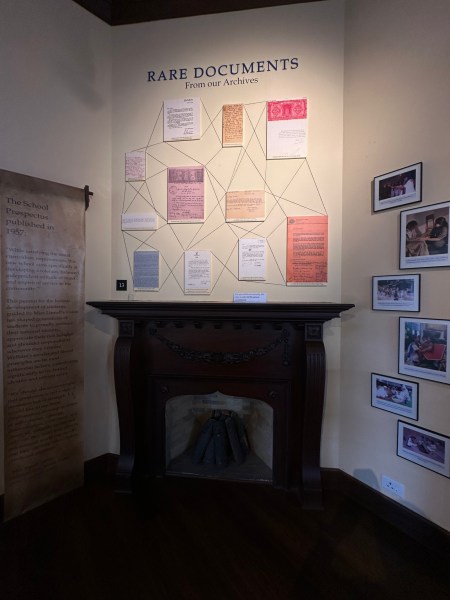 Rare documents at the museum (Express photo)
Another document is acircular sent by Miss Linnell to a parent, Raja Badhwar, which addresses the increase in school fees in 1967. In it, she wrote, “…I am afraid I forgot to give the unpleasant news that the Board of Governors, at its October meeting, felt regretfully compelled to raise school fees by Rs 100/-, per month for day girls.”
The museum also documents the war efforts made by Welham Girls’ over the years. “When India went into war in 1965 [with Pakistan],” writes Renee Sen Chandra from the Batch of 1965, “we once again threw ourselves wholeheartedly into war work. Dehra Dun was by now the headquarters for many strategic organisations. We therefore had the astonishing experience of air-raid sirens and early morning or late night air-raid practice… In 1962, anyone who could knit was rounded up and issued rough, scratchy wool to make socks, caps, sweaters for our soldiers…”
Indu Goswami, a former teacher, recalls in one of the school magazines: “During the war with Pakistan, everyone was making rotis and sending blankets. Miss Linnell insisted we contribute too. We decided to put on a ticketed play for fundraising. Miss Linnell played a six-foot-tall Goldilocks…Our goal was to raise money for donations, and she made it unforgettable.”
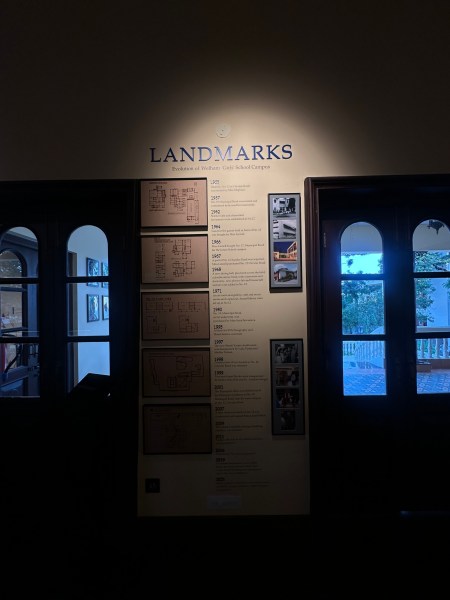 Evolution of Welham Girls’ School (Express photo)
Later in 1991, moved by the devastating cyclone that struck coastal Bangladesh in April, the Junior School students swiftly launched a fundraising campaign. They organised a ticketed show, sold old clothes for the support staff, gave up their ice cream on ‘Happy Night’, and even urged holiday-visiting parents to contribute – all in an effort to aid the victims. On July 27, they also organised a sponsored walk beginning from the Jawaharlal Nehru Stadium and concluding at the Bangladesh High Commission in Lajpat Nagar, Delhi.
Story continues below this ad
‘We got the girls and then built the school’
“When one looks around today, it is not easy to realise the courage with which the difficulties of the early years were faced,” said former teacher and Vice Principal Madhuri Jayal Mathur. It is to preserve and retell this history that the museum was created. After 24 months of perseverance, the museum finally opened in July this year. “It took a village,” said Kapoor. Current and former students, staff, historians and heritage management experts all came together to shape this museum.
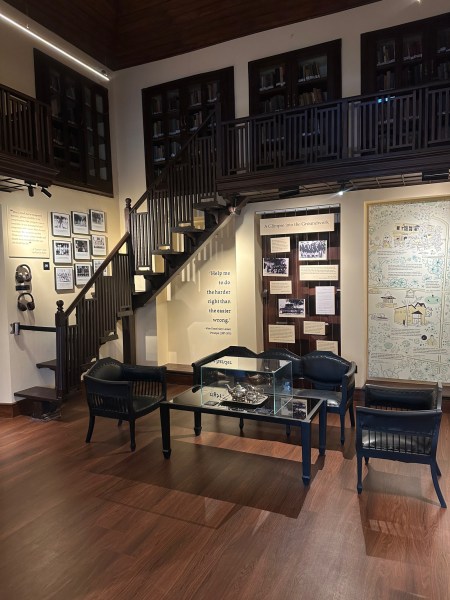 The museum (Express photo)
In a newly independent India, the idea of a premium institution for women’s education was still novel, the idea of a boarding school even more so. “People build structures and bring students but we got the girls and then built the school,” said Anuradha Bawa, Dean of Academics, Senior School. With about 60-65 admissions each year, Welham remains highly competitive and one space that vividly captures the spirit behind that competition is the museum itself.
As Basu remarked, one could spend hours poring over the documents and photographs displayed in the museum. Interestingly, in a quiet corner rests one of its most intriguing exhibits — “What makes a Welhamite”. The five items showcased are simple yet symbolic: bank currency,bajri, toffees from the iconic Kwality store, ID cards, and gate passes – each signifying independence, resilience, versatility, fearlessness and adaptability, respectively. These were among the aspirational qualities in independent India, though expected more of men than of women – the very gap Welham Girls’ aimed to bridge.
Also in the museum, in a spot best left undisclosed, lie the secret recipes of the beloved Welhamkadhi, tarts, and more. But perhaps, ingredients alone can never recreate the taste, for what is savoured is not merely a dish, but a legacy. A legacy that, if not honoured, preserved and presented, Kapoor believes, can be lost to time and memory.
