


In the heart of Vietnam’s Mekong Delta, plastic waste is more than an environmental issue; it is a community challenge.
Anh Duong Center is facing up to the challenge by turning plastic waste into products, learnings, and livelihoods.
Their innovative school-based model has earned recognition from the 2025 EXO Foundation Sustainability Awards in the ‘People’ category.
Connecting education and the environment
Anh Duong Center’s approach began with a simple but powerful idea: link environmental awareness with children’s education.
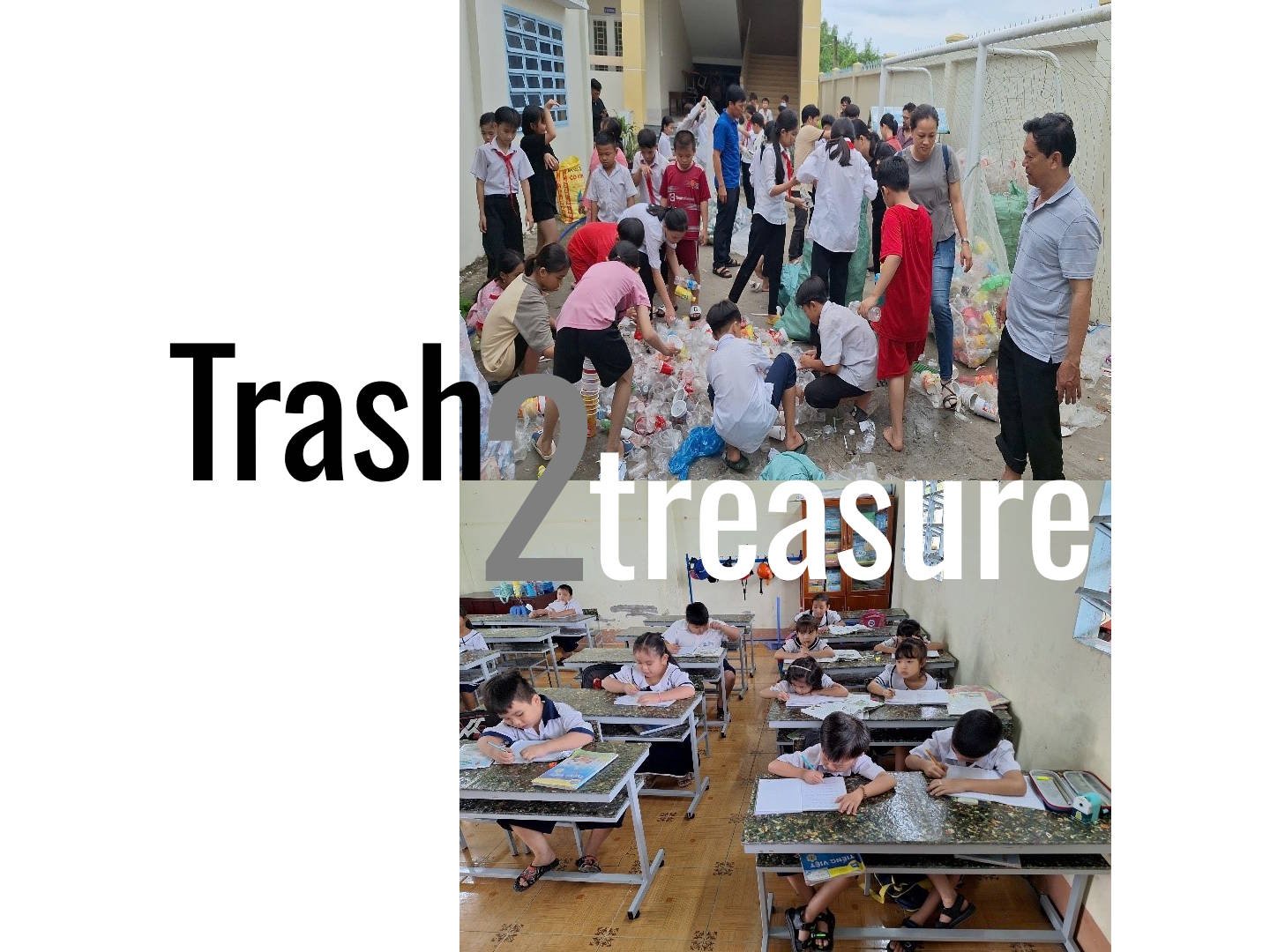
For our plastic waste recycling project, for example, instead of merely collecting waste, we empower students to become environmental ambassadors. During scholarship and school events, students are invited to bring in sorted plastic waste.
Anh Duong Center buys the waste, providing a small but symbolic income to the students’ families while reinforcing the value of recycling and collective responsibility.
So far, the program has collected and recycled nearly nine tons of plastic. Long Tri A1 School stands out as a leading example, with 600 kg of waste collected, inspiring the wider community to take action.
Plastic waste reborn as educational assets
Through Anh Duong Center’s close collaboration with technical partners, the collected plastic waste is transformed into tangible, useful products for schools.
The results speak for themselves. So far we have given plastic waste new useful life in the formof:
- 260 sets of desks and chairs
- 44 trash bins, and
- 30 bookshelves
Made almost entirely from recycled plastic, these are not only functional assets, they are powerful symbols of the circular economy in action.
Beyond the classroom, recycled plastic has also contributed to 33 eco-houses with roofing sheets made from one ton of reused plastic.
Local artisans have found new livelihoods through this process, strengthening community resilience and making local people the true heart of the project.
The initiative supports low-income families while reducing pollution, demonstrating that sustainability and social impact can go hand-in-hand.
Classrooms that clean the environment
Every classroom that is equipped with 20 sets of recycled-plastic desks and chairs helps remove approximately 500 kg of plastic waste from the environment.
What was once trash now supports children’s learning; a vivid example of education and ecology working together.
This transformation creates ripple effects: cleaner villages, inspired youth, and a shared pride in sustainable living.
Join us to be part of the change
The journey doesn’t end with an award. Anh Duong Center continues to expand this model to more schools and communities across the Mekong Delta.
Everyone can play a part; students, parents, local authorities, and organisations committed to a greener, more caring Vietnam.
About Anh Duong Center
Anh Duong Center has been implementing projects in poor communities in the Long My and Phung Hiep districts of Hau Giang province, Vietnam since2005.
Project areas include:
- Education and training
- Infrastructure
- Environment
- Microcredit
Anh Duong Center projects aim to help poor women, children, and households improve their living standards.
Our mission is to improve the quality of life for the poor while protecting the environment. We encourage poor communities to improve their capacity to solve their own problems, improve their living standards, and prioritise education for women and children.
We wish to build solidarity and mutual support among communities and towards sustainable development.
Find us on our website and on Facebook.
Anh Duong Center Office
HB Residential Area, Cluster 1, Long My Ward, Can Tho City (former Hau Giang Province)
Email: [emailprotected]
Telephone: (+84) 2933 871869
Anh Duong Center is anEXO FoundationSustainability Award winner.
About the author
Phạm Phi Anh, Anh Duong Center’s Deputy Head of Project Development — Fundraising Unit, has written this blog post on behalf of the whole Anh Duongteam.
Featured image (top ofpost)
Top image: Students enthusiastically collect plastic waste during school activities, turning environmental action into a learning experience. Bottom image: Recycled-plastic desks and chairs breathe new life into classrooms while reducing 500 kilograms of plastic waste per 20-student class. Both images supplied by Anh Duong Center.
