

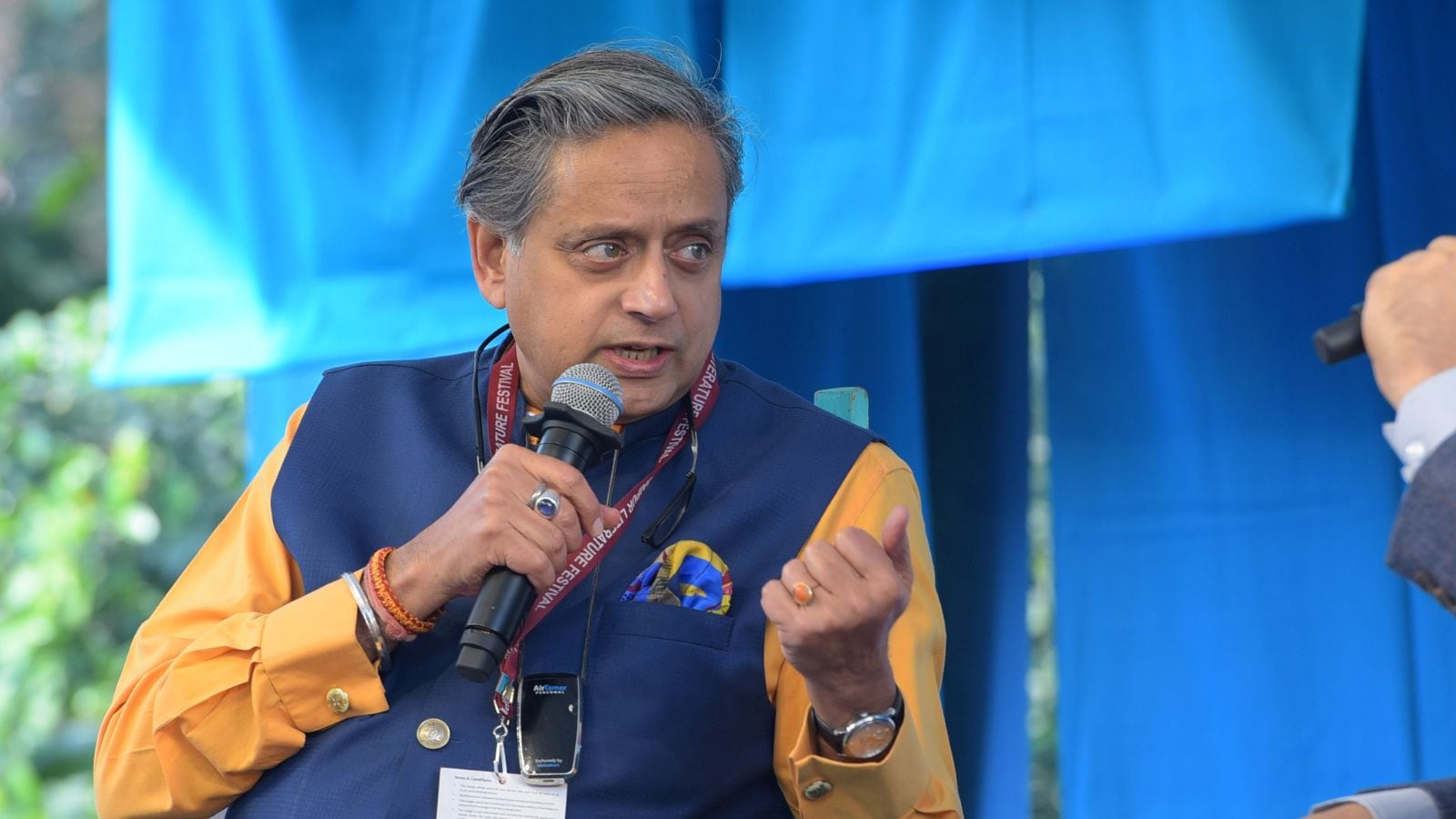
Congress MP Shashi Tharoor has again caused unease within his party, this time by writing an article on dynasty politics in which he says that the Nehru-Gandhi family “cemented the idea that political leadership can be a birthright”. Dynastic politics, he says, poses a “grave threat to Indian democracy” and it is time to trade “dynasty for meritocracy”.
In a column published by Project Syndicate on October 31, Tharoor writes, “For decades, one family has towered over Indian politics. The influence of the Nehru-Gandhi dynasty — including independent India’s first prime minister, Jawaharlal Nehru, prime ministers Indira Gandhi and Rajiv Gandhi, and current opposition leader Rahul Gandhi and MP Priyanka Gandhi Vadra — is bound up with the history of India’s struggle for freedom. But it has also cemented the idea that political leadership can be a birthright. This idea has penetrated Indian politics across every party, in every region, and at every level.”

Congress sources said the Thiruvananthapuram MP’s mention of Leader of Opposition Rahul Gandhi and Wayanad MP Priyanka Gandhi Vadra did not go down well with the party leadership. However, party leaders refused to comment on the article.
“He regularly does such things for attention. Why should the party take note of it or give a statement?” asked a senior Congress leader. Congress communications in-charge Jairam Ramesh and Media and Publicity Department chairperson Pawan Khera refused to comment. The Indian Express also reached out to Tharoor, but did not receive a response.
BJP national spokesperson Shehzad Poonawalla praised Tharoor’s “very insightful piece” and wondered what repercussions the Congress leader would face “for speaking so candidly”.
In the column, Tharoor points out that dynastic politics is a feature in regional parties too, such as Shiv Sena, Samajwadi Party, Peoples Democratic Party (PDP), and National Conference (NC).
“Dynastic politics pose a grave threat to Indian democracy. When political power is determined by lineage, rather than ability, commitment, or grassroots engagement, the quality of governance suffers. Drawing from a smaller talent pool is never advantageous, but it is especially problematic when candidates’ main qualification is their surname,” he writes.
Story continues below this ad
Arguing “it is high time India traded dynasty for meritocracy”, the Congress MP says it “would require fundamental reforms, from imposing legally mandated term limits to requiring meaningful internal party elections, together with a concerted effort to educate and empower the electorate to choose leaders based on merit”.
“As long as Indian politics remain a family enterprise, the true promise of democracy – ‘government of the people, by the people, for the people’ – cannot be fully realized,” Tharoor writes.
In the past few months, Tharoor has left the Congress red-faced several times. In February, the four-term MP came under fire from the party’s Kerala unit after he wrote a newspaper article highlighting the start-up boom in Kerala during Left rule and saying that “Kerala is beginning to stand out as a model of economic innovation and sustainable growth”.
The Congress MP then caused unease in the party when he led a multi-party delegation to the US and some countries in South America to explain the government’s position on the conflict with Pakistan following the Pahalgam terror attack. During the tour, his comment that India had breached the LoC (Line of Control) for the first time during the surgical strikes in 2016 in response to the Uri terror attack did not go down well in the party.
Story continues below this ad
Several of his Congress colleagues, including Khera, “fact-checked” Tharoor. The same month, when Ramesh was asked about Tharoor’s remark that India would never allow third-party mediation in its bilateral issues with Pakistan, he said that when “Tharoor speaks, it is not the party’s opinion”.
