

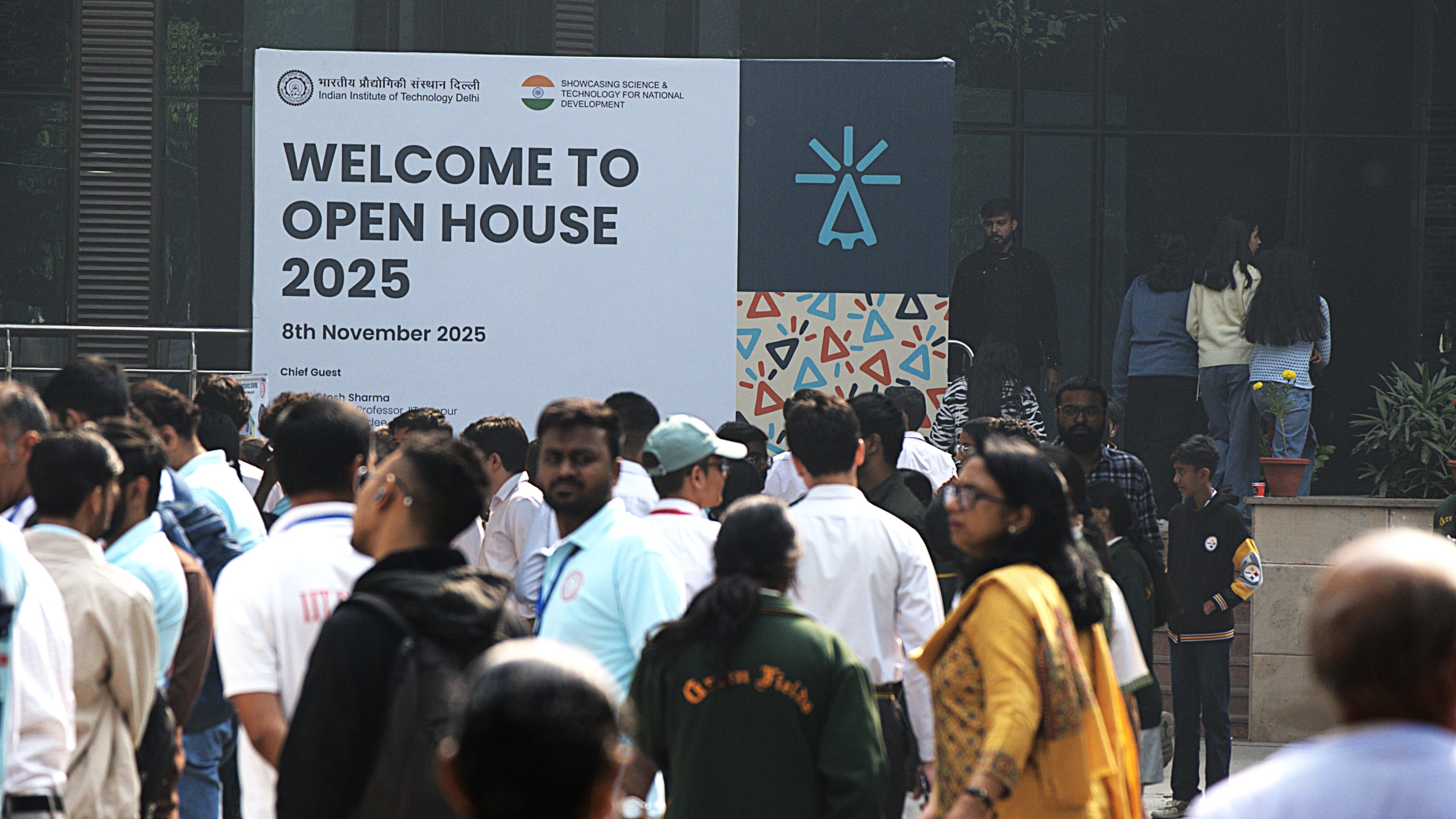
Indian Institute of Technology (IIT) Delhi conducted its 18th Open House Saturday, showcasing cutting-edge research by students and faculty, including industry representatives, with students from schools and colleges across the region visiting the institute.
IIT Delhi Open House 2025, which saw over 3,500 visitors, focused on ten key themes, including Healthcare, Biotechnology; Manufacturing, Industry 4.0, and Robotics; Smart and Sustainable Infrastructure; Advanced Material and Devices; Energy, Climate & Sustainability; Quantum & Semiconductor Technologies; Next Generation Communication; Management, Policy, Social Sciences; AI-ML/Data Science/Algorithms; and Fundamental Science.

Among the various research projects on display, many stood out for tackling urgent public health and workplace challenges, from invisible air pollutants affecting newborns to the food on our breakfast tables.
Tiny particles, massive consequences: Air pollution’s much-ignored impact on birth
Can the air we breathe determine whether a child is born healthy or not? Doris Seyinde, a researcher at IIT Delhi’s Centre for Atmospheric Sciences, originally from Lagos, has spent seven years finding the answer.
“We’ve all heard of air pollution and there are various substances that pollute the air,” explains Seyinde.
“One of those substances is particulate matter. When we talk about air pollution, people think about lung problems and respiratory problems. However, this PM2.5 can reach the lungs, cross through them, and enter the bloodstream. Anything that gets to the blood flows through the body.”
Seyinde’s study, spanning 2012 to 2018, examined birth outcomes in Nigeria. “For low birth weight, there is an 8 per cent chance of babies in Nigeria being born with low birth weight if they are exposed to higher levels of PM2.5. There is 6 per cent for preterm birth and 4 per cent for stillbirth,” she says.
Story continues below this ad
Also Read|University of Queensland, IIT Delhi open applications for Joint PhD programme for July 2026 intake
Not everyone faces the same level of exposure, even within the same region. “A rich person will not be living in a slum. A slum is more polluted,” Seyinde notes. “Somebody poor will make use of biomass for cooking, which has more PM2.5, while richer people will use cooking gas.”
The research also revealed that the first trimester is when developing babies are most vulnerable. “We think that is when the baby is developing. So mothers need to be very careful in the very first trimester,” she explains.
Seyinde’s work explores what would happen if countries met their air quality guidelines. Nigeria’s standard is set at 20 micrograms per cubic meter, while the WHO recommends just 5.
Story continues below this ad
Her projections show that meeting even national standards would significantly decrease the prevalence of adverse birth outcomes. “We see that if we can meet that 20 micrograms per cubic metre, the prevalence for this parameter will decrease,” she says, showing projection maps where greener colours indicate better outcomes.
When humans fear machines: The GenAI anxiety epidemic
While many exhibits at Open House 2025 showcased technical innovations, Shweta Kumari Choudhary from the Department of Management Studies was investigating something far more human: fear in the age of artificial intelligence.
“My research talks about how generative AI is creating a fear among working professionals who think that generative AI will soon or later replace them in the organisation,” explains Choudhary, a second-year PhD student. To find out if these fears are justified, she visited organisations where employees actively use generative AI tools and asked them ‘uncomfortable’ questions.
Also Read |Free AI courses from IISc Bangalore, IIT Guwahati, Google & more
Story continues below this ad
“Whenever I talk to them about generative AI, they get triggered. They feel that I feel insecure in the future,” she says.
Sharing a professional’s confession was particularly telling: “I am a researcher, but I am not very good at the coding part. So my skills are getting obsolete. My organisation will hire some people, research work may be done by some other people, and the coding part will be done by the generative AI only.”
Also Read|BTech in Chemical Engineering vs BTech in Chemical Science & Technology: What will you choose?
Through her grounded theory approach, Choudhary identified adaptive strategies that emerged from workers themselves. “I need a collaboration,” one professional told her. “The manual part will be done by me, the creative thinking where I need to apply generative AI, and I should not apply it because it is giving me an error again and again.”
Also Read | Top Free Artificial Intelligence courses
Story continues below this ad
Other adaptation strategies included networking with peers facing similar challenges, maintaining a sense of self-importance within the organisation, continuous skill enhancement, and demanding that organisations transform their work culture entirely. “It should not be that technology is taking all the jobs,” Choudhary emphasises. “The technology part and the human part are working together.”
Threat of a silent epidemic: Antibiotic resistance hiding in your food
Ever wonder why you’re becoming resistant to antibiotics despite finishing your prescribed courses? Shikha Balayan from the Centre for Rural Development and Technology has an unsettling answer: it might likely be from your food.
“Antibiotics are given to small chicks from day one till a specific amount of time for the prevention of disease because the mortality rate is higher in chickens,” explains Balayan.
The problem isn’t just that chickens receive antibiotics; it’s how these chemicals enter the food chain. “There is a trophic level transfer of antibiotic residues. If I give antibiotics to my chicken, and when they lay eggs, antibiotics transfer to the eggs, and the chick will eventually have the same antibiotic residue.”
Story continues below this ad
“The issue with antibiotics is not just the quantity, but that it will harm us. It’s the antibiotic resistance,” Balayan warns. Prolonged exposure to low levels of antibiotics through food creates perfect conditions for bacteria to evolve resistance.
Balayan conducted a systematic review and analysis of antibiotic residues in poultry products, referring to data across ten years. “I found that the residues found in specifically poultry products and specifically eggs were mainly tetracyclines and fluoroquinones,” she says.
Also Read|‘Numbers, logic, and the garden of ideas’: Palak’s Journey from Pune to IISc Bangalore
Why are antibiotics so ubiquitous in poultry farming? The answer reveals more of an economic reality. “From day 1 to day 4 every chick is given antibiotics for prophylaxis,” she explains. “Let’s say there are five chickens. It will be easier to mix it in the whole feed than to go in and feed individual chickens.”
Story continues below this ad
Her solution? Rapid detection kits that work like pregnancy tests, using antibody-antigen interactions to identify specific antibiotics in eggs or meat. “We want to make our kits, which will be consumer-centric, and any layman can do it,” she emphasises. The process is simple: pound the meat, place it in an extraction buffer, and test. Results appear within minutes, and the cost is about Rs 100 for a test.
“We are targeting people who buy (poultry and related goods) from local stores. Most of our Indian population buys it from a local store,” Balayan notes, highlighting the gap between regulatory oversight and reality. While the Food Safety and Standards Authority of India (FSSAI) has standards for antibiotic residues, enforcement at local markets remains weak.
