

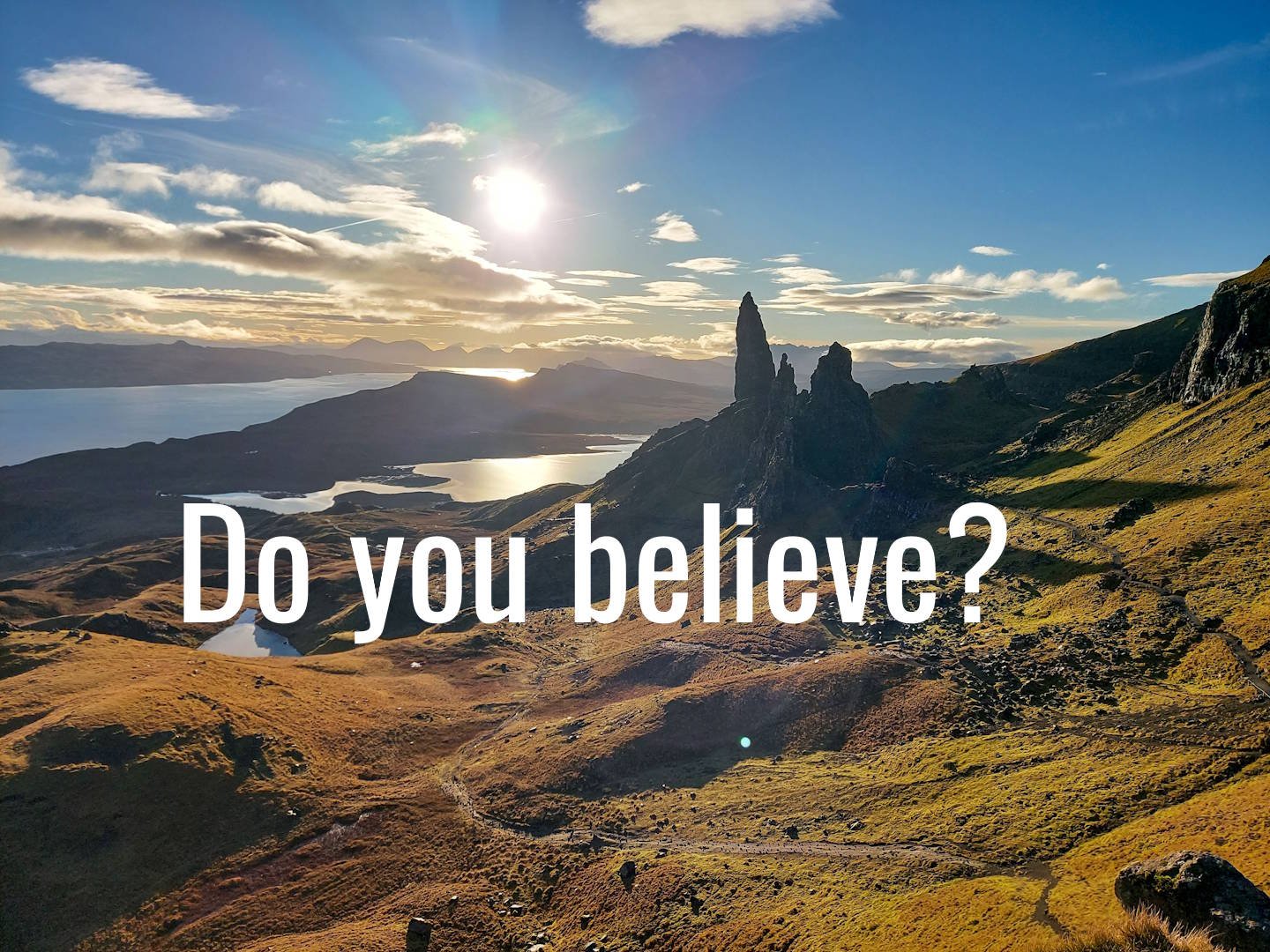
In what ways might supernatural folktales — and their animist characteristics — influence residents’ and tourists’ perceptions of and behaviours within landscapes?
Vivian Sakko investigated this question on the Isle of Skye, Scotland, for an award-winning master’s thesis about folklore tourism.
Thanks to “Good Tourism” Insight Partner Tourism’s Horizon: Travel for the Millions for inviting Ms Sakko to write this “GT” Insight.
Once upon atime…
Folklore tourism has surged in popularity over the last few years, enticing people from all over the world to explore landscapes infused with the supernatural. Here, folklore serves as a teaching tool to interpret heritage, the environment, andplace.
However, this popularity creates tensions that require further insight, especially as destinations incorporate folklore into development strategies. These tensions include, among other things, cultural commodification, appropriation, authenticity issues, and land degradation.
My research aims to address the limited scholarship in folklore tourism by looking into the relationship between tourism, the landscape, and folklore.
The tourist gaze and folklore
Tourists’ perception of folklore landscapes significantly impacts how these areas are consumed and experienced.
Discourses surrounding sites like Transylvania (Dracula tourism) and Roswell (UFO tourism) predetermine how travellers view the environment and culture. Folklore becomes a product of consumption, viewed through the lens of entertainment rather than as a reflection of cultural values linked to the living landscape, heritage, and community.
The folklore-centric gaze
A folklore tourism strategy that respects the landscape, the people living in a place, and heritage value can generate visitor enjoyment while promoting respect for the social and natural context.
Contemporary travellers crave narratives to animate landscapes. Supernatural folktales offer transformative experiences — possibly impacting perceptions and behaviour — by creating a ‘liminal space’, a threshold between the real and imagined. In this space, people become more receptive to new perspectives on, for example, environmental matters.
My thesis explores the impact of supernatural folktales on residents and tourists in Skye, particularly regarding their interactions with the ‘more-than-human’ world. Fusing natural and mythical elements, these tales convey an animistic worldview, potentially influencing how people experience, perceive, and behave in certain environments.
Inspired by Ironside and Massie (2020), I propose an animist ‘folklore-centric gaze’ for sustainable folklore tourism. Key topics include:
- Folklore as a reflection of human-nature relationships; and
- Folklore and the consideration of more-than-human kinship.
An animistic worldview
According to Harvey (2005), the world is filled with persons, only some of whom are human, and life is relational. Animism involves respectful interactions with others, viewing them as beings rather than objects. Overall, it emphasises learning how to be a good person in relationships with others.
This worldview commits us not to presume we know every dynamic aspect of our reality. It encourages ‘relational awakeness’; refusing to take the living world for granted and instead recognising the teeming life around and withinus.
Don’t miss other posts tagged “culture, cultural heritage, & history tourism”
Folktales influencing environmental experiences
Evident from my phenomenological interviews, native residents of Skye felt that awareness of local folktales enhanced their connection to a place, influencing their overall experience and understanding.
Both residents and tourists noted that these stories could significantly shape their perceptions, positively or negatively. While some folklore might evoke fear or caution, it generally enlivened landscapes positively for people. This involved sparking imagination and adding meaning to objects and places, allowing people to “seemore”.
Interviews revealed that exposure to folklore, in some cases, increased awareness of the landscape, prompting individuals to seek out its “magical” aspects and pay closer attention to the naturalworld.
Nevertheless, this folklore-centric gaze can also create a selective focus that limits connections with the natural world. Consequently, the impact of folktales on environmental experiences varies by individual, influenced by their background, interests, and beliefs.
Folktales influencing environmental behaviour
Many interviewees noted that understanding a place’s history and stories fosters respect, transforming it from mere landscape to something meaningful.
This awareness of a place’s living character — whether through animism or recognition of living entities — can inspire greater environmental awareness and respectful behaviour among both tourists and residents.
Similarly, however, the influence of folktales on one’s environmental behaviour varies by individual, shaped by their values, background, interests, beliefs, and the importance they ascribe to folktales.
Additionally, despite most tourists showcasing eco-friendly behaviour and tour guides educating visitors better, environmentally harmful practices by tourists persist in Skye due to insufficient management capacity.
According to DMO SkyeConnect, some of these practices include:
- Stacking stones;
- Making stone circles;
- Going off-trail for the perfect picture;and
- Dressing up and leaving ‘gifts’ for the fairies.
Hence, visitor management will be a key focus for the Isle in the comingyears.
Happily everafter?
Ultimately, the process of letting oneself be influenced by folktales is not about believing in the supernatural. It is about wanting to believe.
It requires an openness; to change and to ‘others’, whatever they might be. Consequently, it is up to the individual to decide whether to embrace the nudge that supernatural folktales provide towards adopting a folklore-centricgaze.
What do youthink?
Share your own thoughtsaboutfolklore tourismin a commentbelow.
(SIGN INorREGISTERfirst. After signing in you will need to refresh this page to see the comments section.)
Orwrite a“GT” Insightor“GT” Insight Biteof your own.The “Good Tourism” Blogwelcomes diversity of opinion and perspective about travel & tourism, because travel & tourism is everyone’s business.
“GT” doesn’t judge. “GT” publishes.“GT” is where free thought travels.
If you think the tourism media landscape is better with “GT” in it, then please…
About the author
Vivian Sakko graduated cum laude with a BSc in Tourism (Wageningen University & Breda University of Applied Sciences) before completing her master’s degree in Tourism, Society & Environment at Wageningen University in2024.
Her master’s thesis, “Vibrant tales that connect us all through folklore tourism: A case study into the folklore-centric gaze using animism”, was awarded the Dr Albert van der Zeijden thesis prize 2024 (Dutch Centre for Intangible Cultural Heritage & Utrecht University). It also took second place for the ATLAS Master thesis prize 2025. She is currently adapting this work for publication as a scientific article.
Vivian currently works as a self-employed project leader on a regional tourism project linked to her research, yet she remains open to other endeavours. Her areas of interest include tourism experiences, heritage, nature, storytelling, sustainability, education, resident participation, sense of place, place-making, and visitor/destination management.
Featured image (top ofpost)
Isle of Skye, Scotland, is a landscape of folklore; a destination for folklore tourism. Photo by Vivian Sakko ©. “GT” added the words: “Do you believe?”
