

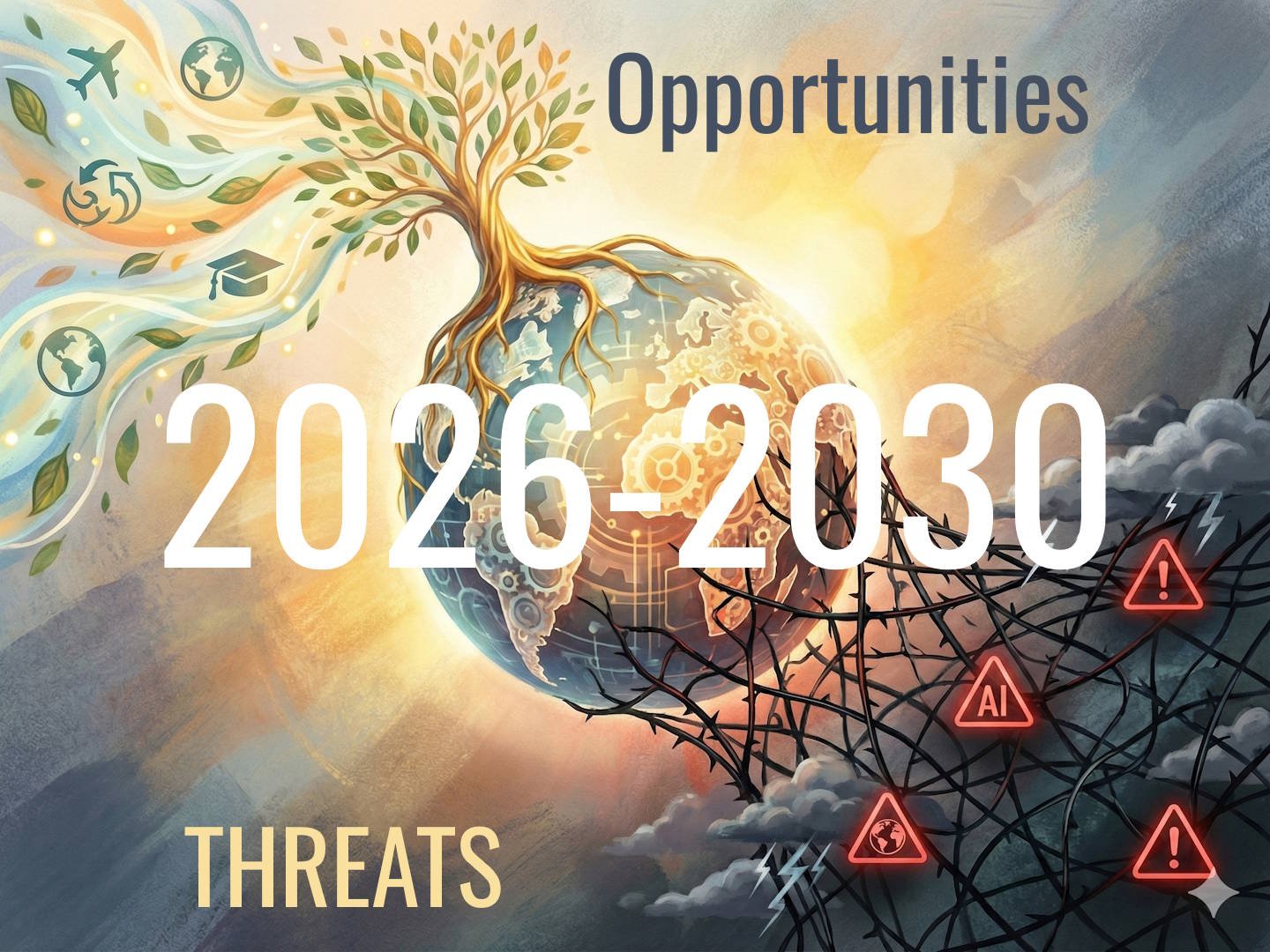
What is tourism’s biggest opportunity and/or threat, either in your specific location or globally, over the next five years (2026 – 2030)?
Thanks to the 17 good people who responded to this “Good Tourism” Insight Bites question, including academics, educators, and activists.
Special thanks to those who work in business and corporate roles for taking the time to share their thoughts. Like the industry it serves, The “Good Tourism” Blog is all about bridging worlds.
Find below, for your consideration and enjoyment, place-based perspectives from England to Iran, Barcelona to Bend; multiple global issues from cost-cutting artificial intelligence to out-of-whack academia; women’s empowerment to ocean plastic. The responses appear in the order I received them.
Have a thought toshare?
Respond in the comments at any time. Orwrite a Biteof yourown.
Pilgrimage, culture, relaxation … and surgery … inIran
Zohreh Khosravi, Content Manager, flysepehran.com, Iran
Since I work for an Iranian airline and our office is located at Mashhad International Airport (MHD), I see many passengers every day who are either returning home after visiting Mashhad and other cities in Iran or departing for pilgrimage trips toIraq.
I have no intention of criticising or endorsing pilgrimages at this time, but the fact that there are daily flights to these destinations, and even multiple flights in a single day, indicates that religious travel is highly desired by the people of Iran and its neighbours, including Iraq, Kuwait, Bahrain, and Saudi Arabia.
These journeys are frequently organised as tours that include accommodation, round-trip tickets, pilgrimage tour services, attraction visits, and souvenir purchases, making the trip easy and enjoyable for the travellers.
International visitors to Iran follow a similar pattern, which involves a combinationof
- Pilgrimage to Mashhad in north-easternIran;
- Cultural excursions to Shiraz, Isfahan, and Yazd;and
- Relaxation by the Caspian Sea and in the UNESCO World Heritage Hyrcanian forests
These will remain the main focus for organised tours to and within Iran, especially among middle-aged and older groups who will continue to make up the majority of travellers.
Medical tourism in Iran, including for cosmetic surgery, is especially popular among Middle Eastern women and represents another opportunity.
Is Bend and Central Oregon caught in an ‘amenity trap’?
Ed Jackiewicz, Professor,California State University, Northridge, USA
Not too long ago, I relocated to Bend, Oregon, witnessing the rapid transformation of this small city. I often consider what the near future might hold. Here I share my thoughts through the lens of the ‘amenity trap’ concept, which describes how places blessed with natural amenities can become victims of their own attractiveness.
Central Oregon’s rich outdoors and year-round appeal continue to draw tourists, long-term visitors, and second-home buyers.
This tourism-driven growth has obvious economic benefits, and local organisations are actively trying to harness economic resources such as lodging-tax revenues and visitor fees to manage the social, economic, and environmental pressures.
The city and region also creatively brand themselves as a responsible, nature-aware, year-round destination attracting conscientious travellers. However, as visitor numbers and inward migration continue to grow, Central Oregon risks sliding deeper into the amenitytrap.
- Housing affordability is already challenged and could worsen, displacing local workers and longtime residents as tourism and second-home demand inflate real-estate prices.
- Infrastructure — roads, water, sewer, public health, emergency services — is stressed by visitor surges and rapid population inflow, often funded disproportionately by locals while visitors generate much of the wear andcost.
- Climate change risks — wildfire, drought, flood — are significant; a major natural disaster could affect the tourism economy and strain the local fiscalbase.
For tourism in this region to be sustainable over the next five years and beyond, stakeholders must recognise the amenity trap warning: natural beauty and lifestyle appeal are strong assets, but they invite growth that can undermine community character, affordability, and infrastructure.
My sense is the region is doing its best to leverage its amenities and opportunities while avoiding the trap of being ‘loved to death’, but time willtell.
Barcelona: No room? Or norooms?
Saverio Francesco Bertolucci, Business Development Specialist,VDB Luxury Properties, Spain
The biggest threats to Barcelona are represented by potential political turmoil and laws that favour hotel lobby groups.
Despite the ongoing multi-billion-dollar expansion plans at its international airport, Barcelona’s policymakers have decided to restrict room capacity instead of expanding it.
Only a few holiday rental buildings and a bunch of private owners who hold the last licences for holiday apartments still stand against the huge hotel lobby comprised of the biggest corporations, which are the only ones to benefit from the latest laws approved by the Generalitat (the Council of the Municipality).
In a previous “Good Tourism” Insight, I described how these discriminatory laws are causing never-ending problems. I can confirm that Barcelona continues to have the worst housing results inSpain.
In this very alarming and unstable situation, public housing investments should be the basis of future development plans, following the example of Vienna. However, an increase in public housing implies even more highly regulated housing prices.
Therefore, to mitigate a crisis that is on the verge of exploding, policymakers should balance estates and investments according to the different social classes that are present in town, and offer a more differentiated product able to accommodate all, i.e. 30% public housing and 70% private properties, plus hotels, serviced apartment buildings, co-livings (residential community models), and the few holiday rental apartments that remain.
The intention economy: A ‘lucrative yet troubling new marketplace’?
Greg Richards (Tilburg University) & Wendy Morrill (WYSE Travel Confederation), The Netherlands
In the past, researchers focused on consumer desires and motivations as the drivers of tourism demand. With the growth of AI, and machines able to predict our wants, some see the emergence of the ‘intention economy’.
This is, according to Chaudhary & Penn (2024), a “lucrative yet troubling new marketplace” in which we could see “AI assistants that forecast and influence our decision-making at an early stage and sell these developing ‘intentions’ in real-time to companies that can meet the need – even before we have made up ourminds.”
In other words, AI will know what we want before we do. Our motivations will be increasingly influenced by algorithms, open to manipulation by companies who will be able to shape our travel intentions to fit their commercial interests.
The travel industry has always been able to shape travel patterns with desirable images, creative storytelling, and attractive prices, but AI takes influence to a newlevel.
Will people find ways to escape the intention economy trap? Could it be used for more benevolent purposes?
If the intention economy could be harnessed to influence intentions towards sustainable travel, perhaps there ishope.
Another positive trend, however, is that people are becoming weary of online content in general.
A return to physical travel agencies was evident from research on travel bookings made by young consumers, revealing an upward trend since 2017. This follows a sharp decline between 2002 and 2012 which tracks with the rise of OTAs and social media.
The return to travel agencies has been echoed by ABN AMRO research from the Netherlands. The percentage of travellers aged 18 – 34 booking at a physical travel agency rose from 4% to 11% between April 2024 and July 2025. And some 38% of US Millennials and Gen Z booked via a travel agent in2023.
Skills shortages threaten hospitality sector
John Morris Williams, Group General Manager,Sanakeo Boutique Hotel&Flora by Sanakeo, Laos
Looking ahead to 2030, my view is that the biggest threat is a shortage of skilled or semi-skilled hospitality personnel.
With more and more hotels and establishments being built and not enough hospitality schools, the industry is not doing its share to promote the hard but good life it can bring to those who embrace it.
Four- and five-star hotels and resorts will slide down in their service delivery and human capital, unless a worldwide revival is created.
‘Why not put our faith in the next generations to do a better job?’
Geoffrey Lipman, Creative Disruption Architect,The SUNxProgram, Malta
All the data shows we are failing on the targets laid out in the Paris Agreement, the Sustainable Development Goals (SDGs), and the Biodiversity Convention, so why not put our faith in the next generations to do a better job? Our kids and grandkids will be the decision makers when the Paris target dates arehere.
Through Dodo4Kids we want them to start their journey toward Climate Friendly Travel and a thriving planet now, so that the dodo becomes a beacon of hope not just a sad reflection on thepast.
Dodo is a quirky character re-incarnated from DNA in Malta. Dodo travels around the world meeting local children and enjoying the pleasures of being a tourist, all the while exploring how to be clean and green through online books, cartoons, andgames.
Dodo4Kids e‑books for Malta, Mauritius, Uganda, Bali, and Ukraine are available now available on Amazon.
SUNx Malta is a valued “Good Tourism” Partner.
‘An imbalance in tourism studies’ = An opportunity to collaborate
S Fatemeh Mostafavi Shirazi, visiting scholar, Iran
Despite the rapid expansion of overtourism research, a striking asymmetry persists: scholars overwhelmingly examine residents’ perceptions, while far fewer investigate tourists’ awareness of how locals feel. This is an imbalance in tourism studies.
Research has long framed overtourism as a phenomenon in which residents bear the heaviest social, cultural, and environmental burdens. Consequently, their experiences are highlighted and treated as the most legitimate and urgent.
While this focus is justified and valuable, it also unintentionally disregards the perceptions of tourists, who play a central role in creating the very pressures residents experience.
Empirical challenges further contribute to this gap. Tourists are transient, time-limited participants in the destination, and typically resistant to reflective questioning during leisure travel.
Moreover, many visitors approach destinations through a consumer-oriented lens, perceiving them as spaces designed for pleasure rather than as lived environments with social tensions. This lens reduces their sensitivity to local distress unless host dissatisfaction becomes overtly visible. As a result, tourists often report high satisfaction and low awareness of social conflict, even in destinations where local frustration is well documented.
There is also an institutional dimension: destination management organisations and local authorities frequently prioritise visitor experience as an economic imperative, creating narratives that downplay resident discontent. This reinforces a research environment in which tourists’ misunderstandings, blind spots, or detachment remain insufficiently examined.
Yet understanding how tourists perceive — or fail to perceive — local feelings is crucial for sustainable destination governance. Aligning tourist awareness with resident realities can directly influence visitor behavior, support community well-being, and inform more balanced policy interventions.
I am very interested in surveying this topic and would welcome collaboration with any academic who shares this research interest.
Can AI offset tourism’s rising costs?
David Jarratt, Senior Lecturer in Tourism Management,University of Lancashire, UK
Over the next five years, the most immediate threat to tourism globally is rising costs. In many places, inflation has pushed up prices across accommodation, food, transport and energy; this affects businesses and travellers, not to mention local residents.
A 2024 report by CaixaBank Research shows that tourism service prices in Spain in 2023 were 17.5 per cent higher than in 2019, with the price of accommodation up by 26.2 per cent over the same period.
This pattern reflects a wider squeeze on operating costs and household budgets. When travel becomes more expensive to provide and to purchase, demand becomes fragile and margins tighten.
Climate disruption adds further pressure through higher insurance costs and greater uncertainty about seasonal patterns. Consequently, affordability is one of the most significant constraints facing the sector as awhole.
A significant opportunity over the same period, however, is the productive use of artificial intelligence (AI).
A 2025 European Travel Commission report notes that early studies of generative AI in ‘knowledge work’ show productivity gains of over 60 per cent for writing tasks and over 50 per cent for coding, often alongside quality improvements. For a sector shaped by tight staffing levels and variable demand, tools that improve workflow, support staff and simplify planning can offer realvalue.
Over a longer time frame, we are also likely to see more automation and robotics in visible roles, such as luggage handlers or waiters, especially where labour markets are tight. AI can also support personalisation, strengthen pre-visit communication and help destinations manage visitor flows more effectively.
Costs create risk, while AI and automation offer a route to efficiency and better use of limited resources.
Indonesia’s 620,000-tonne plastic threat
Anna Clerici, Co-founder, No-Trash Triangle Initiative, Indonesia
These numbers are no longer warnings; they’re a call to action:
In North Sulawesi, in the heart of the Coral Triangle, these figures aren’t abstract. Much of the plastic that ends up in the ocean flows through and to waters tourists call “paradise”.
The local economy is at risk. Regional planning shows tourism will need 15,000 skilled workers soon. Livelihoods depend on healthy reefs.
If degradation continues, iconic destinations like Bunaken may no longer offer the experience that brings visitors back. Resorts and dive centres have a front-row seat. They can help make the system work now, while the bigger machine slowly catches up.
Let’s be honest: we’re still waiting for governments to fully step in, enforce bans, and treat waste management as a priority. We’re still waiting for producers to finally feel responsible.
But tourism doesn’t have to wait. Tourism can co-fund local waste systems. It can create a model where proper collection — meaning fair salaries, safety, and dignity — is possible even in remote islands where costs are higher than in cities. Because proper waste management is expensive, and good intentions don’t cover payroll.
The No-Trash Triangle Initiative proves local stakeholders can support recovery. Best of all? It works. Rivers get cleaner, communities get stronger, and reefs get a fighting chance.
Tourism can’t fix everything. But it can bridge the gap between what should happen in five years and what must happennow.
How much is too much? Managing opportunity and threat in rural tourism
Shamiso Nyajeka, Dean of the School of Hospitality,PSE-Pour un Sourire d’enfant, Cambodia
The line between opportunity and threat can be quite blurry. Sometimes they look almost the same, and it’s hard to tell good news from something to worry about. My experiences living in rural Cambodia and Zimbabwe — in the serene areas of Kirirom and Nyanga — have made thisclear.
In recent years, interest in rural spaces has grown. Tourists, authorities, investors, and an affluent elite are looking to build or buy. Put that together, and you get a mix that carries real opportunities … and realrisks.
There are real opportunities. Rural communities can benefit meaningfully. In Nyanga, Zimbabwe, where climate change affects farming, tourism supports incomes. In Kirirom, Cambodia, new resorts bring better roads, jobs, and services.
But the threats are equally real. Growth can slowly chip away at the essence that makes these places special. It starts with a lodge here, a few homes there, a road pushed slightly further into green space. Small steps seem harmless, but they change the landscape overtime.
Everyone is trying to do something positive; improve livelihoods, support communities, and make sound investments. But we need clear limits, thoughtful planning, and honest conversations about “how much is toomuch”.
For me, the biggest opportunity and the biggest threat lie in the same place: how we choose to manage growth.
If we get it right, communities thrive and nature remains protected. If we get it wrong, we risk loving these destinations todeath.
England’s local pubs: Use them or losethem
Ashika Kalubadanage,Course Director,Canterbury Christ Church University, England
Globally, tourism is increasingly moving toward authentic, sustainable, and experience-driven travel. Modern tourists seek cultural immersion, eco-friendly accommodation, and unique local experiences, such as culinary tourism, craft workshops, or traditionalarts.
This shift presents a major opportunity for the UK tourism industry over the next five years to leverage its rich cultural heritage.
A particularly distinctive element of British culture is the traditional public house (pub), which has long served as a community hub.
However, the pub industry is at a critical point. Economic pressures, lifestyle changes, and urbanisation have led to the closure of many pubs across England.
In my small town, four pubs have already closed, highlighting the risk to this iconic institution. Having worked in this industry, I understand the deep cultural and social value pubs provide.
The solution lies in linking pub culture with sustainable, experiential tourism.
By promoting pubs as authentic destinations, England can attract high-value visitors while preserving local heritage. It allows tourists to engage with communities, experience traditional food and drink, and participate in local storytelling.
This approach not only enriches the visitor experience but also supports village pubs, sustaining local economies and social cohesion.
In this context, tourism’s biggest opportunity is clearly the promotion of authentic, place-based experiences. Sustainable initiatives focused on pubs can help the UK sector adapt to evolving traveller expectations.
Conversely, failing to seize this opportunity could exacerbate the threat of cultural loss and economic decline in ruralareas.
Higher education in the UK: Neglect, erosion, and academic snobbery
Sudipta K Sarkar, Senior Lecturer in Tourism Management,Anglia Ruskin University, England
As an educator in tourism, hospitality, and events (THE) higher education for over two decades, I believe the sector in the UK is facing a slow decline.
Business schools, where many THE courses are now parked, are playing a major role in this erosion. Yes, business schools are killing the THE discipline in the UK, and the reasons are manifold.
Several dedicated THE schools have now been closed or merged without valid justification. Essential training facilities — especially hospitality labs that once shaped impactful learning — have disappeared.
Worse still, in some cases, THE modules are now taught by staff with neither formal qualifications nor meaningful industry experience.
Business schools also show little interest in developing innovation labs in areas like tourism data analytics, experience design, hospitality technology, or revenue management, which are crucial for producing skilled THE knowledge workers.
Cultural attitudes compound these structural issues.
In Anglophone contexts, the conceptualisation of hospitality is not as developed as in France or Switzerland. This is reflected in the tendency to treat THE as a mere subset of marketing rather than a discipline in its ownright.
Yet many US universities, including elite institutions, have developed strong THE faculties. In contrast, the UK has largely confined THE to post-1992 universities, revealing persistent academic snobbery.
Perhaps most troubling is the lack of pushback from THE academics within UK institutions. Many seem to have happily accepted the dominance of Business schools without meaningful resistance.
Regrettably, a turnaround seems unlikely in the next fiveyears.
The industry is growing annually by 6% and is projected to add GBP 4.4 billion (~USD 5.8 billion) a year to the British economy by 2030. Given these figures, business schools’ stepmotherly treatment of the sector deserves callingout.
Opportunities for women’s empowerment in rural Vietnam
Pham Phi Anh, Deputy Head of Project Development — Fundraising Unit, Anh Duong Center, Vietnam
Tourism can do more than create memories; it can shiftpower.
In rural Vietnam, community-led tourism is helping women move from being seen as “beneficiaries” to being respected as the essential contributors that theyare.
Across the Mekong Delta, women hold communities together through farming, handicrafts, cooking, and preserving culture.
Yet these roles often go unnoticed, especially when tourism arrives with a charity mindset. When visitors come to “help the poor”, women’s skills remain invisible.
When tourism is built on dignity and respect, everything changes.
In our community-based programmes, women lead naturally as hosts, artisans, and cultural interpreters. Visitors who join a quilting group or a livelihood tour are not giving charity, they are paying for skill, talent, and authentic culturalvalue.
Starting in 2026, each visitor we host will contribute USD 65 per person per day directly to women-led livelihood projects. This creates stable incomes that support schooling, household decision-making, and long-term resilience.
Tourism cannot solve every challenge. But when women can manage their own earnings and, through their decisions, shape local development, each tourism arrival becomes part of their own journey toward empowerment.
Opportunities rise in Asia while threats linger globally
David Beirman, Adjunct Fellow, University of Technology Sydney, Australia
The biggest opportunity for the global tourism industry over the next five years is the shifting of its centre of gravity from Europe and North America toAsia.
Tourism to and within Asia has grown exponentially since the COVID-19 pandemic slump largely ended in 2023. This resurgence is driven by increased wealth in most Asian countries coupled with effective, innovative marketing at both regional and global levels. All sectors stand to benefit when they invest in Asian tourism.
Regionally, opportunities emerge from marketing initiatives such as the Association of Southeast Asian Nations (ASEAN) Tourism’s incentives for travellers to visit multiple Southeast Asian destinations. These have made it easier and cheaper to combine countries. Marketers are now highlighting destinations previously neglected by international visitors.
Dispersion of visitation and experiences is the natural sustainable antidote to overtourism, which has plagued many attractions. This dispersion includes increasing points of traveller entry by air, sea, and land, and spreading attractions, accommodation, and event infrastructure throughout Asian countries.
However, the biggest threat remains the resurfacing of a global crisis. As seen during the pandemic (2020 – 2023), government regulations can grind tourism to a halt. Beyond health threats, wars, civil unrest, economic downturns, widespread terrorism, political instability, and natural disasters all have the potential to severely disrupt tourism globally.
K Michael Haywood, publisher,‘Destinations-in-Action’, Canada
Destination management organisations (DMOs) have set their sights on achieving ‘community shared value’ (CSV) through tourism.
Why pose it as both an opportunity and a threat?
Welcome to the world of destinations seeking to please everybody: visitors, local governments, key stakeholders, visitor-serving organisations, and citizens.
Can’t bedone?
Please, read the document endorsed by Destinations International. It purports to be a ‘values-based roadmap for destination organisations to embrace community alignment’; an admirable undertaking.
But not if communications about CSV are self-serving.
It is bound to arouse suspicion if citizens believe they are not deriving value from tourism, or know it is being taken away. They see corporate greed, misspent marketing expenditures, plummeting service standards, inflation, and crowding. They feel dispossession and witness spiritual and cultural rot (e.g. ‘Lost Vegas’) alongside the misplaced poetics of space and placemaking.
Ever since the concept of shared value was popularised, it has been subjected to considerable critique, notably for usurping corporate social responsibility (CSR). Shared value cannot be separated from values and behaviours that differentiate right from wrong; what is preferable versus what must be avoided.
Reintegrating business into society to regain public trust requires solutions to a range of diversity, equity, and inclusion (DEI) and environmental, social, and governance (ESG) challenges. It requires commitments to improve the common good, community life, and the overall well-being of citizens. And it needs ideas that stimulate imagination and innovation.
Participatory involvement in the affairs of DMOs is laudatory. However, in too many ‘communities-as-destinations’, the social contract has been allowed tofray.
But all need not belost.
Based on the universal value of ‘leave no one behind’, our communities are far more likely to flourish when everyone’s hope and rational optimism are reinvigorated. As a progressive concept, CSV requires a reimagined roadmap.
Experiential travel, sustainability fatigue, overtourism, and HR challenges
Jeff Wilks, Psychologist, Consultant, Professor, Australia
Tourism is booming, that’s a given. Not only have passenger numbers recovered — and in many cases surpassed pre-COVID levels — but there is also a new surge of people willing to travel widely for unique and personal experiences.
Experiential travel presents the biggest opportunity for the industry over the next five years, provided we can manage tourist flows and deal with a couple of obviousrisks.
So what are tourists looking for, now and over the next fiveyears?
Travel trend predictors, like Mastercard, Booking.com, and Kearney Consulting, highlight the importance of value for money, getting close to nature, and connecting with local residents and their cultures. Tourists want authentic experiences and quality service. Soft adventure, family-friendly, and wellness are themes high on thelist.
While there is continuing interest and support for sustainability, a number of industry reports note a growing sustainability fatigue.
To address this risk, it is suggested destinations ensure that more sustainable options are not only readily available, but also easy to trust and understand. Currently, cost and convenience trump sustainability choices.
The second risk is overtourism.
Destinations can be too successful, with crowding and congestion leading to diminished visitor experiences and negative impacts on nature, culture, and local communities.
Destinations can address this by promoting lesser-known or alternative locations, encouraging low-season travel, and visiting attractions at off-peak hours. A recent Expedia survey found 63% of consumers say they are likely to visit a ‘detour destination’ on their next trip. Detour destinations are less well-known and less crowded than tourist hotspots.
Finally, delivering authentic experiences with quality service requires skilled and knowledgeable staff. Travellers say they will pay a premium for quality service, yet several recent industry reports, including by UN Tourism, highlight ongoing staffing challenges.
What do youthink?
In a comment below share your own thoughtsaboutthreats and opportunities over the next five years.
SIGN INorREGISTERfirst. (After signing in you will need to refresh this page to see the comments section.)
Orwrite a“GT” Insightor“GT” Insight Biteof your own.The “Good Tourism” Blogwelcomes diversity of opinion and perspective about travel & tourism, because travel & tourism is everyone’s business.
This is an open invitation to travel & tourism stakeholders from any background to share their thoughts in plain English with a global industry audience.
“GT” doesn’t judge. “GT” publishes.“GT” is where free thought travels.
If you think the tourism media landscape is better with “GT” in it, then please…
Previous “GT” Insight Bites
- Do fun and politics mix? Can we ‘leave our cares behind’ when we go on holiday?
- Overtourism and overimmigration are thesame?
- What is ‘authenticity’ in travel & tourism?
- Undertourism: Who’s suffering, andwhy?
- Tourism, war, andpeace
- Signalling or substance in tourism: What’s yourtake?
- Visitor value, values, volume: What’s good where youare?
- Outbound doesn’t care about sustainability | Well-being must include meaning
- Is a travel & tourism career still attractive? Important things to understand in2025
- Wishwashing tourism
- Butler’s conundrum: Air travel and ‘sustainable’ tourism
- What is tourism’s biggest opportunity and/or threat where you are in2025?
- “GT” Insight Bites: Nostalgia
- “GT” Insight Bites: Geopolitics and tourism
- Tourism stakeholders: Who has an outsized voice? Who has no voice? Whocares?
- Would you abolish taxes ontips?
- Three critics walk into abar…
- How are emerging technologies transforming the travel & tourism industry?
- What does it mean to be critical of tourism?
- What constitutes ‘progress’ for travel & tourism in2024?
- Considering a career in tourism? Important things you should know in2024
- What did tourism learn from the COVID-19 pandemic?
- In 2024, what are the best opportunities for tourism over the next fiveyears?
- Tourism’s biggest challenges & threats over the next five years to2028
- On empowerment, promotion, and the power of expression
- On enrichment, repatriation, the double-edged blade, andwar
- On tourism technology, progress, and local benefit-sharing
- Hey, travel & tourism, are you ‘neocolonialist’?
- Who’s the new boss? Asia Pacific tourism industry association seeks leader
- ‘The hospitality industry offers a great career.’ Really?
- Cruise ships: Blessing or blight?
- Tourist vs traveller: What’s the difference?
- The heads of finance, operations, and PR walk into their boss’s office…
- Yes, Tourism Minister
- What are tourism’s biggest challenges & threats over the next fiveyears?
- ‘Tourism is built on the backbone of white supremacy’. What do youthink?
- Really, what’s the difference? ‘Sustainable tourism’ vs ‘regenerative tourism’
- Want a career in tourism? Important things you should know
- Diverse perspectives on travel & tourism and a fairer world
- Diverse perspectives on economic degrowth and tourism
- Diverse perspectives on visitor dispersion
Featured image (top ofpost)
Tourism’s biggest threats, opportunities: five years to 2030. A Gemini-generated image. “GT” added thewords.
