

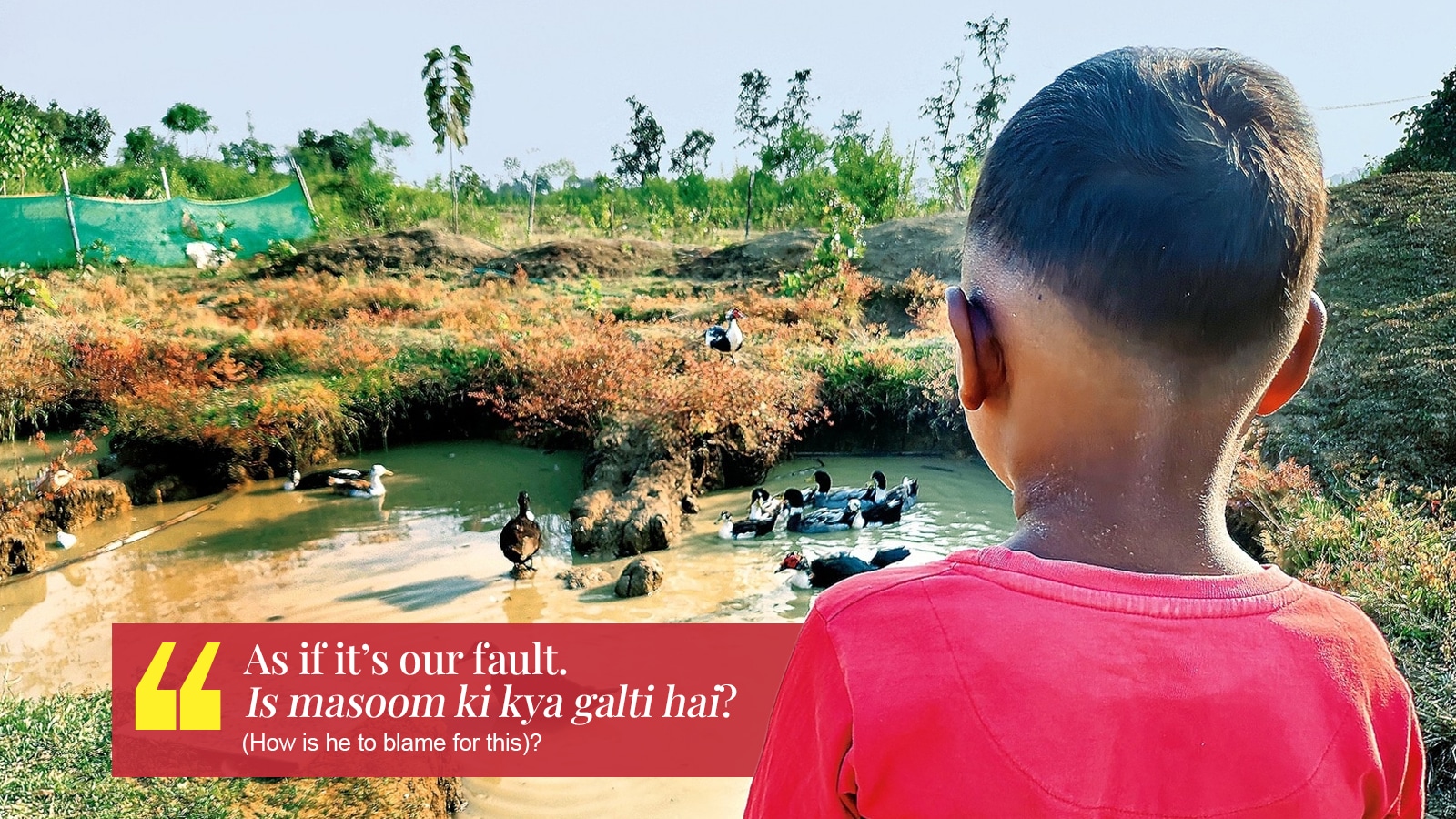
“Maa, dekho, this news is about me,” says the seven-year-old, rushing to his mother. Scrolling through YouTube on her phone, he had paused at a local channel reporting that five children with thalassemia had tested positive for HIV at Chaibasa Sadar Hospital in Jharkhand’s West Singhbhum district. “Nahin, nahin, babu,” says the mother, taking the phone away. But he knew.
From the conversations his parents have been having with doctors and with each other, he knows he has a “nayi bimari (new illness)”, and that friends and relatives look at him differently.

In October, the Jharkhand government confirmed that five children with thalassemia were infected with HIV — all traced to transfusions at the blood bank attached to the 500-bed Chaibasa Sadar Hospital, the biggest health facility in the district.
With everyone from the hospital staff to Health Minister Irfan Ansari admitting to the lapse, at least five officials, including the Civil Surgeon and the blood bank staff, were suspended and the government announced a compensation of Rs 2 lakh to each of the families.
But for the families of those affected — tribals in some of the most remote parts of West Singhbhum, whose children were already under treatment for thalassemia — the HIV diagnosis has added another layer of vulnerability.
Since the diagnosis, no one from the administration, not even the local ASHA workers, has visited them, say the families.
Each of them was given an Antiretroviral Therapy kit (a lifelong treatment for HIV) at the hospital, with medicines to last a month. While they were told about the dosage, with no counselling on social support or routine care, most families, and their communities, remain unaware of the disease and the way it spreads.
Story continues below this ad
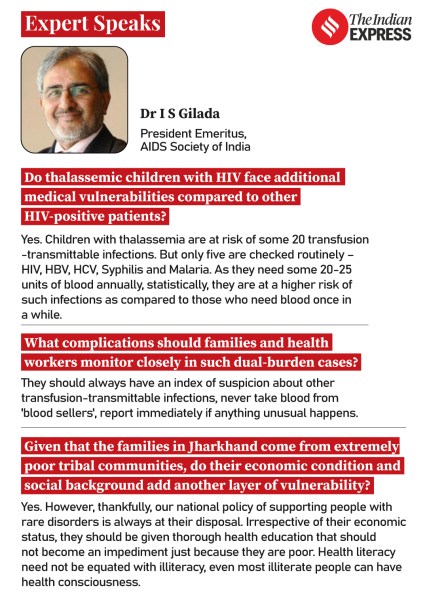 Dr I S Gilada
In Jharkhand, thalassemia patients are entitled to disability certificates and a pension of Rs 1,000, yet none of the families have got any financial relief so far.
Alone, battling stigma and with very little resources or support from the administration, the families are desperate.
“What do I do now? The hospital staff look irritated with us. They cover their faces and look scared when they see us. As if it’s our fault. Iss masoom ki kya galti hai (How is he to blame for this),” says the mother, breaking down.
The seven-year-old is her only child. He was a few months old when he was diagnosed with thalassemia, a genetic disorder that affects the body’s ability to produce hemoglobin and healthy red blood cells. “None of us have the disease, so we don’t know how he got it,” says the father, a labourer who gets occasional work. The family rears a few ducks in a small pond near the house, but the earnings are never enough.
Story continues below this ad
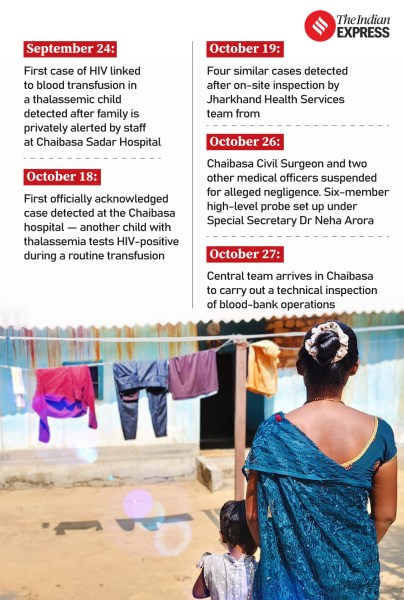 Timeline of events
The child’s thalassemia would be accompanied by frequent bouts of typhoid and malaria that prompted visits — twice a month, sometimes more — to the Chaibasa hospital, around 40 km from their village. After the first few times, when they would take the bus out of their village after a 5-km walk to the bus stop, the family decided to rent a room near the hospital for Rs 3,000 a month and enrolled the child in a nearby private school.
“Most of our days are spent in the hospital. This is why we rented a house close to the hospital,” says the father.
The family managed that way for three years, until the HIV diagnosis. “The news came out and our Ho community members got to know. That day, our landlord asked us to leave,” he says. Since then, the family has been back in their village and the child is out of school.
“The villagers say we did this intentionally to get the compensation, and that we are now rich,” says the father.
Story continues below this ad
As his parents talk, the child slips out to the pond, flicking pebbles into the water and watching the ducks ride the small waves.
The mother walks over, kisses the child on his forehead, draws him towards her and says, “Babu, what do people tell you?” The child smiles and hides behind his mother, so she says, “Villagers know he is unwell. Yet, they keep asking him why he doesn’t go to school. He tells them, ‘Because they (hospital) have given me another disease and the school has told me not to come’,” she says.
The parents say they haven’t heard from the school since the HIV diagnosis. “Earlier, they would call every time he missed school. His exams start tomorrow (November 17). But they haven’t contacted us. We know why,” says the mother.
The family hasn’t contacted the school either. “I am scared they will keep him apart from the other children. The thought of that hurts,” she says.
Story continues below this ad
The Indian Express reached out to the principal of the Chaibasa school, who said they were unaware of the child’s HIV-positive status.
Health Minister Irfan Ansari told The Indian Express, “We are in touch with the agencies concerned. The process is ongoing… We are continuously following up. The final report is yet to be submitted.”
Senior officials in the Health department confirmed that no one had visited the villages to check on the children.
On why the administration hasn’t reached out to the families, Chandan Kumar, Deputy Commissioner and Collector, West Singhbhum, said that under the HIV/AIDS (Prevention and Control) Act, 2017, the privacy of HIV-positive patients has to be strictly protected. “Because of this, providing certain benefits or awareness campaigns directly in the village becomes difficult. Any visit by officials or outreach teams can risk exposing the child’s status,” he said.
Story continues below this ad
Dr Bharti Minj, who took over as Civil Surgeon at the Chaibasa hospital after her predecessor was suspended following the incident, said none of the families were receiving pension under the thalassemia scheme, but assured that they would get it soon.
“A nodal officer has been appointed at the district hospital. Integrated Counselling and Testing Centre technicians are available, the ART centre in the hospital is also involved. We have more than 2,200 sahiya didi (ASHA workers) across the district, and we will hold a meeting with them and give them training to meet the families and understand the ground reality,” she said.
A single mother’s fight
Left adrift, each family copes differently.
Twenty kilometres from Chaibasa, a single mother struggles to make sense of her “misfortune”. Two years ago, her husband, a Home Guard at the DC office, died after his sugar levels spiked. “The day he fell ill, we travelled to Chaibasa to consult a Maa (a traditional healer). In the middle of the prayers, he died. I didn’t know what to do,” she says.
Story continues below this ad
With her six-year-old daughter diagnosed with thalassemia and now HIV, she feels the same sense of panic. “She is all I have. What can I do to keep her alive,” she says, speaking a smattering of Ho and Hindi.
So far, she has tried everything. “From the day she was born, she had a lot of health problems. The village priest advised us to change her name. We changed it to the name of a deity, but she still got HIV,” says the mother who has aged much beyond her 35-36 years.
When her daughter was diagnosed with thalassemia years ago, her husband did the running around. “He loved her very much,” she says. “It is very difficult without him… It is tiring to go from home to hospital and hospital to home, again and again.”
She brews rice beer at home and sells it by the roadside on the outskirts of her village, earning Rs 150-200 a day.
Story continues below this ad
She says panchayat officials told her she doesn’t qualify for the state’s widow pension scheme since she gets Rs 2,500 a month under the Jharkhand Mukhyamantri Maiya Samman Yojana (for women in the Antyodaya category). A year ago, she applied for the thalassemia pension, but says she hasn’t received any money yet.
She worries the recent Rs-2 lakh compensation will run out fast. “After HIV (the diagnosis), my daughter was admitted for 11 days with malaria. I spent a lot of money on food and travel.”
She knows little about HIV. “The nurses at the hospital didn’t explain. They told me to get my daughter’s blood tested. Once the report came out, they gave it to me and asked me not to share it with anyone. They told me to go to Room No. 112 at the hospital for the (ART) medicines,” she says.
As she sits on a plastic chair, her daughter clambers on, sits on her lap and whispers into her ear. She is hungry. “Are you?” asks the mother, rising to go inside. She comes back with a treat — some misri (sugar candy).
Behind them is a pink bicycle that she uses to take her daughter to the missionary school, nearly 10 km away, and sometimes to nearby health facilities.
She hasn’t informed the nuns in the school about the HIV diagnosis. “This disease… I barely understand it. I didn’t know you had to keep it a secret. Someday, I’ll tell her school. But not now. What if they refuse to teach her?,” she asks.
Since November 28, the mother and daughter have been camping at the Chaibasa hospital — the child’s haemoglobin levels had dropped and she needed a transfusion. “There is a shortage of blood in the hospital. We are still waiting… She has exams from January 5; I don’t want her to fall sick during the exams,” she says.
A mother’s lonely battle
Much before the HIV diagnosis, the 31-year-old would travel 40 km with her seven-year-old daughter to Chaibasa, at least twice a month, for the child’s blood transfusions. Her husband, a daily wager, rarely accompanied them on these journeys.
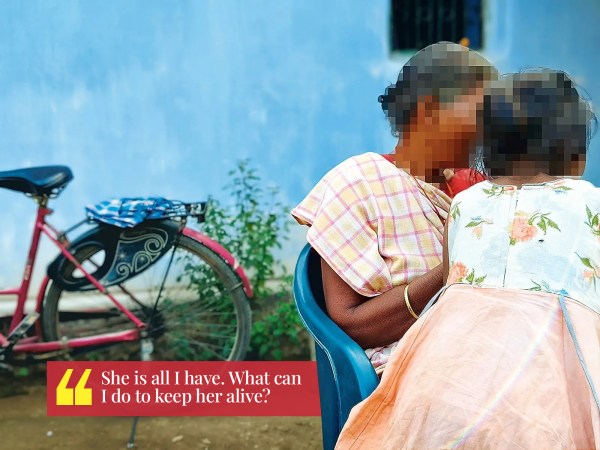 ‘She is all I have. What can I do to keep her alive’. (The photograph has been modified to protect the identity of family)
“When I was pregnant, my husband wanted me to abort our third child; he wanted to stop at two. But I decided to let my daughter live.
Months after she was born, we found out about her thalassemia. We have fought every day since,” she says.
Her daughter’s HIV diagnosis added to the tension at home. “Last month, my husband was going to work in UP. He was on the train, and I told him about her HIV. He got upset and asked, ‘Kya yeh bhi zindagi bhar jhelna padega (Will we have to bear this cross for the rest of our lives)’?” she says.
In all these years, she says, her husband has accompanied her to the hospital only twice. “Whenever she got sick, I would wake up in the middle of the night and rush her to hospital in an ambulance or hire a vehicle from the village,” she says.
But since the HIV diagnosis, villagers have distanced themselves. “Everytime I go to the river with my daughter, I hear people saying, ‘Look, here she comes’. I heard they will hold a meeting in the village to make sure my daughter stays away from the river,” she says.
On November 24, she called The Indian Express to say her daughter was unwell. She had tried calling the ambulance at the Chaibasa hospital, but got no response. She stood at the bus stand for nearly two hours, but none of the buses stopped for her. She then approached one of the villagers, who owns a goods-carrying vehicle.
“He has always helped me during emergencies, but this time, he didn’t even step out of his house. Then I went to another villager. His wife came out and said he is busy. Villagers taunt me, saying I should buy a vehicle with the Rs 2 lakh compensation I got from the government. That money is an insult. I can sell all my property and give them more money than they have given me,” she says.
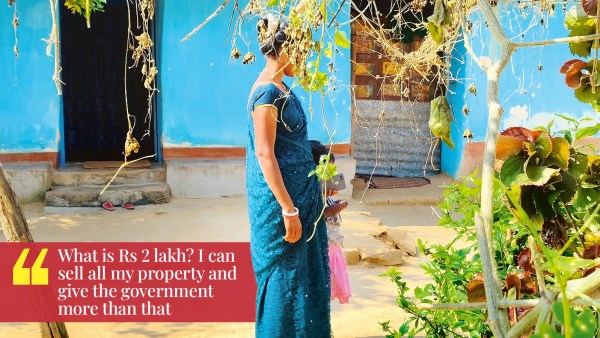 “What is Rs 2 lakh? I can sell all my property and give the government more than that” (The photograph has been modified to protect the identity of family)
An ambulance was sent to the village after The Indian Express reached out to Deputy Commissioner Chandan Kumar.
The woman has sent her two older children to her brother’s home in another village. “I am worried they will get it too.”
A Class 7 dropout, she now looks up YouTube on her phone to know more about HIV. She has come across a 2023 case, where the Supreme Court ordered a compensation of Rs 1.54 crore to a retired Air Force officer who contracted HIV during a blood transfusion at a military hospital in 2002, while on duty. “So why are we being given only Rs 2 lakh? Is it because we are poor?” she asks, angrily.
Minister Ansari said there will be no additional compensation. “Whatever amount the government decides, that is what will be given. We cannot announce any additional compensation on our own… On humanitarian grounds, I will see what can be done for the families. Even if the mistake is unintentional, a child is involved and that cannot be ignored.”
A family’s silent suffering
Thirty kilometres from Chaibasa, a family has been living in dread — that their neighbours and relatives will find out about their son’s HIV. “He won’t be able to live freely then,” says the father, who used to help out at a shop in the market, but quit work after his third child was diagnosed with thalassemia months after he was born.
“If 10-15 days of every month go in hospital visits, who will give me a job?” he says.
The child, now five years old, used to attend the village anganwadi, but the parents say they can’t risk sending him there anymore. “He has thalassemia… he falls, gets hurt. And now, after HIV, we are even more scared that he might get weaker,” he says. The child still plays with other children in the village but always under the quiet, watchful eyes of his parents.
The last time they went to the hospital for the blood transfusion, they waited the whole day before the blood bank staff told them to come back the following morning. “This has been our story for years. Sometimes, we wait three days, sometimes five. We can’t go 30 km and back, so my wife sleeps on the hospital bed with the child, I sleep on the floor somewhere.”
He fears the wait will get longer now that operations at the blood bank have been suspended. “Other patients blame us, say we are the reason for the shortage. Because they now have to go to Jamshedpur for blood.”
The family, like the others, know little about HIV. They haven’t applied for a disability certificate, and don’t receive the thalassemia pension either.
The Rs-2 lakh compensation, the father says, feels meaningless. “How can we trust the government with anything now?”
The mother, holding her child close to her, says softly, “He is too small to understand anything about HIV, thalassemia. But I worry about when he grows up. How will he live? Will someone marry him? His body was already weak because of thalassemia… now HIV.”
The father, his eyes fixed to the floor through much of the conversation, says, “It’s as if a shadow, a spirit, has settled inside our home.”
An uncle’s guilt
Over 70 km from the Chaibasa hospital, an uncle is weighed down by guilt. His seven-year-old nephew, who is in his care, is among the five affected children.
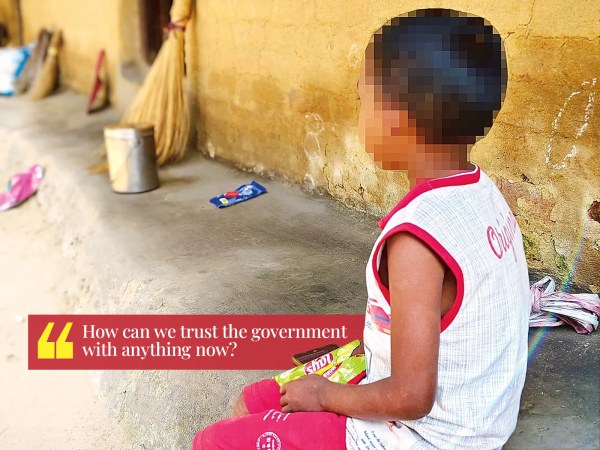 ‘How can we trust the govt with anything now?’ (The photograph has been modified to protect the identity of family)
“He had thalassemia and my sister had no means to look after him,” says the man who runs a shop in the village. So he took over everything — from the child’s schooling to his hospital visits.
He has decided to not let anyone know of the HIV. “For his whole life, I am ready to hide this,” he says.
The Rs-2 lakh compensation, he says, is an eyewash. “What is Rs 2 lakh in today’s times? And it wasn’t even our fault,” he says.
Like the others, the family doesn’t receive the pension for thalassemia or HIV.
Every month, the man and his nephew would travel 70 km to the Chaibasa hospital on his motorcycle for the transfusions. Now, with HIV, he fears there will be more hospital visits. “But I will take care of him for life.”
