

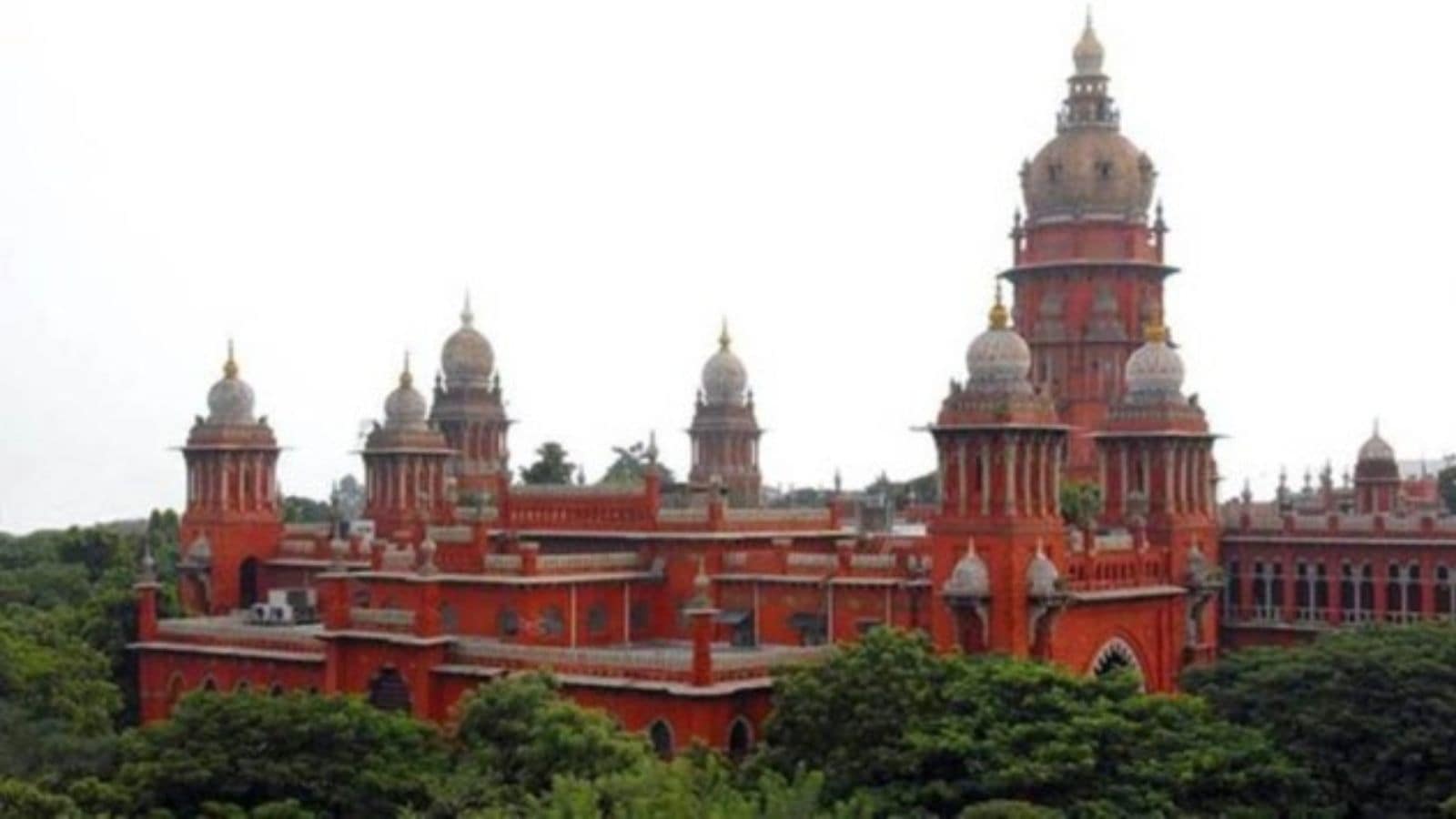
The Madras High Court’s Division Bench on Thursday dismissed the Tamil Nadu government’s appeal challenging a contempt order related to the lighting of the Karthigai Deepam festival lamp at a disputed stone pillar in Madurai’s Thirupparankundram, leaving the original directive and the enforcement mechanism involving a CISF escort fully intact.
The ruling marks the latest escalation of a dispute where ritual practice, constitutional law, historical ownership claims and contemporary political mobilisation have converged.

Late on Thursday night, BJP state president Nainar Nagendran and H Raja were detained when they attempted to enter the disputed site. This marks the BJP’s first direct political intervention in the issue.
The Bench, comprising Justices G Jayachandran and K K Ramakrishnan, described the state’s appeal as both procedurally unsustainable and substantively misplaced. The judges held that the government had approached the appellate court not to contest legal findings, but “as a pre-emptive step” to avoid the consequences of non-compliance with the single-judge Bench’s directive.
On December 1, Justice G R Swaminathan had ordered temple authorities to light the ceremonial lamp at the Deepathoon — a stone pillar located on the lower peak of Thirupparankundram Hill — near but not within the Sulthan Sikkandar Avulia Dargah premises.
When the lamp was not lit at the location by Wednesday evening, despite the ritual being performed at the Uchi Pillaiyar shrine higher up the hill, the court issued a contempt order allowing the petitioner and 10 others to perform the act under CISF protection.
The state responded by issuing prohibitory orders under Section 163 of the Bharatiya Nagarik Suraksha Sanhita, citing an “emergent law and order situation”. The Division Bench took note of allegations that the prohibitory order had been issued either before or “manipulated after this Court called for the original file”, calling the explanation unclear and insufficient to override a binding judicial direction.
Story continues below this ad
In its appeal, the government argued that the single Bench lacked authority to requisition central paramilitary protection and to substitute the Executive Officer with the petitioner for performing a religious act. The Division Bench rejected both arguments, stating that the Single Judge had merely altered “the person discharging the responsibility” after the designated official defaulted on a court order. The reasoning, the Bench said, remained within the constitutional framework of Article 226 enforcement.
In his order on Thursday evening, after the Division Bench order, Justice G R Swaminathan sharply rebuked the administration for defying a judicial direction. “When a judicial order has been passed, that too by a Constitutional Court, so long as it is holding good, it has to be enforced… The jurisdictional police are obliged to assist in the enforcement of the order. They cannot defy for any reason whatsoever… If officers are allowed to defy court’s orders in this fashion, it will lead to anarchy. Such a situation is impermissible and must be nipped in the bud,” he wrote the order.
The dispute has unfolded alongside rising mobilisation by Hindu groups. The petitions seeking the revival of ritual practices, including the lighting of the lamp at the Deepathoon, were filed by people affiliated with Hindu Munnani, an organisation that has repeatedly held demonstrations over the issue in Madurai. Police recorded at least two criminal cases earlier in the year after speeches at Hindu Munnani-organised demonstrations were alleged to be provocatively communal.
On Wednesday evening, shortly after the contempt order was issued, Hindu Munnani supporters gathered at the site and at least six policemen were injured in stone-pelting incidents, prompting security reinforcements and restricted access to the hill. By nightfall, nearly three dozen CISF personnel were deployed near the temple precinct.
Story continues below this ad
The state’s position has been that the recent litigation and mobilisation represent attempts to manufacture a grievance where coexistence has historically been stable. Ever since the matter was taken to the court, Tamil Nadu Minister for Hindu Religious and Charitable Endowments P K Sekarbabu has been accusing the BJP and allied organisations of “attempting to start religious riots” and “divide people on the basis of caste, religion and language”.
The hill, home to both places of worship for centuries, has seen periodic legal intervention. A dispute over hill access and structures between 1915 and 1916 eventually reached the Privy Council in London, which in 1931 ruled that the hill belonged to the temple, except the specific site of the dargah, its flagstaff, steps, and the Nellitope area.
That order remains a key reference point in the current litigation. With the appeal dismissed, the matter now returns to the Single Judge, who will determine whether officials wilfully defied the court’s directive — a finding that may invoke contempt sanctions. The Bench did not comment on culpability, noting that determination belongs to the ongoing contempt proceedings.
For now, the court’s order leaves the state with a narrowed path — comply with judicial direction or face potential penalties.
