

What happens when emissions from a truck passing through Delhi at 2 am meet the morning sun at 8 am?
How do aerosols — fine solid particles or liquid droplets suspended in the air — evolve chemically over time, and how does this evolution change their toxicity, size, and water-absorption capacity?

Does the air get progressively more toxic as the concentration of particulate matter increases?
As the danger signal from Delhi’s air pollution crisis flashes increasingly brighter, 2,000 km away, a team of scientists in Chennai are conducting an experiment to better understand what it is exactly that makes the air dangerous.
Researchers at IIT-Madras are running a machine that simulates Delhi’s pollution chemistry under controlled and accelerated conditions.
The simulation allows processes that unfold naturally over days in the capital’s air to be compressed into hours inside a stainless steel chamber that is flooded with ultraviolet light and oxidants.
“We set it up about six months ago,” said Dr Sachin S Gunthe, a professor at the environmental engineering division of the Department of Civil Engineering who leads the team at IIT-M’s Centre for Atmospheric and Climate Sciences. “We are trying to reproduce, inside the chamber, how particles form and age in the real atmosphere,” Gunthe told The Indian Express.
Story continues below this ad
At the heart of the IIT-M experiment is a Potential Aerosol Mass Oxidation Flow Reactor (PAM OFR), a laboratory instrument used in atmospheric chemistry to understand air pollution and climate change.
The OFR creates an “artificial atmosphere” in which scientists introduce volatile organic compounds (VOCs), both biogenic (such as isoprene and alpha-pinene from trees) and anthropogenic (such as toluene, benzene, and xylene from traffic). Once vaporised, the VOCs are oxidised by hydroxyl (OH) radicals and exposed to intense UV radiation, which triggers a set of reactions that convert gases into particles called secondary organic aerosols (SOA).
“The advantage,” Gunthe said, “is that whatever takes one to seven days in the open atmosphere, we can simulate in two or three hours.”
The results obtained in the reactor are compared with baseline data from a remote research station in Munnar, Kerala, which provides conditions closer to a clean atmosphere, and offers a reference point for natural processes.
Story continues below this ad
A striking insight from the first set of OFR experiments is that the health impact of fine particulate matter is not always proportionate to its mass concentration. “In some cases, a decrease in overall fine particulate matter mass concentration was linked to an increase in particle toxicity,” Gunthe said.
This suggests that what matters is not just how much particulate matter is in the air, but what it is made of, and how it changes as it ages in Delhi’s atmosphere.
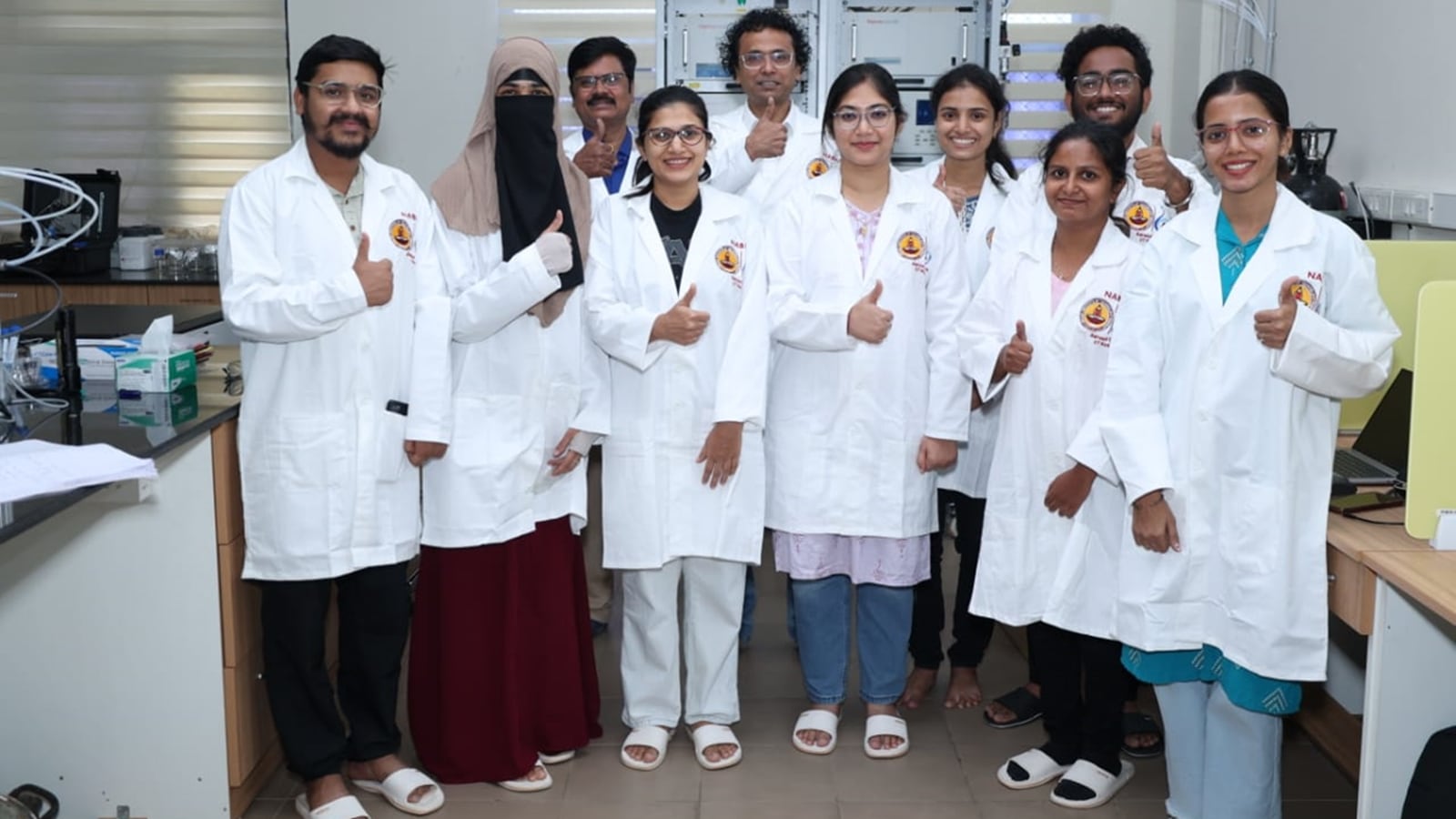
The team of about 20 students and faculty at IIT-M is now studying how “aged” particles behave when they reach the body’s first line of defence, the epithelial lining fluid (ELF) in the lungs. Lab-aged particles introduced into a mock-up of the lungs have been shown as capable of inducing oxidation in the epithelial lining and potentially triggering allergic responses.
“This is important,” Gunthe said. “People often say, if PM2.5 increases by this much, so many people will die. But unless we know how particles interact physiologically and when they meet the ELF, we cannot derive scientific results.”
Story continues below this ad
According to Gunthe, the high concentrations of ultrafine particulate matter in Delhi are not just due to direct emissions; a significant portion that is yet to be quantified comes from secondary organic aerosols. In other words, a large share of the city’s PM2.5 is born in the sky, not in the tailpipe.
Globally, secondary organic aerosol formation peaks around noon — morning traffic produces nitrogen oxides (NOx), which react with VOCs to create ground level (tropospheric) ozone, which then forms OH radicals, the key oxidant.
“But in Delhi, the secondary formation often peaks much earlier in the morning,” Gunthe said. “Nobody talks about this. It means that other oxidants, not just OH, are driving the chemistry.”
This irregularity is the reason Gunthe believes a comparison between Delhi and Beijing is superficial. “Beijing’s problem was very different,” he said. “The chemistry is different.”
Story continues below this ad
The notoriously severe “airpocalyse” in China’s capital was caused by rapid industrialisation, the use of coal, and the explosion of the vehicular population. The government responded with its “war on pollution” around 2013, implementing strict controls on industry, promoting clean energy, and expanding public transportation, which led to a sharp decline in PM2.5 levels by 2017.
The PAM OFR is funded by IIT-M, but the experiment is in collaboration with the Max Planck Institute for Chemistry at Johannes Gutenberg University Mainz, the University of Manchester in the UK, and Harvard University and Georgia Institute of Technology in the US.
“Some instruments cost Rs 4-6 crore. No agency will immediately give you that money. So we go to collaborators, pitch our scientific ideas, and they lend us the instrument because they trust our rigour,” Gunthe said.
The researchers’ long-term goal is to “understand the underlying processes and mechanisms of SOA formations”. They are not yet ready to offer policy recommendations; however, it is understood that “If a significant secondary source can be pinpointed, and its precursors substantially reduced, that could form the basis for future policy implications”.
Story continues below this ad
According to Gunthe, India needs better process-based monitoring, not just more air pollution sensors. He suggested that identical process stations be installed at six points across the Indo-Gangetic Plain from Jammu to Kolkata to track atmospheric chemistry along the region’s seasonal wind pathways. This, he said, will help quantify how much of the air pollution is local, how much is transported, how much is primary, and how much is secondary.
“Unless you know the processes, you cannot treat the disease,” he said. “You will only treat the patient.”
