

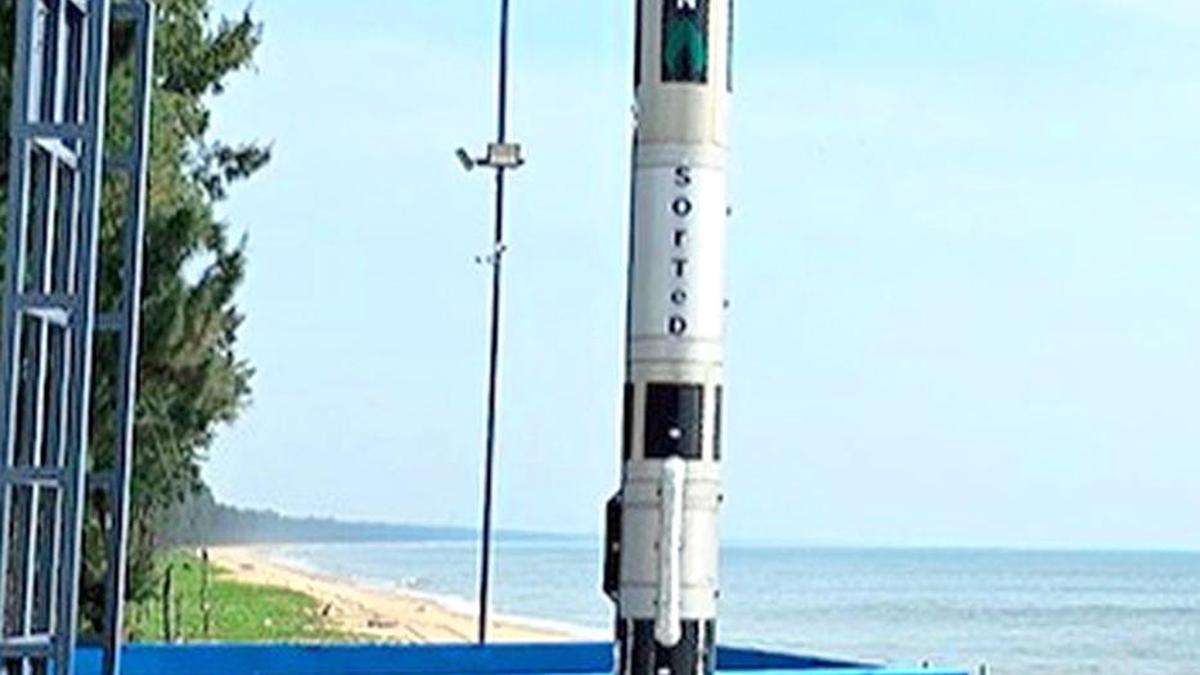
The recent fund raise of $17 million (₹153 crore) by Chennai-based start-up Agnikul Cosmos, valuing the company at over $500 million, signals maturing investor confidence in India’s space sector, analysts said.
The fundraise also reflects that India’s spacetech ecosystem is steadily moving from exploratory projects to commercially credible ventures, they added.
They pointed to a wider shift in global perceptions of India’s ability to compete in a sector that has long been controlled by a small group of technologically advanced nations. Industry observers attribute this change to a rare alignment of enabling policy reforms, institutional support and a strong pool of engineering talent.
Together, these factors have enabled companies such as Agnikul to achieve in a few years what has traditionally required decades of development.
Anirudh A. Damani, Managing Partner, Artha Venture Fund, and an early investor in Agnikul, said that the ecosystem has expanded from a handful of startups to a broader network of companies solving global challenges related to space access.
While Agnikul was founded in 2017, it was after the Indian Space Research Organisation (ISRO) opened the space sector to private participation in June 2020 that the start-up recognised an opportunity to translate an ambitious idea into a functional enterprise.
Co-founded by Srinath Ravichandran and Moin SPM, and incubated at IIT Madras under Professor Satyanarayanan Chakravarthy’s guidance, Agnikul Cosmos has since emerged as one of the early movers in India’s private spacetech ecosystem through its early emphasis on in-house development and tightly integrated design-to-test workflows.
In 2023, the company became the first private entity to establish and operate a dedicated launchpad within ISRO’s Sriharikota facility — a milestone that would have been unthinkable a decade ago.
This access was enabled through reforms introduced after the creation of the Indian National Space Promotion and Authorisation Centre (IN-SPACe), which was mandated to facilitate private sector participation by acting as a regulatory and enabling body.
Rather than representing support to any one company, the move reflects a broader national shift in how space infrastructure is governed and accessed by private players.
“Deep-tech sectors inherently involve long gestation periods and high capital intensity,” said Manish Singhal, Founding Partner, Pi Ventures.
“What shared access to national infrastructure has done is compress portions of this cycle, allowing companies to move from design and testing to market validation more efficiently. This materially improves the time-to-learning and capital efficiency across the sector,” he added.
Access to national testing and launch infrastructure has typically required billions of dollars in upfront investment. By institutionalising shared usage frameworks, India has shortened development timelines for emerging space companies while preserving sovereign oversight and safety standards, analysts said.
This approach has given Indian start-ups a structural advantage compared with peers in other emerging spacefaring nations, where private companies are often required to independently replicate core infrastructure before achieving market readiness, they added.
According to sector estimates, capabilities such as stage recovery systems, propulsion efficiency and upper-stage performance optimisation, all critical for competing in the global small-satellite launch market, are advancing more rapidly under India’s evolving policy environment.
Reflecting this broader shift, Dr. Pawan Kumar Goenka, Chairman, IN-SPACe has emphasised that “the growing success of Indian spacetech companies demonstrates what becomes possible when public institutions and private innovators work in true partnership. India has the talent, the engineering depth, and the policy environment to lead the next era of space access. We see tremendous potential for India not just to participate in the global space economy, but to help define its future.”
Agnikul recently stated that the latest infusion of capital would support its transition from demonstration missions to commercial launches while also proving technology that is needed for being profitable.
The company plans to bring design, testing and manufacturing onto a single campus.
The move is expected to reduce turnaround times between missions. In addition to this, the launch vehicle it is developing is also designed for full reusability, with the stated aim of ensuring that no stage or major component is expended or left behind, allowing the company to offer satellite-launch services at globally competitive price points.
“The real test ahead is operational consistency,” Mr. Damani said. “Agnikul’s team of more than 300 engineers has worked against significant odds to establish technical capability and build a viable platform for satellite launches at a fraction of traditional costs. The next challenge is to convert this into reliable and repeatable launch services, and to execute at an industrial scale while maintaining competitive economics,” he said.
Investors also point to India’s evolving regulatory framework as a major enabler. IN-SPACe’s single-window system for licensing, mission authorisation and facility access has reduced bureaucratic delays that previously discouraged private investment in space.
Greater policy clarity, ranging from spectrum allocation to liability norms, has made long-term financial commitments more viable.
While several start-ups are emerging in India’s spacetech sector, developing orbital and sub-orbital launch vehicles, satellite constellations, and space-based services, Agnikul has already carved out a lead, having validated complex launch technology, integrated advanced 3D-printed components, and established a consolidated manufacturing ecosystem that few others have attempted.
Indian space start-ups will need to demonstrate new technology, consistent launch cadence, strengthen supply chains and compete with established global players that benefit from decades of flight heritage and large capital reserves, analysts said.
Technical success in isolated test missions must eventually translate into commercial reliability, a transition that has proven difficult even for well-funded international companies, they added.
“We have created a viable platform for launching satellites from anywhere at a fraction of traditional costs,” Mr. Damani said.
“The supportive government ecosystem, combined with strong engineering talent, has placed India in a favourable position to democratise space access. However, the shift from achieving technological breakthroughs to becoming a globally trusted commercial provider is demanding and long-term,” he added.
As India’s spacetech sector matures, it faces the central challenge of scaling deep-tech enterprises: converting early promise into stable commercial performance.
With one of its kind patented technology, institutional support, patient capital and improving unit economics, companies such as Agnikul are helping position India as an emerging contender in the global commercial space economy.
However, the next phase of growth will be shaped not by fundraise announcements but by launch manifests, payload deliveries, technological advances and demonstrated reliability. These remain the true indicators of credibility in the space industry.
