

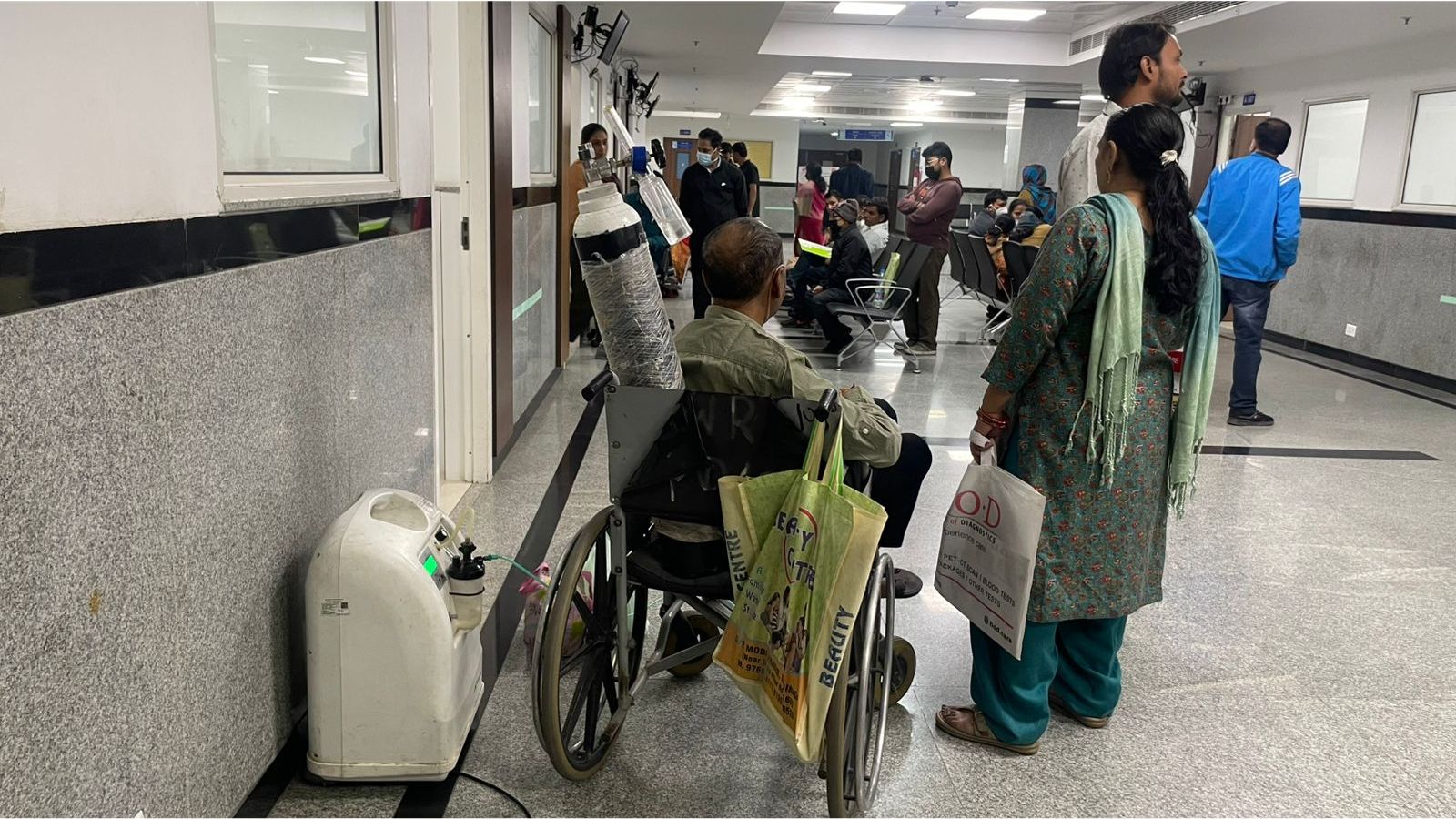
On most Fridays, the Interstitial Lung Disease (ILD) clinic at AIIMS sees roughly 30 patients, people whose damaged or inflamed lungs make routine breathing an effort. But as Delhi’s air quality deteriorates each winter, the footfall rises sharply. The clinic often records nearly double its usual caseload, underlining how heavily pollution bears on those with chronic respiratory illness.
This Friday, about 60 patients, mostly women, waited outside the clinic by mid-afternoon, many punctuating the corridor with persistent, rasping coughs. ILDs have varied causes, ranging from autoimmune conditions to environmental and occupational exposures, yet pollution remains a common trigger for flare-ups.

Among the patients was 58-year-old Vineeta Singh, who has pulmonary fibrosis, a progressive scarring of lung tissue. A resident of Ghaziabad, she now makes far more frequent hospital visits between November and March. “Every morning I struggle to breathe,” she said. “I manage for most of the year, but once winter starts, the dry cough and fatigue return.”
Nearby sat 32-year-old Shalini Rawat, diagnosed with emphysema, which has damaged and enlarged the air sacs in her lungs. She has been unable to cook or walk for more than a few minutes in recent weeks. “My lung capacity is down to 50 per cent,” she said. “The coughing hasn’t stopped for a month.”
According to Dr Vijay Hadda, professor of pulmonary and critical care medicine at AIIMS, the seasonal surge is now firmly established. “We usually schedule follow-ups every three to six months, but from October to December, patients come every two weeks as symptoms worsen,” he said. Pollution, he added, inflames the airways, increases susceptibility to infections and “considerably exacerbates” the condition of ILD patients during the smog season.
Clinicians say India may be experiencing a disproportionately high burden of ILDs compared with other countries, and worsening air quality could be a contributing factor. Yet the extent to which pollution drives the disease remains unclear.
Dr Saurabh Mittal, assistant professor in the Pulmonary, Critical Care and Sleep Medicine department, noted the absence of quantified data linking ILD prevalence to pollution exposure. “Most ILDs occur because of some kind of environmental or occupational exposure. Air pollution is one such exposure,” he said. “There is no quantified data on how much ILDs are contributed by pollution, but the higher prevalence in dusty countries suggests pollutants may lead to lung fibrosis.”
Story continues below this ad
AIIMS will this year begin a dedicated study examining the link between ILD and air pollution. Preliminary work, including the collection of residential details and local AQI data, has already started. The effort will run alongside a national database of 10,000 ILD patients across 23 centres, for which Dr Hadda is the lead investigator.
Doctors warn that while ILDs typically progress slowly, sudden worsening, known as exacerbations, can be life-threatening. “Patients with asthma and COPD (Chronic Obstructive Pulmonary Disease) tend to improve quickly after treatment. But in ILD patients, once an exacerbation occurs, it is very difficult to treat and very difficult for them to recover,” Dr Mittal said.
Mortality in ILD exacerbations is estimated at 50–60 per cent, far higher than in asthma, where only a small proportion of patients die from flare-ups. Many ILD patients take immunosuppressive drugs, making them more vulnerable to infections, another key trigger for deterioration. “They should stay indoors as much as possible to avoid viral infections,” Dr Mittal advises.
While pollution’s precise role remains difficult to isolate, he emphasised that it is a significant aggravating factor. Exacerbations occurring during spells of poor air quality are particularly hard to manage. “Patients become oxygen-dependent, may require ventilator support, and returning to baseline health is rarely possible even if they survive,” he said. “Their overall health remains compromised.”
