

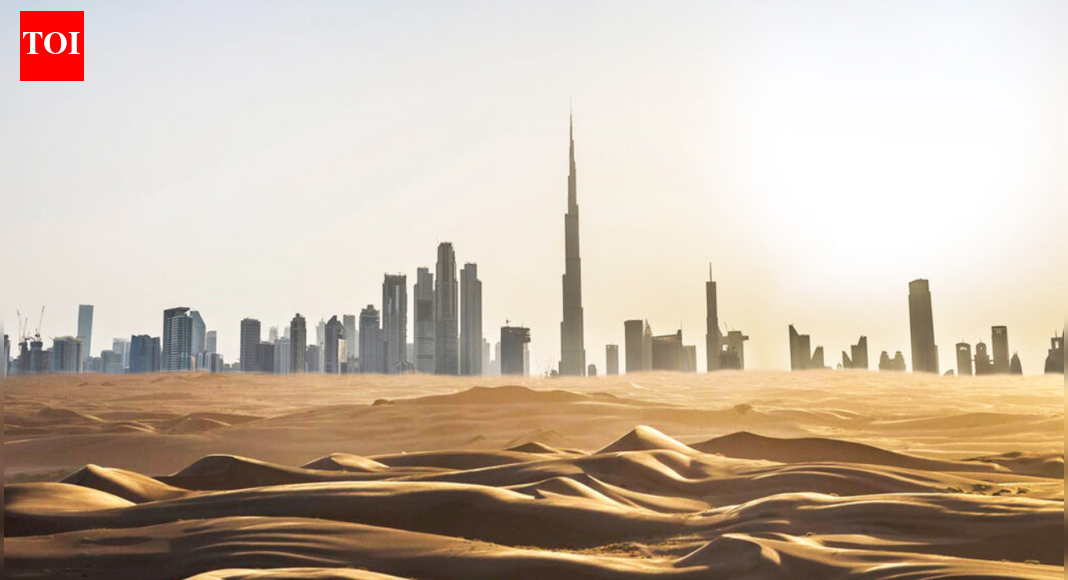
Sending coals to Newcastle is a phrase from the early 16th century, describing the pointless act of bringing coal to a city that already had plenty. As ironic as it may seem, similar paradoxes play out in the real world, sometimes on a massive scale. Gulf countries like Saudi Arabia and the UAE, for instance, are importing sand from countries such as Australia, China, and Belgium, according to the OEC. While the idea of desert nations buying sand seems puzzling, the reason lies in the specifics of construction requirements. As these countries race ahead with multi-billion-dollar projects, Saudi Arabia with its Vision 2030 developments, and the UAE with its skyline-transforming towers, the demand for a specific type of sand that deserts cannot provide has led to a steady stream of imports.This lesser-known fact sheds light on a broader global issue: the growing scarcity of construction-grade sand and the paradoxes of resource dependency even in the most unlikely places.
Why desert sand won’t do
Desert landscapes like Saudi Arabia’s might be abundant in sand, but ironically not all sand is created equal. The grains found in deserts are typically too round and smooth because they have often been eroded by wind over thousands of years. This makes them poorly suited for concrete production, where angular and coarse microscopic grains are essential to form a strong, cohesive structural mix when combined with cement and water ultimately.Concrete itself has three basic components: cement, water, and aggregate, combined in slightly different proportions depending on the intended strength and use. Cement is the powdery substance that reacts with water to form a ‘glue’, binding the mixture together. Because it is made from limestone and processed at incredibly high temperatures, cement production is highly energy-intensive and releases millions of tonnes of CO₂ each year. Some estimates suggest that the global cement industry alone may be responsible for up to 8% of the world’s CO₂ emissions, highlighting its environmental footprint.Aggregate provides concrete with its bulk. Depending on the mix, it can account for between 60 and 80% of the volume of concrete and 70-85% of its weight. Yet the term ‘aggregate’ masks the true origins of this essential material: it is made from a combination of coarse gravel and fine sediment, including sand, which can make up to 45% of the aggregate by volume. Crucially, not just any sand will do—its texture and shape are decisive factors in the strength and durability of the final concrete.The type of sand required for skyscrapers, infrastructure, and urban development usually comes from riverbeds, lakes, and seabeds, environments that produce more angular grains capable of binding effectively. Most natural sand is created through the slow, continuous process of weathering across various landscapes. A glance at satellite images shows just how abundant desert sand appears to be. Yet, despite its abundance, wind-tumbled desert grains are far too smooth and small to provide the necessary structural grip. The construction sector, therefore, relies on sand from quarries and riverbeds, where water-shaped grains are naturally angular, rough, and perfectly suited for cement to adhere.As investigative journalist Vince Beiser notes in The World in a Grain, trying to make concrete with desert sand is like “trying to build something out of a stack of marbles instead of a stack of little bricks.” The nuances of sand composition may seem trivial, but they underpin the foundations of cities and economies. According to the United Nations Environment Programme (UNEP), the world consumes around 50 billion tonnes of sand every year, making it the most extracted solid material globally—yet only a fraction is suitable for construction purposes.
Australia’s role in supplying sand
Australia has emerged as one of the key exporters of high-quality silica and construction sand. As per the OEC world, in 2023, Australia exported $273M of Sand, making it the 2nd largest exporter of Sand (out of 183) in the world with Saudi Arabia among the importers. In 2023, Saudi Arabia imported about US $140,000 worth of natural construction-grade sand from Australia.Saudi Arabia’s purchase of Australian sand, notably highlights the Kingdom’s reliance on these imports to meet construction standards for large-scale mega infrastructure projects. The conversation resurfaced on social media in 2024, as the trend clearly continues in the wake of Saudi Arabia’s ambitious urban development plans, including NEOM, The Red Sea Project, and Qiddiya nationwide.These projects require not just vast amounts of concrete but also the highest standards in material quality, a demand that desert sand simply cannot fulfil.
The broader Gulf context
Saudi Arabia isn’t alone in this phenomenon today. Other Gulf countries, including the UAE and Qatar, face the same paradox: vast deserts, yet a long-standing reliance on imported sand for high-quality construction. The UAE, particularly Dubai and Abu Dhabi, has increasingly sourced construction-grade sand from overseas to support its rapid skyline expansion, a necessity dictated by the structural demands of complex modern engineering.Consider the Burj Khalifa, the tallest building in the world at 828 metres. Its construction required immense quantities of materials: 39,000 tonnes of steel, 103,000 square metres of glass, and 330 million litres of concrete, enough to fill 132 Olympic-sized swimming pools. Desert sand, despite its abundance, was entirely unsuitable. Its grains are too small, round, and smooth to provide the fractured surfaces necessary for high-compression concrete, leading builders to import sand from Australia for the project.Sand in the UAE serves multiple roles beyond skyscrapers. It forms the basis of glass production, shapes artificial islands such as The Palm Jumeirah, and replenishes popular tourist beaches through large-scale ‘beach nourishment’ projects. According to the UN, constructing the Palm Jumeirah alone consumed 186.5 million cubic metres of marine sand, effectively exhausting local reserves. A 2024 UNEP policy brief reinforces this reality, noting that the Middle East’s rapid urbanisation is driving global demand for construction sand. While regional countries are beginning to explore more sustainable solutions, the near-term dependence on imports remains entrenched.
Vision 2030 and the need for quality
Saudi Arabia’s Vision 2030, a blueprint to diversify the Kingdom’s economy beyond oil is driving massive infrastructure developments. The $500 billion NEOM city, the futuristic The Line urban concept, and other mega-projects require specialised building materials that meet international standards.Thus, importing industrial-grade sand isn’t just a matter of preference but often a necessity. Without it, the construction of ultra-modern facilities, smart cities, and tourism hubs would face significant material shortages or quality compromises.
A global sand crisis
The dependence on imported sand is not just a Saudi issue; it reflects a growing global concern. The UNEP has flagged that the world is facing a “sand crisis,” warning that unregulated sand extraction is leading to environmental degradation in many parts of the world, including riverbed erosion, habitat destruction, and loss of biodiversity.In response, some countries are investing in alternatives like manufactured sand (M-sand), made by crushing rocks to create suitable construction material. Additionally, recycled construction waste is being repurposed to alleviate pressure on natural sand resources.Saudi Arabia, too, is actively exploring these options. While there’s no comprehensive national policy yet on reducing sand imports, experts suggest that ongoing innovation in materials science could eventually help the Kingdom lessen its reliance on foreign sand.
