


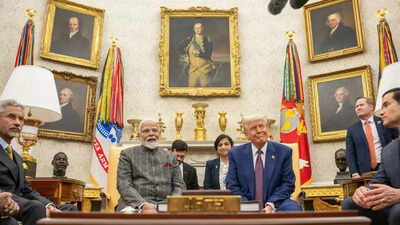
The TOI correspondent from Washington: US commerce secretary Howard Lutnick has offered a blunt and unusually personal account of why a long-anticipated US–India trade agreement failed to materialise, placing the blame squarely on timing, political hesitation in New Delhi, and what he described as President Donald Trump’s deliberately competitive approach to deal-making. Among the reasons the deal did not happen: Prime Minister Modi’s reluctance to call the US President. Speaking to the All-In podcast hosted by Sri Lankan-origin venture capitalist Chamath Palihapitiya, Lutnick said India “did not grab the opportunity the United States presented” and waited too long to conclude negotiations, only to later seek terms comparable to those secured by the United Kingdom. By then, he said, the moment had passed.
At the heart of Lutnick’s explanation is what he called Trump’s “staircase” model of trade negotiations — a strategy designed to reward speed and decisiveness while penalising hesitation. Under this approach, the first country to conclude a deal receives the most favorable terms, setting a baseline that subsequent agreements must exceed. Each new deal, Lutnick said, moves “up and to the right,” making later bargains progressively more expensive or restrictive.“The first stair gets the best,” Lutnick explained. “After that, everyone says, ‘I want the UK deal.’ And the answer is no — they were first.”The United Kingdom, he said, moved quickly under a tight deadline. Lutnick recalled telling British officials they had “two Fridays” to finalise the agreement before the opportunity disappeared. Prime Minister Keir Starmer, he said, personally called Trump as the deadline approached, and the deal was concluded and publicly announced within days.India, by contrast, was given what Lutnick described as three Fridays — a “shot clock” to complete negotiations. During that window, Trump publicly signaled that India could be next, a message Lutnick said was meant to encourage urgency. But New Delhi hesitated, in part because of internal political considerations and discomfort with the optics of Prime Minister Narendra Modi personally calling Trump to seal the agreement.“I said, you’ve got to have Modi call the president,” Lutnick recounted. “They were uncomfortable doing so. Modi didn’t call.”As the deadline passed, the administration moved on. Over the following weeks, Washington announced a series of trade deals across Asia, including agreements with Indonesia, the Philippines and Vietnam. Those deals, Lutnick said, were negotiated at higher tariff and market-access levels than what India had been offered, precisely because the staircase had already moved upward.When Indian officials later returned to the table, Lutnick said, they were seeking terms that no longer existed — effectively asking for a deal “in between the UK and Vietnam,” which would have between 15 per cent and 20 per cent tariff. That, he said, was impossible.“They said, ‘But you agreed,’” Lutnick recalled. “And I said, then — not now.”Lutnick framed India’s predicament through an extended metaphor drawn from his early career as a trader, likening it to being stuck on the wrong side of a seesaw — a position where every move seems to make matters worse. In his telling, India repeatedly missed the moment when action would have paid off, while other countries stepped in and secured agreements.Despite the sharp tone, Lutnick suggested the breakdown was not the result of hostility but of misaligned timing and domestic political constraints. He acknowledged that trade negotiations are “deeply complex,” often requiring parliamentary approval and consensus-building that can slow decision-making. Still, he emphasised that the Trump administration had little patience for delay.“There are a lot of countries,” Lutnick said, “and each has its own deep internal politics. But the train doesn’t wait.”The episode underscores a broader shift in US trade policy under Trump, one that prioritises leverage, speed and visible wins over protracted negotiations. Lutnick portrayed the president as the ultimate “closer,” with himself as the “table setter” who structures deals but leaves final decisions to Trump. While Lutnick expressed confidence that the US and India would “work it out” eventually, his remarks make clear that any future agreement would come on less favorable terms than those once on offer. Trump too has not expressed any overt hostility towards India or Modi, insisting that the Prime Minister is a “great guy” and a “good friend.” But for India, the missed deal has become a cautionary tale about the cost of hesitation in a White House that sees trade not as a slow diplomatic process or a strategic subset, but as a competitive race with clear winners and losers.
