

Kerala high court news: Punching holes in the manner in which a sessions court conducted a murder trial, the Kerala High Court has set aside a man’s conviction and held that the trial judge committed “grave illegality” by acting as a prosecutor, while underlining other serious procedural lapses that resulted in denial of a fair trial.
A bench of Justices Raja Vijayaraghavan V and K V Jayakumar found that the convict was not afforded a competent lawyer during a substantial period in the trial and had to cross-examine the prosecution witnesses by himself.

The court took exception to instances where witnesses were examined in the absence of the accused and where the sessions judge assumed the role of public prosecutor and conducted examination-in-chief by herself in the absence of the public prosecutor.
“On a careful consideration of the records of this case, the relevant statutory provisions, the mandate of Constitution and the binding precedents of the Honourable Apex Court discussed in the foregoing paragraphs, we have no hesitation in holding that a fair trial is denied to the accused in the case on hand,” the order read.
Key findings
- Accused has been in judicial custody for more than seven years as an undertrial prisoner.
- He was not represented by a lawyer either of his choice or a Legal Aid Counsel during a substantial period of the said seven years.
- He was granted bail on September 24, 2012, but continued to be in judicial custody till the conclusion of the trial.
- The reason why the accused remained in judicial custody for more than seven years is not clear from the order sheet.
- Trial court has failed to ensure that the accused is represented by a competent lawyer to defend his case, discarding the directions issued by the Apex Court.
- Sessions judge committed a grave illegality by examining the prosecution witnesses in the absence of the accused.
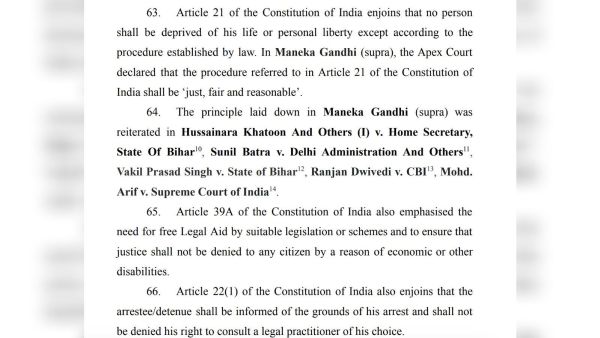 Kerala High Court said the constitutional right afforded to an accused charged with an offence to defend himself is not illusory or imaginary.
- Approach of the sessions judge is illegal and unfair. It is a trite law that the court shall afford a fair opportunity to the prosecution and the defence to adduce evidence to substantiate their contentions.
- Sessions judge herself assumed the role of public prosecutor and took up the chief examination by herself and thereby exceeded the powers vested in the court.
- Trial was prolonged for about five years after the framing of the charge and the accused remained in judicial custody for a continued period.
- The matter was adjourned more than 100 times after the framing of charge.
- It appears that the reasons recorded by the sessions judge, on many occasions, are unjustifiable and not compelling.
Background
On September 18, 2011, during Onam celebrations, a stage programme was organised by the Royal King Arts and Sports Club, Kunnelpeedika and two groups of people were playing cards in consideration of money. An altercation ensued and one person was stabbed and died. The accused was arrested on September 24, 2011, in connection with the crime. The trial concluded on October 16, 2019 which resulted in the man’s conviction for murder. The main contention of the counsel for the convict was that a fair trial was denied to him by not being represented by a competent lawyer.
Conclusion
- No hesitation in holding that a fair trial is denied to the accused in the case on hand.
- Accused had to face the prolonged custodial trial which was conducted in a piecemeal manner.
- Accused was not represented by a competent lawyer during a substantial period in the course
of the trial. - He had to cross-examine the material witnesses (1 to 6) by himself. Numerous witnesses were examined in his absentia.
- The records would further reveal that the learned sessions judge has assumed the role of public prosecutor and conducted chief examination by herself in the absence of the public prosecutor.
- Finding of guilt, conviction and sentence arrived at by the sessions judge are liable to be set aside.
- The alleged crime was committed on September 18, 2011, and the accused remained in judicial custody for about 14 years during the investigation, inquiry, trial and during the pendency of this appeal.
- A direction to conduct a “de novo trial” (fresh) in this matter may not be just, fair and proper.
- Registry to forward a copy of this judgment to the Director, Kerala Judicial Academy for future guidance to the Sessions Judges of the State of Kerala, to ensure that such episodes would not occur in future.


© IE Online Media Services Pvt Ltd
