

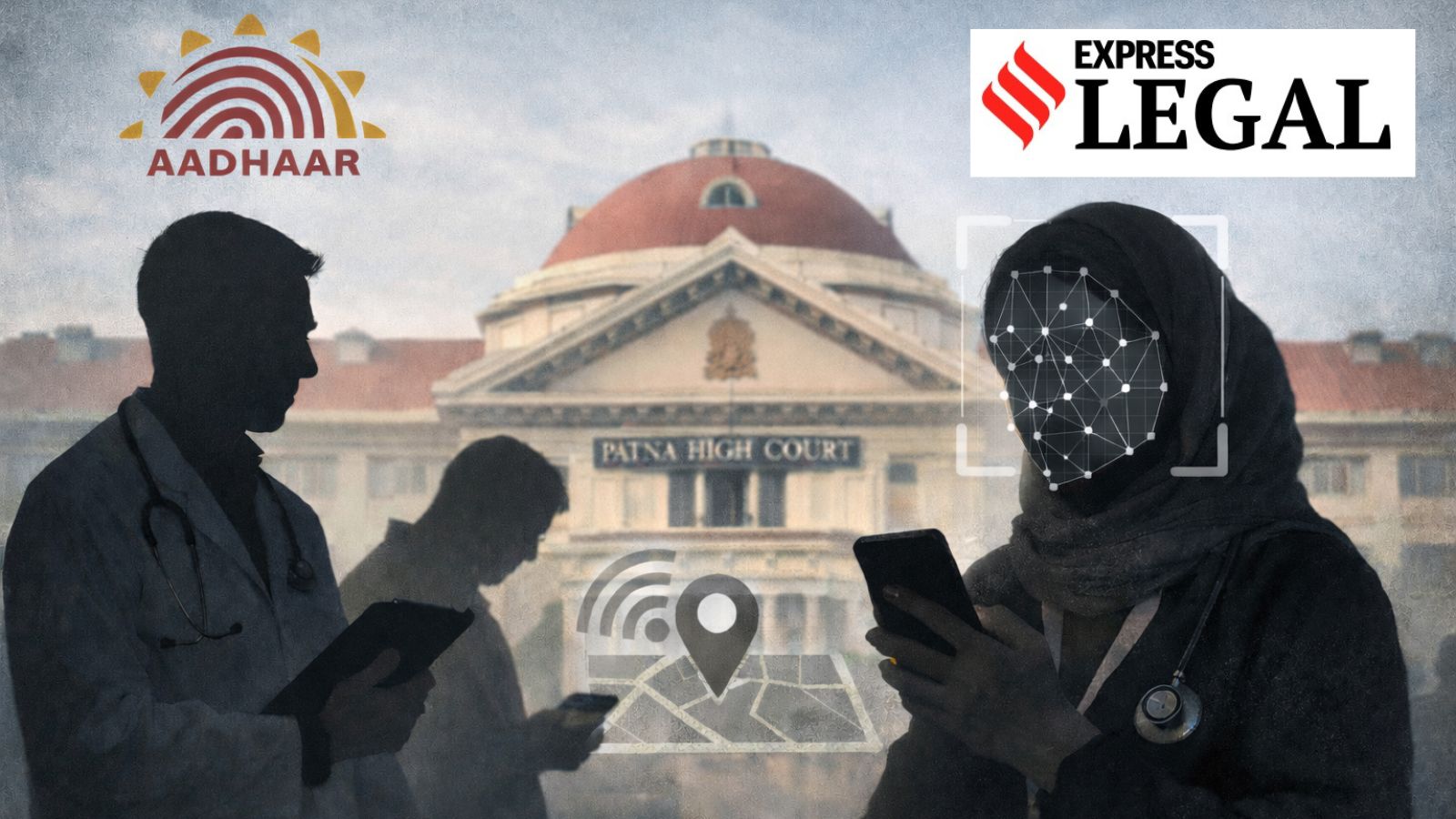
Patna High Court News: The Patna High Court recently ruled the mandatory implementation of Aadhaar-based facial authentication and GPS-enabled attendance for faculty members of medical colleges in Bihar is not a violation of right to privacy and observed that governments’ intention to use Aadhar based attendance system for “good governance”.
Justice Bibek Chaudhuri dismissed a petition filed by several doctors employed in government medical colleges and hospitals across the state challenging the policy stating that the measure does not violate the right to privacy.

“Governments’ intention to use the Aadhar based attendance system for good governance. The petitioners alleged that Aadhar authentication is voluntary in nature, but it does not state the alternative system by which attendance of the faculty members of medical colleges and hospitals can be ensured,” the January 17 order said.
 The Patna High Court said that an unfounded apprehension cannot be the basis for issuance of prerogative writs for protection of fundamental rights. (Image enhanced using AI)
Findings
- An unfounded apprehension cannot be the basis for issuance of prerogative writs for protection of fundamental rights.
- No such case is made out.
- The petitioners must come forward with the specific case of violation of fundamental rights.
- Privacy of a person is not lost or surrendered merely because the individual is in a public space.
- Privacy is a postulate of dignity itself.
- Privacy concerns arise when the state intrudes into the body and mind of the citizen.
- Informational privacy is a facet of Right to Privacy.
- Apart from outraging the right of privacy, the petitioners have not come forward to any other issue while challenging the Aadhar linked biometric attendance system.
- It is apprehended by the petitioners that their personal information will be revealed before the government authority but no case is made out to substantiate such apprehension.
- The biometric attendance system is in force in the entire country in medical colleges and hospitals.
- This court does not find any reason to raise this grievance by some medical officers and faculty members of a few medical colleges and hospitals in the state of Bihar.
- The National Medical Commission (NMC) is a statutory body, controlling the medical education, ethics and other related matters of the country.
- It is found by the NMC during their inspection that the medical colleges are run with inadequate numbers of teaching staff.
- As a social being, this court is not unaware of the condition of the health system of the country.
- The government and government aided medical colleges are run by inadequate faculty members, inefficient contractual teachers, lesser number of laboratory and technical assistants and administrative staff.
- Under such circumstances if the NMC introduces a full proof attendance system for faculty members, such a system should not be scrapped on the ground of arbitrariness and unconstitutional.
- The NMC is directed to take appropriate action directing the State Government(s) to initiate appointment / recruitment drives to fill up a huge number of vacant posts in medical teaching service within a time bound period.
- This court anxiously notes that securing attendance of faculty members will not change the dilapidated health of the health department of the states.
- On the contrary, the condition must be improved if the vacancies are filled up.
- The court recognises that forcing faculty to work 24 to 72 hours without a break inevitably leads to exhaustion.
- Even with this petition dismissed, such overburdened staff will likely continue to evade attendance or seek other ways to escape these grueling conditions.
Background
- The petition challenged a public notice dated April 16, 2025, issued by the NMC.
- The notice directed all medical colleges and institutions to mandatorily shift to face-based Aadhaar authentication with GPS location tagging for marking attendance from May 1, 2025.
- It required faculty members to mark attendance through a mobile application within a 100-metre GPS radius of the institution.
- Following this, the state health department and principals of government medical colleges issued follow-up orders, including a memo dated April 21, 2025, directing immediate implementation.
- The petitioners approached the high court seeking quashing of the NMC notice and subsequent directions issued by the state government bodies.
- They also sought deletion of any data already collected.
Arguments by petitioners
- Advocates Shrishti Singh, Pranav Kumar, Saurabh Sunder and Ashish Gaurav contended that compulsory Aadhaar-based facial authentication and GPS location sharing violated their fundamental right to privacy under Article 21.
- Relying on the Supreme Court’s landmark rulings in KS Puttaswamy (Privacy-9J) v Union of India (2017) and KS Puttaswamy (Aadhaar-5J) v Union of India (2019), the counsel argued that Aadhaar could be made mandatory only for welfare schemes, subsidies, and benefits, not for service conditions like attendance.
- Citing Sections 7, 8, 23, 53 and 57 of the Aadhaar Act, the counsel submitted that Aadhaar authentication is voluntary and cannot be imposed without consent.
- They said that facial data and GPS location constitute sensitive personal information, and compelling faculty members to install third-party applications amounted to continuous surveillance, undermining dignity and informational privacy.
State and NMC’s Stand
- Advocate general PK Sahi, assisted by advocate PN Sharma, defending the move of the state argued that the practical purpose behind the attendance mechanism must be considered.
- They submitted that Aadhaar-enabled biometric attendance had been progressively introduced since 2020 through gazette notifications and circulars.
- The counsel said that face recognition with GPS tagging was adopted to overcome shortcomings of fingerprint-based systems.
- The advocate general pointed out that prior systems allowed attendance to be marked remotely, even when doctors were not physically present in the institution.
- The GPS-linked system was introduced to ensure that doctors in government service do not engage in private practice during official working hours, safeguarding public interest and patient care.

© IE Online Media Services Pvt Ltd
