


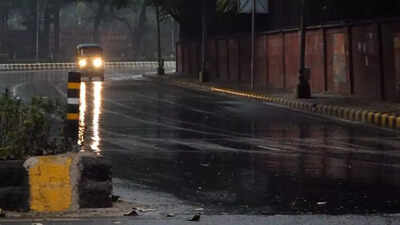
NEW DELHI: Light rain and a thunderstorm on Friday provided slight relief from pollution in the national capital, but air quality remained in the “poor” category, with the AQI recorded at 297 at 7 am, according to the Central Pollution Control Board (CPCB). Light rain also lashed Ghaziabad and Noida.This marked a marginal improvement from Thursday morning, when the AQI had been in the “very poor” category at 312.Several parts of the national capital continued to register poor air quality, with Anand Vihar at 317, Ashok Vihar 335, Wazirpur 351, Punjabi Bagh 326, RK Puram 315, Bawana 342, ITO 266, Chandni Chowk 326, and Dwarka Sector 8 316, the CPCB reported.Meanwhile, the temperature in Delhi was around 16.4°C at 7 am, according to the India Meteorological Department (IMD).Under the AQI classification, readings are categorised as follows: 0–50 ‘Good’, 51–100 ‘Satisfactory’, 101–200 ‘Moderate’, 201–300 ‘Poor’, 301–400 ‘Very Poor’, and 401–500 ‘Severe’.Thursday had been unusually warm, with the mercury soaring to 27.1°C, about seven degrees above normal, marking the warmest January day in seven years.The high temperature was attributed to persistent warm easterly winds and clear skies, which increased sunshine hours. “Westerly winds are cold, while easterly winds are warm during this time of the year,” a weather official explained.With multiple spells of rain expected on Friday, the temperature is likely to drop. Officials said the maximum temperature is forecast to fall to 18-20°C on Friday and further to 16-18°C on Saturday. The rainy spells, accompanied by cloud cover, are also expected to bring down Delhi’s air quality index (AQI) to the poor category on Friday and to moderate by Saturday, if the predictions hold true.The IMD has issued a yellow alert for rain across the city. “Another round of very light to light rain is likely towards the afternoon or evening on Friday,” officials added, advising residents to remain cautious of strong winds and localized thunderstorms.A day earlier, the Sub-Committee on the Graded Response Action Plan (GRAP) of the Commission for Air Quality Management (CAQM) revoked all Stage III measures across Delhi-NCR with immediate effect on January 22, following improvements in air quality and favorable forecast trends.A statement from the Ministry of Environment, Forest and Climate Change said: “The Sub-Committee had invoked Stage III of GRAP on January 16, 2026, after a deterioration in Delhi’s average AQI.” Since then, air quality has shown a downward trend. According to the daily AQI Bulletin from the Central Pollution Control Board (CPCB), the average AQI improved from 378 on January 20 to 330 on January 21 and 322 on January 22.Considering this improving trend, and based on air quality and meteorological forecasts from the India Meteorological Department (IMD) and the Indian Institute of Tropical Meteorology (IITM), the CAQM Sub-Committee convened today to review the situation.
