

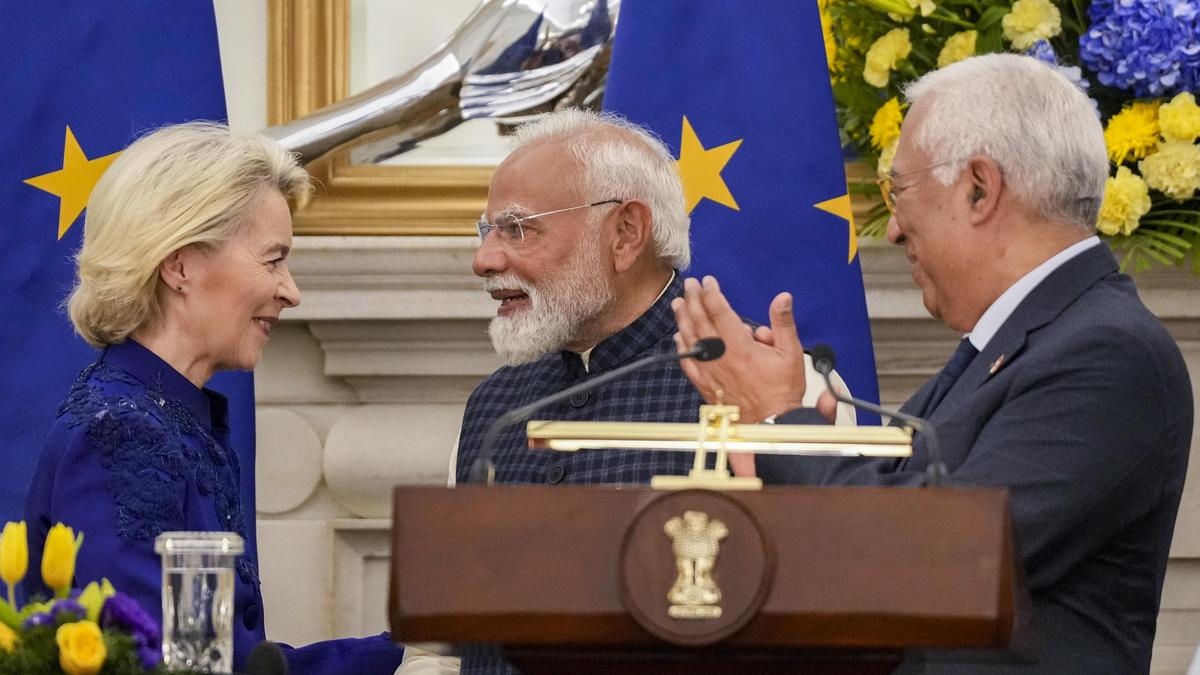
India and the European Union have formally inked the trade agreement which has been suggested to be the “mother of all trade deals”, Prime Minister Narendra Modi announced at the inauguration of the India Energy Week in Goa. He added that the deal would provide varied opportunities to the one-forty crore people of India and the European Union.
“The agreement represents approximately 25% of the global GDP and one-third of the global trade,” he stated, adding, “Along with the trade, the agreement is also reflective of our [India and European Union] shared commitment for democracy and rule of law.”
The Prime Minister further held that the E.U. trade deal would compliment the existing free trade agreements with United Kingdom, as well as the Asia-Pacific Trade Agreement (APTA).
Also read | Follow the India-EU Summit LIVE
Mr. Modi enumerated that sector textiles, gems and jewellery, and leather and shoes would be positively impacted with the deal.
“The trade deal would not only provide a fillip to the manufacturing sector but also extend advantages to those in the service sector as well,” he stated.

Speaking from a broader perspective, the Prime Minister held that the trade deal would also help boost confidence for India among innovators [globally].
Eyeing $100 billion investments in the oil & gas sector by end of decade
Whilst enumerating about the potential in India’s oil and gas sector, Mr. Modi stated India eyes to scale $100 billion investments in the space by the end of the decade. He added that India also endeavours to expand its exploration acreage to one million square kilometres. “It is with this thought that more than 170 [exploration] blocks have been awarded [in the past]. Andaman Nicobar basin is becoming our next hydrocarbon hope,” he said.

Additionally, in a related context later in his address, Mr. Modi said, “If you invest in India’s exploration space, then your companies can be sure of acquiring profitability.”
Separately, the Indian Prime Minister also held that the energy sector is at “the epicenter of the our [the country’s] aspirations”. He stated there is potential for $500 billion worth investment opportunities in the sector. “Therefore, I call upon you to make in India, innovate in India, scale in India and invest in India.”
Oil demand to remain above 100 million barrels/day until 2040: UAE Minister of Industry
Speaking at the inaugural ceremony, Sultan Ahmed Al Jaber, Minister of Industry and Advanced Technology and the Managing Director and CEO of the Abu Dhabi National Oil Company (ADNOC) put forth that between now and 2040, global oil demand would remain above 100 million barrels per day. He added that demand for both liquefied natural gas (LNG) and electricity would increase by 50% each.

He further added that an additional component to the energy demand dynamics would emerge from air-conditioners. He explained that by 2050, the world will have 5.6 billion air conditioners, up from 1.6 billion today. “That is, ten new units sold every second for the next thirty years,” he observed.
Elaborating from a broader perspective, the ADNOC CEO held, “Demand at this scale and pace requires investment in all forms of energy. The biggest risk is not over-supply, it is underinvestment.”
Separately, he added, “What we are really seeing play out [today] is energy addition.”
Global Energy order continues to evolve in complex ways: Hardeep Puri
Union Minister for Petroleum and Natural Gas Hardeep Singh Puri in his address stated that while erstwhile pressures from geopolitical shifts and structural changes have intensified, the global energy order “continues to evolve in complex ways”.
Further, Mr. Puri mentioned that nearly eighty-percent of incremental global energy demand came from emerging and developing economies, with close to sixty percent originating in developing Asia. “As these regions grow and gain wider access to mobility, cooling and digital services, energy demand will rise further, both in scale and complexity,” he said.
Separately, the Petroleum Minister also observed that while “renewables have grown rapidly in the past decade”, notwithstanding conventional energy continues to play a “critical role”. “If investment in existing oil and gas production were to stop today, global oil output would decline by around 8 percent annually over the next decade, equivalent to losing more than the combined annual production of Brazil and Norway each year,” he observed.
Explaining the dynamics, the Union Minister stated, “The history of energy has never been about replacement alone. It has been about addition. New sources have consistently complemented existing ones, allowing systems to expand and adapt.”
Published – January 27, 2026 11:54 am IST
