

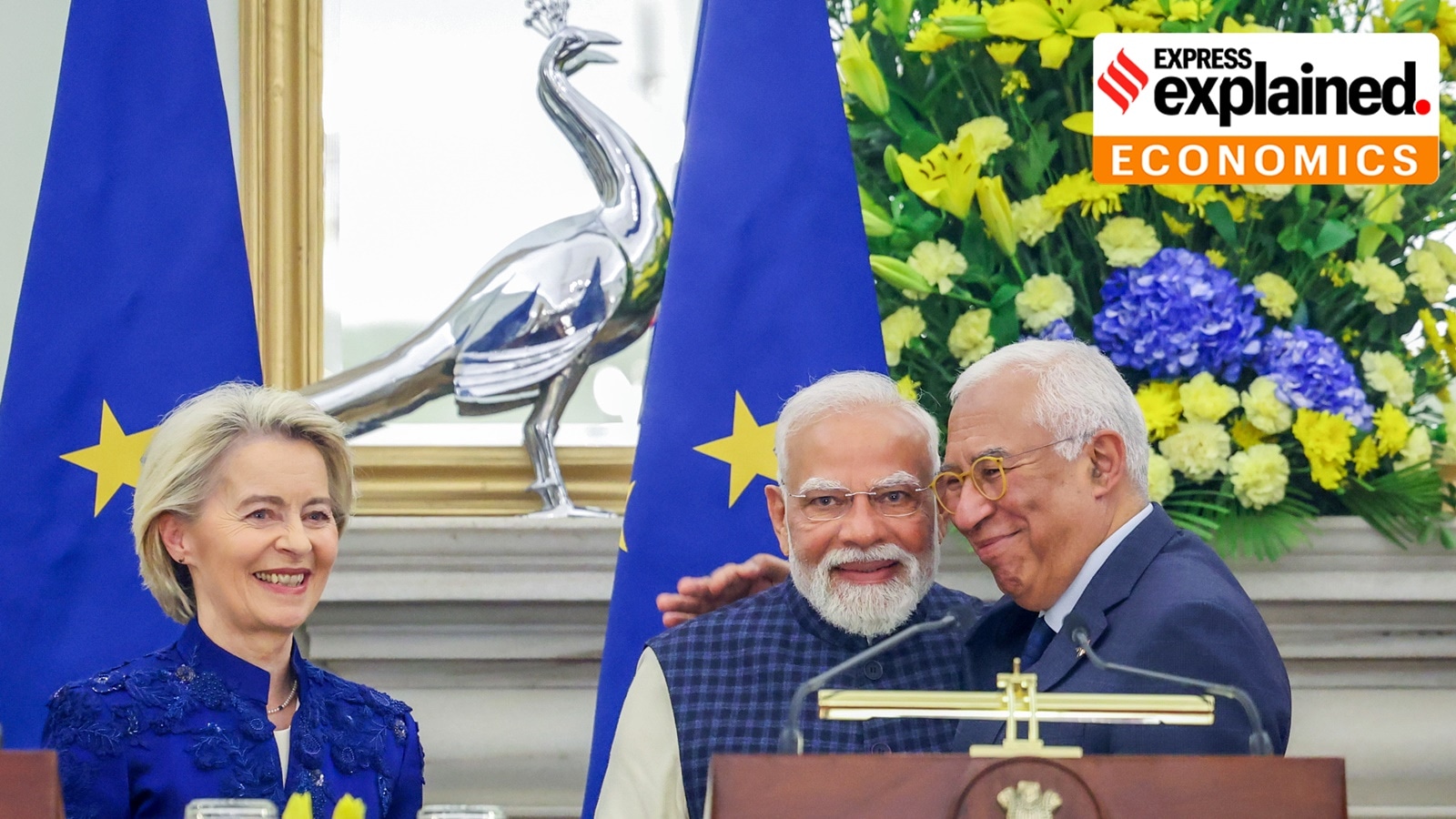
Indian trade negotiators have managed to secure a ‘forward-Most Favoured Nation’ Clause (MFN) clause on the carbon border adjustment mechanism (CBAM) under the India-EU trade deal, which was concluded on Tuesday (January 27). The move will help the Indian industry receive the same concessions that the European Union has promised the US under their trade agreement signed earlier last year, a senior government official said.
In the EU-US trade deal joint statement released in August last year, the European Union had said, “Taking note of the US concerns related to treatment of US small and medium-sized businesses under CBAM, the European Commission, in addition to the recently agreed increase of the de minimis exception, commits to work to provide additional flexibilities in the CBAM implementation.”

The Indian Express had reported in August 2025 that Indian negotiators planned to push for similar relief during the next round of talks in Brussels the following month. Before the US-EU deal, EU officials had maintained that CBAM is not a trade measure. “It is not part of trade and the FTA [with India]. It’s about compliance with our climate agenda to accelerate decarbonisation,” Hervé Delphin, EU Ambassador to India, had told The Indian Expressin June.
The complains over carbon tax
The carbon tax ensures that imported carbon-intensive goods into the EU bear a cost starting January 2026, and is seen by several developing nations as discriminatory and in conflict with international environmental law. Brazil, China, India and South Africa have raised serious concerns about CBAM at forums of the World Trade Organisation (WTO), and Russia initiated a formal dispute on May 12 last year.
Government officials said that India has also sought easier access to steel scrap, a critical input for low-carbon steel production, and arrived at an understanding. “We have applied to receive scrap under the EU’s recycling policy. We have an understanding. But we also have a rebalancing mechanism that allows us to impose cost on them in equal measure if our interests are hurt,” the official said.
The official said that the negotiations over CBAM have been the most tricky as the EU carbon tax applies to all countries, but that India and the EU have reached an “understanding” under which both trade partners will work together towards decarbonisation, with the EU agreeing to share expertise for the same.
The steel angle
Indian trade negotiators had sought easier access to steel scrap produced in the European Union under the trade deal, as a workaround to soften the impact of the bloc’s CBAM.
Story continues below this ad
The move followed concerns raised by Indian manufacturers that CBAM, combined with the EU’s recycling policy, acts as a “non-tariff barrier” by not only restricting metal exports to the 27-nation bloc but also limiting scrap exports to other countries to support the domestic industry. The EU is the world’s largest producer of steel scrap.
“On the issue of the India-EU free trade agreement (FTA), it was mentioned that the CBAM measures of the EU would necessitate the use of arc furnace technology with the sourcing of steel scrap. However, it was difficult to source scrap from the EU due to its recycling policy, and hence this would be a non-tariff barrier,” the Engineering Export Promotion Council flagged during the Board of Trade (BoT) meeting on November 25, as per the minutes of the meeting.
Steel production emissions are typically highest for blast furnace–basic oxygen furnace (BF–BOF) routes, lower for gas-based direct reduced iron (DRI), and lowest for scrap-based electric arc furnace(EAF) routes. Indian manufacturers largely use the blast furnace route and are currently underprepared to tackle CBAM. However, the government has plans to ramp up steel production using steel scrap with the arc furnace technology under the ‘green steel initiative’.
Think tank Global Trade Research Initiative (GTRI) estimates that CBAM will hurt India’s exports of metals such as iron, steel and aluminium products to the EU and will translate into a 20-35 per cent tax on select imports into the EU.
Story continues below this ad
However, under the green steel initiative, the government aims to increase the share of scrap in steelmaking to 50 per cent by 2047. Steel production via electric arc furnace and induction furnace routes using scrap can reduce carbon emissions by 1.5 metric tons per ton of scrap used and cut energy consumption by 75 per cent, compared to traditional blast furnace methods using virgin iron ore, as per the World Steel Association.
An Indian Council for Research on International Economic Relations (ICRIER) report said that despite the environmental and economic benefits, scrap currently constitutes only 20 per cent of India’s steelmaking feedstock, constrained by limited domestic availability of approximately 25 Million Metric tons (MMt) annually.
“In the face of intensifying non-tariff barriers and climate-linked trade instruments such as the Carbon Border Adjustment Mechanism (CBAM), hard-to-abate sectors like steel are under unprecedented pressure to decarbonise. Scrap steel is central to this transition, yet India’s constrained access to quality scrap remains a critical bottleneck,” ICRIER report in May 2025 by Amrita Goldar, Kumar Abhishek, and Sunishtha Yadav said.
