

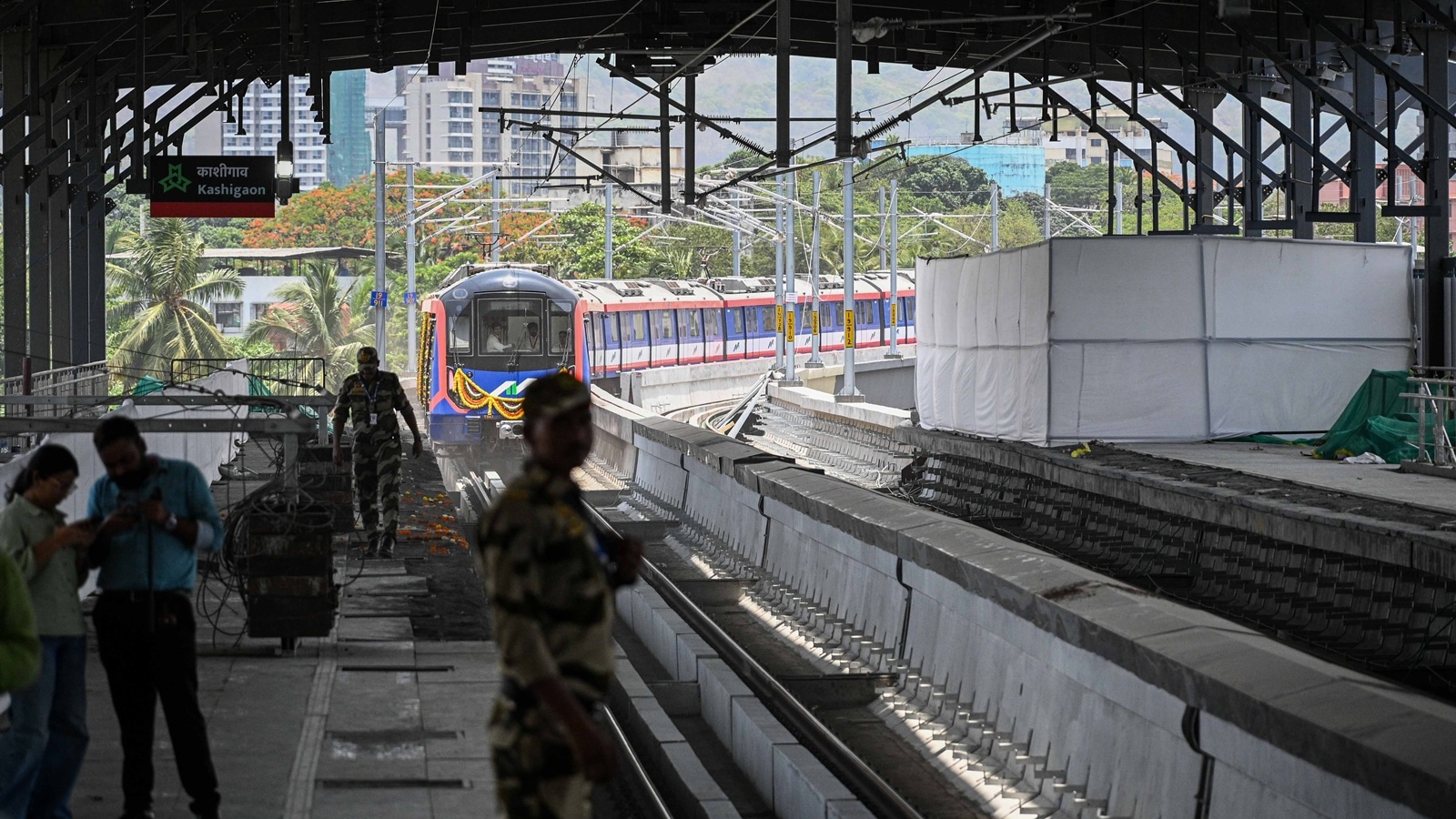
Mumbai’s long and traffic-choked airport commute may soon be a thing of the past. On Tuesday, the Maharashtra Cabinet Infrastructure Committee approved a 35-km Metro corridor Metro Line 8 or the Gold Line to directly connect Chhatrapati Shivaji Maharaj International Airport (CSMIA) with the upcoming Navi Mumbai International Airport (NMIA). Estimated to cost Rs 22,862 crore, the project will be the first Metro link between Mumbai and Navi Mumbai and a key pillar of the region’s emerging twin-airport system.
Once operational, the Gold Line is expected to cut travel time between the two airports to just 30–35 minutes, potentially transforming airport connectivity as well as commute between Mumbai and Navi Mumbai.

Q) Why does Mumbai need an airport-to-airport Metro line?
Mumbai is preparing for a twin-airport system, with NMIA expected to share passenger load with the saturated CSMIA. As air traffic continues to rise, seamless connectivity between the two airports will be critical not just for passengers, but also for airport staff and transit travellers.
At present, road travel between CSMIA and NMIA can take 75–120 minutes, and often more than two hours during peak traffic. The Gold Line aims to bridge this gap by offering a fast, reliable and congestion-free alternative bringing down travel time to 30 minutes.
What difference will the Gold Line make?
The Gold Line is expected to reduce airport-to-airport travel time by more than half, ease pressure on Mumbai’s road network, provide dependable connectivity for air passengers and airport staff, and strengthen integration between Mumbai and Navi Mumbai. In effect, it fills a long-missing link in the region’s transport network. The road distance between Mumbai’s Chhatrapati Shivaji Maharaj International Airport (CSMIA) and the upcoming Navi Mumbai International Airport (NMIA) is around 38–40 km. At present, the journey by road takes 75–120 minutes and can stretch beyond two hours during peak traffic. Once Metro Line 8 (the Gold Line) becomes operational, the end-to-end travel time between the two airports is expected to be around 30 minutes.
What will the route look like?
Metro Line 8 will run from Chhatrapati Shivaji Maharaj International Airport (CSMIA) Terminal 2 in Mumbai to Navi Mumbai International Airport (NMIA) Terminal 2, passing through the eastern suburbs and key nodes in Navi Mumbai. The corridor will have a total length of around 35 km, of which 9.25 km will be underground and 24.36 km elevated, with an average station spacing of about 1.9 km. The underground section will extend from CSMIA to Ghatkopar, while the elevated stretch will run from Ghatkopar East to the Navi Mumbai airport.
How many stations will the Gold Line have?
The corridor will have 20 stations in total six underground and 14 elevated. The underground stations will be located between CSMIA Terminal 2 and Ghatkopar East, while the elevated section will run onwards to NMIA.
Story continues below this ad
Proposed stations from west to east are: CSMIA T2, SG Barve Marg, Kurla Central, Lokmanya Tilak Terminus (LTT), Ghatkopar East, Govandi West, Mankhurd, ISBT–Mankhurd, Vashi, Sanpada, Juinagar, Nerul Sector 1, Nerul, Seawoods, Belapur, Sagar Sangam, Targhar, Moha, NMIA West and NMIA Terminal.
How will it integrate with Mumbai’s transport network?
The metro will have three lines and will also have a connection with LTT station ensuring better connectivity. This means commuters including outstation travellers will be able to reach either airport using a single Metro line.
Who will build it and what will it cost?
The project will be implemented by CIDCO under a public-private partnership model. The estimated cost is between Rs 22,862 crore. Around seven hectares of land will be acquired at a cost of Rs 388 crore. Funding will include 20 per cent viability gap funding from the Centre and the state, with the remainder coming from a private partner.
When will it be ready?
While the project’s framework has been approved, tendering is yet to begin. Chief Minister Devendra Fadnavis has directed officials to fast-track clearances to keep the project on schedule. The intended timeline is five years, though the state has indicated it aims to complete the project in 3.5 years.
