

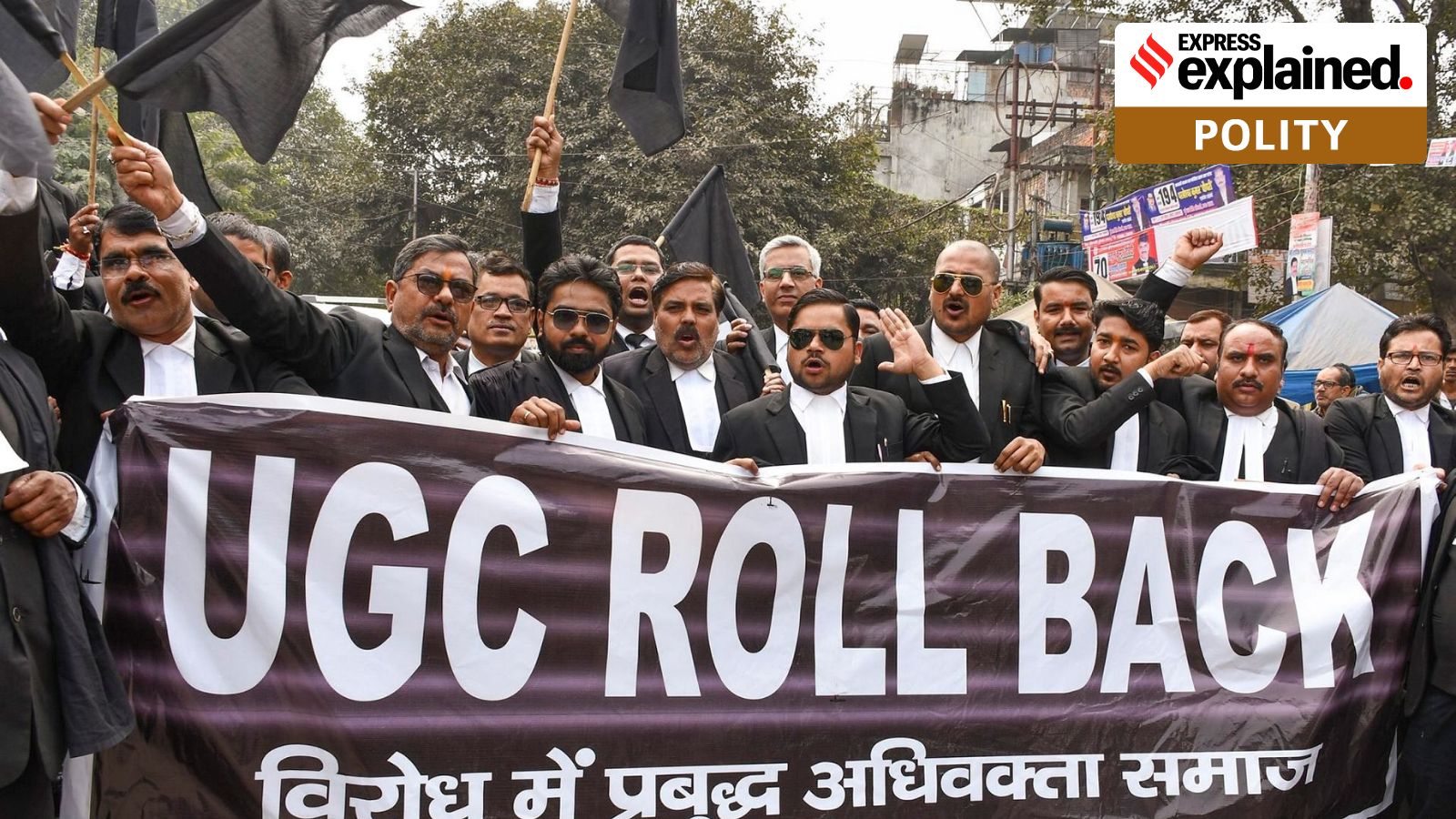
The Supreme Court on Thursday stayed the 2026 University Grants Commission (UGC) equity regulations notified earlier this month, which addresses discrimination, including caste-based discrimination, in higher education institutions.
The new regulations, which replaces the commission’s 2012 equity regulations, sparked protests and calls for their withdrawal among sections of students. These groups claim that the rules could create divisions over caste and result in “harassment” against those in the general category.
The bench comprising Chief Justice of India Surya Kant and Justice Joymalya Bagchi directed that the 2012 regulations remain in force till further orders.
The 2026 regulations defines ‘discrimination’ (section 3(1)(e)) and ‘caste-based discrimination’ (section 3(1)(c)) separately, while the 2012 version defines ‘discrimination’.
Under the new guidelines, caste discrimination is “discrimination only on the basis of caste or tribe against the members of the scheduled castes, scheduled tribes, and other backward classes.” This definition was challenged before the Supreme Court for excluding the general category.
Justice Bagchi questioned the need to define caste-based discrimination under a separate section, and asked if 3(1)(e) was thus made redundant. “We are looking into the evolution of the Regulations to create a free and equitable atmosphere in universities… When we see this, we see no reason why Section 3(1)(e) continues to subsist as it did in the 2012 Regulations. How does 3(1)(c) become relevant? Is it a redundancy?…We fail to understand when 3(1)(c) is already ingrained in 3(1)(e), why it was culled out as a separate definition clause?”
Story continues below this ad
Discrimination is separately defined as “any unfair, differential, or biased treatment or any such act against any stakeholder, whether explicit or implicit, on the grounds only of religion, race, caste, gender, place of birth, disability, or any of them”, and including “any distinction, exclusion, limitation, or preference which has the purpose or effect of nullifying or impairing equality of treatment in education and, in particular, of imposing conditions on any stakeholder or group of stakeholders which are incompatible with human dignity.”
This is similar to the 2012 regulations, but the latter included language and ethnicity in addition to religion, caste, gender, and disability. The 2012 regulations also separately defined ‘harassment’, ‘victimisation’, and ‘ragging’, which are omitted from the new guidelines.
“The constitutional question is… Article 15(4) empowers the state to make special laws for the Scheduled Castes/ Scheduled Tribes. If the 2012 Regulations spoke of a more widespread and all-inclusive discrimination, including discrimination in the nature of ragging, why should there be a regression in a protective or ameliorative legislation?” Justice Bagchi asked.
SPECIFIC FORMS OF DISCRIMINATION NOT DEFINED IN 2026:
The 2012 regulations listed specific forms of discrimination, harassment, or victimisation. This included breaching the reservation policy in admissions; discrimination in accepting and processing applications for admissions; limiting or denying access to benefits for students; announcing the names of castes, tribes, religion or region of students; labelling students as ‘reserved category’; passing derogatory remarks indicating caste, social, regional, racial or religious background as a reason of underperformance in class; earmarking separate seats for students; discrimination in evaluation of exam papers; segregating students in hostels, mess, common rooms; ragging targeting against sections of students.
Story continues below this ad
These specific forms of discrimination have been left out of the 2026 regulations, which task the ‘equal opportunity centre’ within institutions to prepare and disseminate an illustrative list of acts that shall be construed as discrimination.
The new rules also instruct institutions to ensure that any selection, segregation, or allocation into hostels, classrooms, mentorship groups, or any other academic purposes is transparent, fair, and non-discriminatory. The CJI questioned this provision: “Another provision which I am finding is an indication among the measures you are taking, you are speaking of separate hostels. For God’s sake, don’t do that. We have lived in hostels. Every community has students living together. We have developed inter-caste marriages also. We should move forward to develop a casteless society.”
PUNITIVE ACTION NOW INTRODUCED:
Under the new rules, non-compliant institutions can be debarred from participating in UGC schemes, offering degree and online programmes, or removed from the list of institutions that can receive central grants.
The UGC is also required to establish a monitoring mechanism to review progress made in achieving the objectives of the regulations and to constitute a national-level monitoring committee to oversee the implementation.
Story continues below this ad
The old regulations did not provide for any such action.
EQUAL OPPORTUNITY CENTRES AND PROCEDURES:
While the 2012 regulations provided for ‘Equal Opportunity Cells’ to be set up at institutions to promote equality, they did not specify the composition and functions of these cells, or the procedure to be followed in an instance of discrimination. The 2026 version mandates ‘Equal Opportunity Centres’ at institutions, with ‘equity committees’ which must be represented by OBCs, Persons with Disabilities, SCs, STs, and women.
The 2012 rules applies to “students belonging to marginalised sections, including SC/ST students”, but does not specifically identify OBCs.
The new rules also outline the procedure to be followed when an incident of discrimination is reported, including specific timeframes. Institutions are also required to set up equity helplines and ‘equity squads’.
Why were the new regulations framed?
Story continues below this ad
The new regulations were formulated after a plea in the Supreme Court filed by Radhika Vemula and Abeda Salim Tadvi, the mothers of Rohit Vemula and Payal Tadvi.
The petitioners suggested that the regulations focus on discrimination against SC, ST, and OBC individuals, given UGC guidelines on ragging, sexual harassment, and rights of persons with disabilities. They also suggested that the regulations include OBCs and that the specific aspects of discrimination, as mentioned in the 2012 regulations, be incorporated.
In an order issued in April 2025, the court noted: “We have no reason to doubt that the UGC shall formally notify the Regulations after considering all the suggestions received by them from different stakeholders.”
