

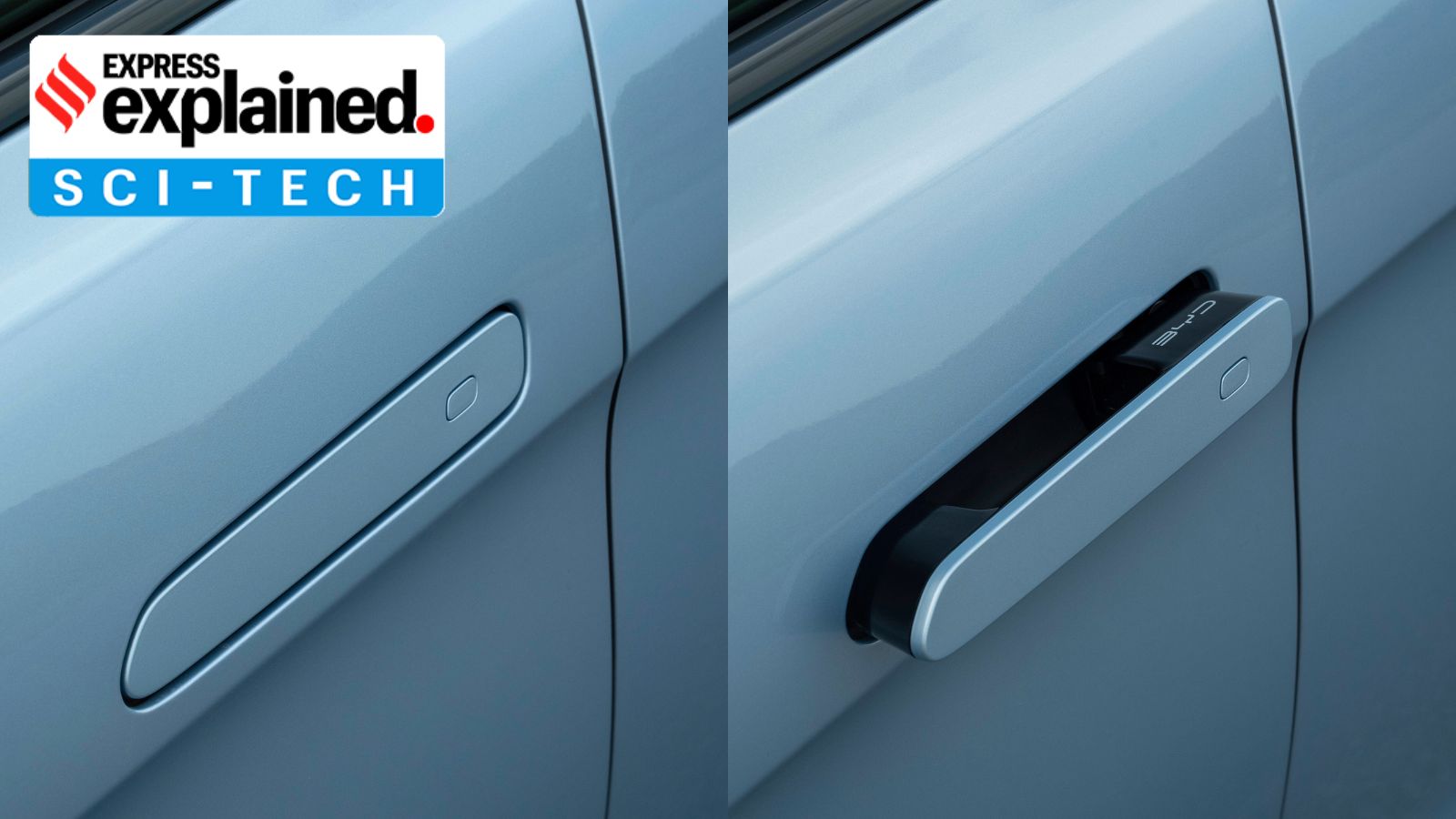
In a global first, China has announced a ban on “hidden” or retractable car door handles from 2027. A feature increasingly found in several manual and electric cars, its global popularity has been attributed to Elon Musk’s Tesla.
Simultaneously, the system has raised safety concerns. As early as 2013, Musk himself said, “We’ve got quite a fancy door handle, and occasionally the sensor would malfunction… So you’d pull on the door handle, and it wouldn’t open. Obviously, it’s quite vexing for a customer.”
Chinese state broadcaster CGTN reported that in some cases, passengers have been trapped in their vehicles after car crashes or power failures, because the doors couldn’t be opened. Under China’s new rules, every car must have the standard mechanical release on both the inside and outside of all doors.
The regulations could nudge other countries, but also matter in and of themselves, since China is both the world’s biggest producer and market for cars.
Tesla leads the way
Tesla began rolling out cars in the late 2000s, and within a few years, it carved out a niche for itself by selling futuristic-looking designs. The company and its CEO, Elon Musk, were also credited with making Electric Vehicles (EVs) an aspirational and attractive segment in the market.
Among Tesla’s modern features was the hidden door handle (also called flush). Unlike traditional or mechanical car door handles that can be opened manually, by lifting a flap or pulling a handle, these handles are at the same level as the door. They only reveal themselves once the car keys are brought near the vehicle.
As the South Korean carmaker Hyundai notes on its website, “When retracted during driving, it reduces aerodynamic drag and creates a cleaner, more future-forward look.” Drag is the force that acts on a body (a vehicle in this case) during its motion. An engineer told Chinese state media China Daily that hidden door handles can increase a car’s range by five to ten kilometres by reducing drag, but the extent of the mileage benefit has been questioned.
Story continues below this ad
Hyundai adds that EVs and premium models often feature the design, since sleek styling is a priority for the categories. It further details two types of flush handles — “an automatic style that pops out as needed, and a manual style where the user presses part of the handle area and then pulls to open the door.”
For handles that fully “pop out” automatically, the car battery powers the entire mechanism — activating sensors that detect the car keys, and sending commands to the handles to protrude. Passengers sitting inside must also push buttons to open the doors. While emergency systems exist, they often vary model-to-model in terms of placement and may not always be conveniently located.
As Tesla gradually became the standard for EVs, other companies began incorporating features like the hidden handle. According to the China Daily report, such handles are “widespread” in China’s hybrids and EVs. In April 2025, about 60% of the top 100 selling New Energy Vehicles included them.
In India, some of the popular models sold with the feature include Tata’s Sierra and Curvv, Kia’s Seltos and Syros, and Mahindra’s XEV 9e, BE 6 and XUV700.
Fires to electric failures
Story continues below this ad
While considered stylish, flush door handles have become a serious safety risk following multiple reports of system failures. A Chinese carmaker’s engineer told China Daily, “Sensors are often located at the front of the door; if they’re damaged in a crash, the handle may not pop out.” Accidents, fires resulting from accidents, or cars being submerged can also damage the battery, possibly leading to people getting trapped inside cars.
TheFinancial Times reported that in China, “A fatal crash in 2024 involving Huawei-backed Aito’s M7 sport utility vehicle, which has retractable handles, sparked debate after videos on social media showed rescue workers breaking windows in an attempt to save victims. Three people, including a two-year-old boy, died.”
“The power and signal cables had been immediately severed, preventing the door handle controller from receiving the ejection signal,” Aito had said in a statement. The windows had to be broken to enter the vehicle. There were also similar cases involving Xiaomi’s SU7.
In the United States, too, the National Highway Traffic Safety Administration (NHTSA) has ordered probes into cars over electronic door handles becoming inoperative. In at least four instances, parents had to break the car windows for their children to exit the vehicle. “Although Tesla vehicles have manual door releases inside of the cabin, in these situations, a child may not be able to access or operate the releases even if the vehicle’s driver is aware of them,” the NHTSA report said.
Story continues below this ad
Franz von Holzhausen, Tesla’s design chief, told Bloomberg last year that the company was looking to combine the electronic and manual door-release mechanisms as a possible solution. This came soon after a Bloomberg investigation found that the NHTSA had received more than 140 consumer complaints related to doors on various Tesla models from 2018.
The case of door handles, however, represents the increasing trend of car mechanics transitioning towards electronic systems. Reuters reported that in April 2025, Chinese carmaker BYD rolled out at least 21 affordable models equipped with free “smart driving” features. This is visible in other markets too, including India, where Advanced Driver Assistance Systems (ADAS) are being offered at a lower price range as well.
(With inputs from Soumyarendra Barik)
