

(Each week in the Backroom Brief,the National Political Bureau of The Indian Express examines a political party or a leader, tracking their moves and explaining why they matter.)
On February 8, 2025, as he flipped through news channels, Arvind Kejriwal watched as Delhi’s reins slowly slipped out of his hand.

Kejriwal, who was at the CM residence at 6 Flagstaff Road, was in near constant touch with the Aam Aadmi Party’s (AAP) election war room at its new headquarters on Pandit Ravi Shankar Shukla Lane, and, according to party leaders, was “visibly upset, but not angry”. It was an election that would have meant Kejriwal would have surpassed Sheila Dixit as Delhi’s longest-serving CM, vindicated the party after years of corruption allegations and run-ins with the Centre that had left the administration in the National Capital in a state of near paralysis, and pushed it up in the pecking order of Opposition parties.
ALSO READ | ‘Murder… not accident’: Rahul Gandhi, Kejriwal attack Delhi Govt after biker falls into pit dug by DJB, dies
But this was not to be. Amid a stinging loss that had left the party with 22 seats in the 70-member House, down from 64 five years earlier, and without some of its prominent faces — such as Manish Sisodia and Saurabh Bharadwaj, who too lost their re-election bid — around 2 pm, Kejriwal asked for a video message to be recorded and accepted the mandate. Then, he went quiet, stepping away from the public glare for months.The AAP chief remained indoors for the next 15 days for what insiders termed an “aatm manthan”, a self-assessment exercise. This calm after the din of an intense electoral campaign, however, sparked speculation ranging from Kejriwal preparing to take charge of the AAP government in Punjab to him moving to the Rajya Sabha.
AAP insiders said Kejriwal, contrary to the buzz, utilised this time to concentrate on the organisation and get back to the basics. “In that period, contrary to public opinion, Arvind ji was hard at work; he met each candidate along with trusted and senior party hands to assess the granular details of the AAP’s performance in each of Delhi’s 70 Assembly seats down to the civic ward level,” said a leader.“Senior leaders and election managers kept coming and going from his then-residence on Ferozeshah Road, around the clock. This was also when Arvind ji took some tough decisions, deploying senior and trusted party hands to different states as in-charges and refreshing the party’s leadership in Delhi.”
ALSO READ | Delhi court acquits Arvind Kejriwal in two ED cases over summons
Missing in action?
AAP leaders insist Kejriwal was missing in action “only as far as public appearances in Delhi” were concerned. In the following three months, the AAP leader quietly took steps to strengthen the party’s organisation.
“Some party workers felt that he was doing what he usually does following a political defeat: lose interest. But that was clearly not the case. Not only did he not forget Delhi, but his focus was also on making the AAP future-ready by laying the foundations of its expansion everywhere it currently exists … He made it a point to usher in a second-tier of leaders, while the senior leadership, including himself, either relocated or frequently visited Punjab to consolidate the AAP government’s foundations there.”
ALSO READ | Kejriwal hits out at BJP: ‘Who ate samosas worth Rs 2 cr from tribal grant?’
While Sisodia and former Delhi minister Satyendar Jain shifted base to Punjab, with Kejriwal also increasingly spending his time there, former Delhi CM Atishi was deployed in Goa, former Delhi minister Gopal Rai in Gujarat, and Bharadwaj was handed charge of Delhi.
“The direction was clear to each leader: build the party up from the municipal to Assembly-level well in time for elections and do not return to Delhi unless asked to by the party. Since then, he has taken any non-compliance in this regard very seriously,” a source said.
However, this strategy also brought its own problems, especially in Punjab, where the AAP top brass’s presencecreated unease among some in the state unitand led to the Opposition alleging that the Bhagwant Mann government was being remote-controlled. Kejriwal, however, has continued to remain closely involved in party and government affairs in the state, which goes to the polls early next year. Last month, hetook the stage along with Mannas the government launched its universal healthcare scheme.
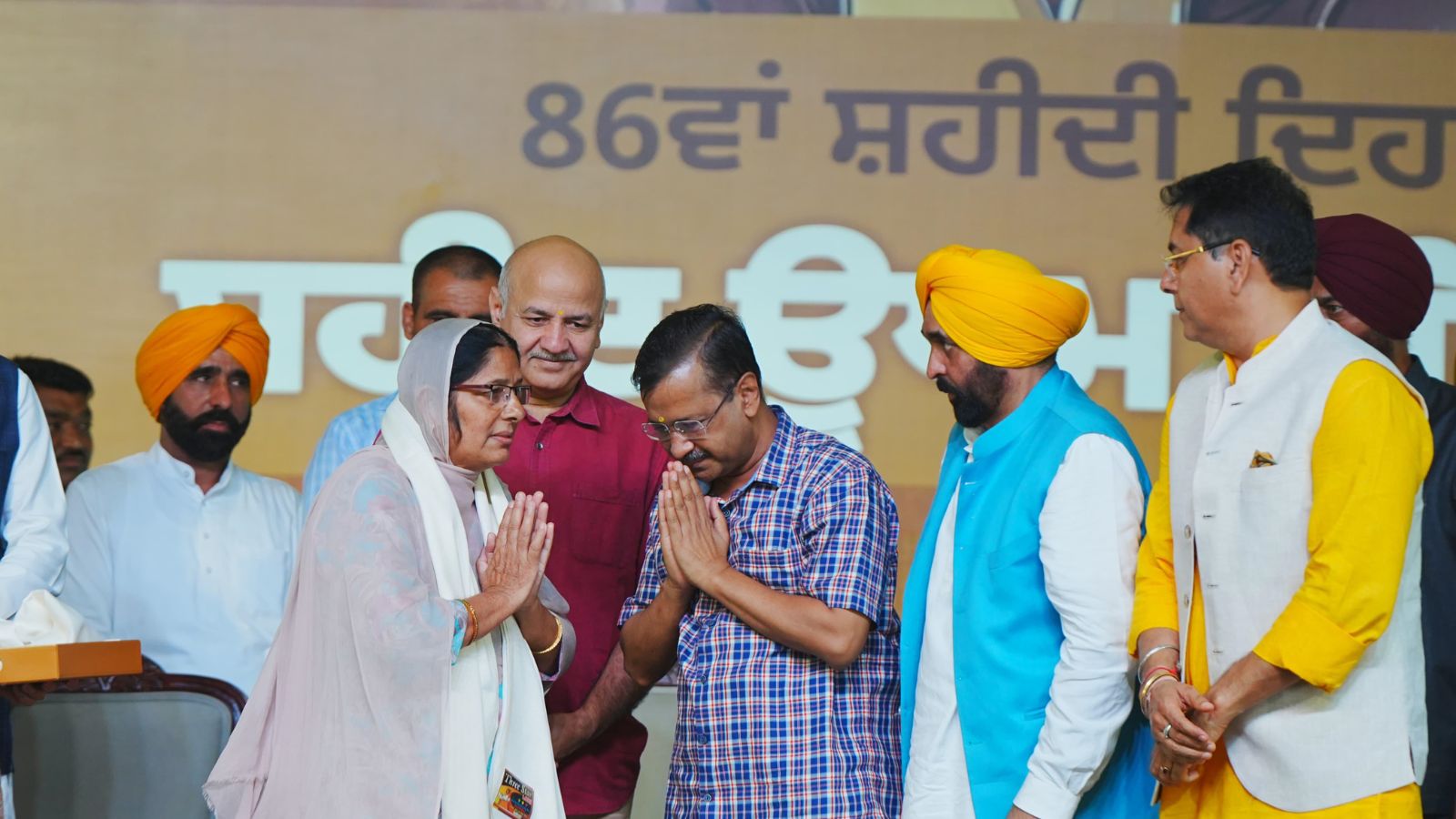 AAP National Convener Arvind Kejriwal with Punjab CM Bhagwant Singh Mann and AAP leader Manish Sisodia (Express Archive Photo).
AAP in Delhi
In the National Capital, Kejriwal made his first public appearance at Jantar Mantar, the party’s birthplace, late June last year, when he led the AAP’s protest against the government’s demolition drive in slums and unauthorised colonies.
On New Year’s Eve, for the first time since being voted out of power, the AAP’s senior leadership, including Kejriwal, rubbed shoulders with party workers during a celebration. “We made it a point to play our poll song, ‘Phir Se Kejriwal’, to which everyone came to the dancefloor to shake a leg,” said a worker who was present. “Arvind ji watched us from a distance, smiling and clapping his hands. But he was visibly happy.”
Having shaken off the disappointment of its loss, the AAP over the past several months has been a vocal Opposition, taking on the Rekha Gupta government over issues such as pollution, non-payment of the monthly Rs 2500 ex gratia to eligible women beneficiaries, and school fee hike. After a 25-year-old man was killed when his motorcycle fell into a deep pit dug by the Delhi Jal Board (DJB) in West Delhi’s Janakpuri area late on Thursday night, Kejriwal on Friday led the AAP’s attack on the government, describing it as a “murder”.
The top priorities
Kejriwal’s public appearances remain scarce, limited to either Punjab or Gujarat, and party insiders say this is by design.
AAP sources spoke of three priorities: retaining Punjab, winning Goa, and expanding in Gujarat and Uttar Pradesh. All states go to the polls next year and it will be a litmus test for the party following the Delhi setback.“Retaining Punjab, especially in the wake of losing Delhi, is of utmost importance. It will not only safeguard the AAP’s national footprint, but it will also allow us to expand to Himachal Pradesh. Gujarat and UP are also next on the list,” said an AAP leader.
The AAP, insiders said, was trying to build its organisation in UP and Gujarat. “Arvind ji personally sets up his entire schedule of micro-meetings with those who want to be a part of its organisation there; going forward, he will likely revert to the party’s first model of vetting candidates based on merit, something which gradually stopped happening, instead of focussing on winnability or their family connection,” said a leader.“The Delhi defeat has provided many lessons, including the fact that usually, the old ways that come naturally to you are the best way forward. This is precisely what Arvind ji and the AAP appear to be back in favour of,” said the leader.
