

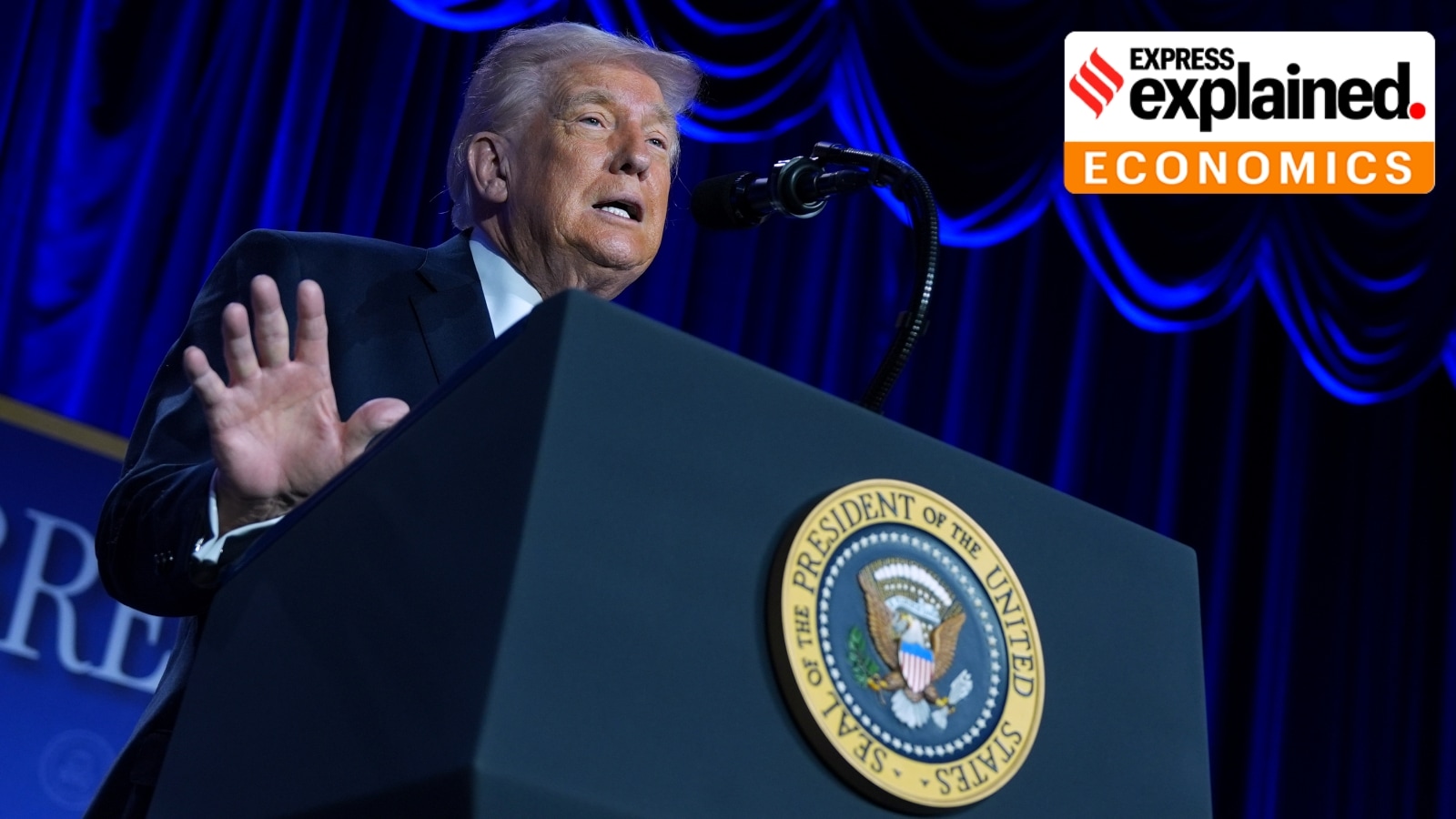
The US on Saturday notified the rollback of an additional 25% tariffs on India, imposed on August 27 last year, after India agreed to “stop” importing Russian oil, increase purchases of American oil, and commit to “expand defence cooperation” over the next 10 years, a White House executive order showed.
Rolling back the additional tariffs starting February 7 with provisions of refunds, US President Donald Trump, in the executive order, said: “India has committed to stop directly or indirectly importing Russian Federation oil, has represented that it will purchase United States energy products from the United States, and has recently committed to a framework with the United States to expand defense cooperation over the next 10 years.”

The executive order states that US officials “shall monitor whether India resumes directly or indirectly importing Russian Federation oil”. The order said that if the US official finds that India has resumed imports of Russian oil, they “shall recommend whether and to what extent” Trump should take additional action against India that could involve “reimposition” of the punitive 25% tariffs on India.
The White House issued this executive order separately from the India-US joint statement. The joint statement, issued after the two sides reached an interim trade agreement framework, makes no mention of Russian oil. Under the deal, US tariffs on India are being reduced to 18%.
Moscow’s crude only finds a mention in Trump’s executive order. New Delhi has so far not commented on the claims made in this executive order about India’s Russian oil purchases. Even after Trump claimed on Monday that that Prime Minister Narendra Modi agreed “to stop buying Russian oil” and “to buy much more from the US and, potentially, Venezuela”, the Indian government did not directly comment on the Russian oil claim.
In the only official comment on the oil issue so far, Ministry of External Affairs (MEA) spokesperson Randhir Jaiswal reiterated India’s stated position that ensuring the energy security of 1.4 billion Indians is the main priority of the government, and that diversifying energy sourcing in keeping with objective market conditions and evolving international dynamics is at the core of the strategy.
Oil imports from Russia
This comes as Russian oil imports have been declining and Indian imports of American oil have already been rising. Trade data showed that the US’s share in India’s oil imports has surged to 7.48% between April and October this year, compared with 4.43% during the comparable period last year. In contrast, Russia’s share has come down from 37.88% to 32.18% during the comparable period.
Story continues below this ad
Over the past couple of months, India’s Russian oil imports have declined steadily to a three-year low, as per tanker data. This followed US sanctions against Russia’s top oil producers and exporters Rosneft and Lukoil. From the 2025 peak of 2.09 million barrels per day (bpd) in June, India’s Russian oil imports dropped to 1.16 million bpd in January 2026, according to data from commodity market analytics firm Kpler.
Indian public sector refiners last year signed a one-year deal for American liquefied petroleum gas (LPG) imports. While crude oil imports are already nearing 10 per cent, the imports of LPG of around 2.2 million tonnes per annum (MTPA) of LPG also come close to 10 per cent of India’s annual imports.
“I have determined that India has taken significant steps to address the national emergency… and to align sufficiently with the United States on national security, foreign policy, and economic matters,” Trump said as per the executive order.
Indian refiners have so far not received any directive on the matter from the government, it is learnt. Evidently, though, they appear to be preparing to cut down on their Russian diet significantly.
Story continues below this ad
But completely halting Russian oil imports doesn’t appear to be a feasible option for India in the prevailing circumstances. Moreover, even a substantial reduction in import volumes from Russia and a corresponding increase in American crude supplies are easier—and faster—said than done, according to industry executives and experts. Technical and commercial challenges exist, and so do considerations around India’s strategic autonomy on its energy trade. Industry analysts expect a gradual reduction in oil imports from Moscow, rather than a sudden stop.
Russian oil imports
Indian refiners have already booked Russian oil cargoes through March and even part of April, and turning them down is not really an option. So, even if there is a heavy cut in Russian oil purchases, Indian refiners will need an extended window to wind down their purchase of Russian crude. And even if they do that on the government’s advice, one refiner—Nayara Energy—will not be in a position to do so, experts pointed out.
Nayara Energy, which counts Russia’s national oil company Rosneft as a significant shareholder, is almost entirely dependent on Russian crude. This is because it has been sanctioned by the European Union, while Rosneft has been sanctioned by the US as well, in addition to the EU. With these sanctions in place, the refiner, which processes 400,000 barrels per day (bpd) of crude, has not been able to secure oil from most countries, other than Russia. Unless Nayara Energy is able to get a stable and consistent supply of crude from other sources, asking it to shun Russian oil would translate to effectively shutting the refinery.
Industry experts said that once the already-contracted volumes of Russian crude are delivered to Indian refiners, and if the government indeed wants to seriously cut down on Russian oil imports, the volumes in the medium term could fall to around 500,000 bpd, which would be roughly half of the oil Indian refiners imported from Russia in January. Even at 500,000 bpd, Russian crude would account for roughly 10% of India’s oil imports, although that would be much lower than the 35-40% share Moscow’s oil used to enjoy in India’s oil import basket.
Story continues below this ad
Tanking up on American crude
The extent to which American oil could replace Russian crude is the key question.
According to industry insiders, India has been increasing its oil imports from the US — its fifth-largest source of crude — and can continue to do so, provided it is priced competitively, as the cost of shipping oil from the US to India is currently more than double of getting oil from West Asia.
The other key consideration would be the US crude grades on offer and their compatibility with Indian refineries. This is because different crude grades are suitable for different petroleum products from an operational and efficiency perspective. Indian refineries are currently more accustomed to medium-sour crudes from Russia and West Asia, although they have the capability to process nearly all types of crude. US crude is lighter and sweeter.
Story continues below this ad
However, ramping up liquefied natural gas (LNG) imports from the US would be relatively straightforward from a commercial perspective. Washington is New Delhi’s second-largest supplier of LNG, after Qatar.
Higher freight, while also a factor in importing LNG from the US, is not as major a concern as in the case of crude oil. This is because American gas itself is usually priced at a significant discount to gas from other major suppliers like Qatar. This means that despite paying more for transportation of American LNG to India, the landed price for Indian LNG importers would mostly be lower than importing from West Asia. Also, unlike crude that has numerous grades and qualities, LNG from various geographies is broadly consistent and similar in quality.
Iran tariffs
While on one hand, the Trump administration has rolled back the additional tariffs, it has threatened countries with additional tariffs of 25 per cent for trading with Iran.
“Beginning on the effective date of this order, an additional ad valorem rate of duty — for example, 25 per cent — may be imposed on goods imported into the United States that are products of any country that directly or indirectly purchases, imports, or otherwise acquires any goods or services from Iran,” the White House said
Story continues below this ad
“ I determine that it is necessary and appropriate to impose an additional ad valorem duty on imports of articles that are products of foreign countries that directly or indirectly purchase, import, or otherwise acquire any goods or services from Iran,” Trump said as per the order.
India’s trade with Iran has been declining over the years. Data showed that the top export items to Iran included cereals worth $757.52 million, tea, coffee, and spices worth $70 million, animal fodder worth $71 million, and fruits and nuts worth $55 million in 2024-25.
In 2024, Iran’s total imports were about $68 billion, of which its leading partners were the UAE ($21 billion), China ($17 billion), Turkiye ($11 billion), EU ($6 billion). India’s share was only $1.2 billion.
India had earlier called the targeting of India over the purchase of Russian oil “unjustified and unreasonable” and vowed to take “all necessary measures” to safeguard its “national interests and economic security”.
