

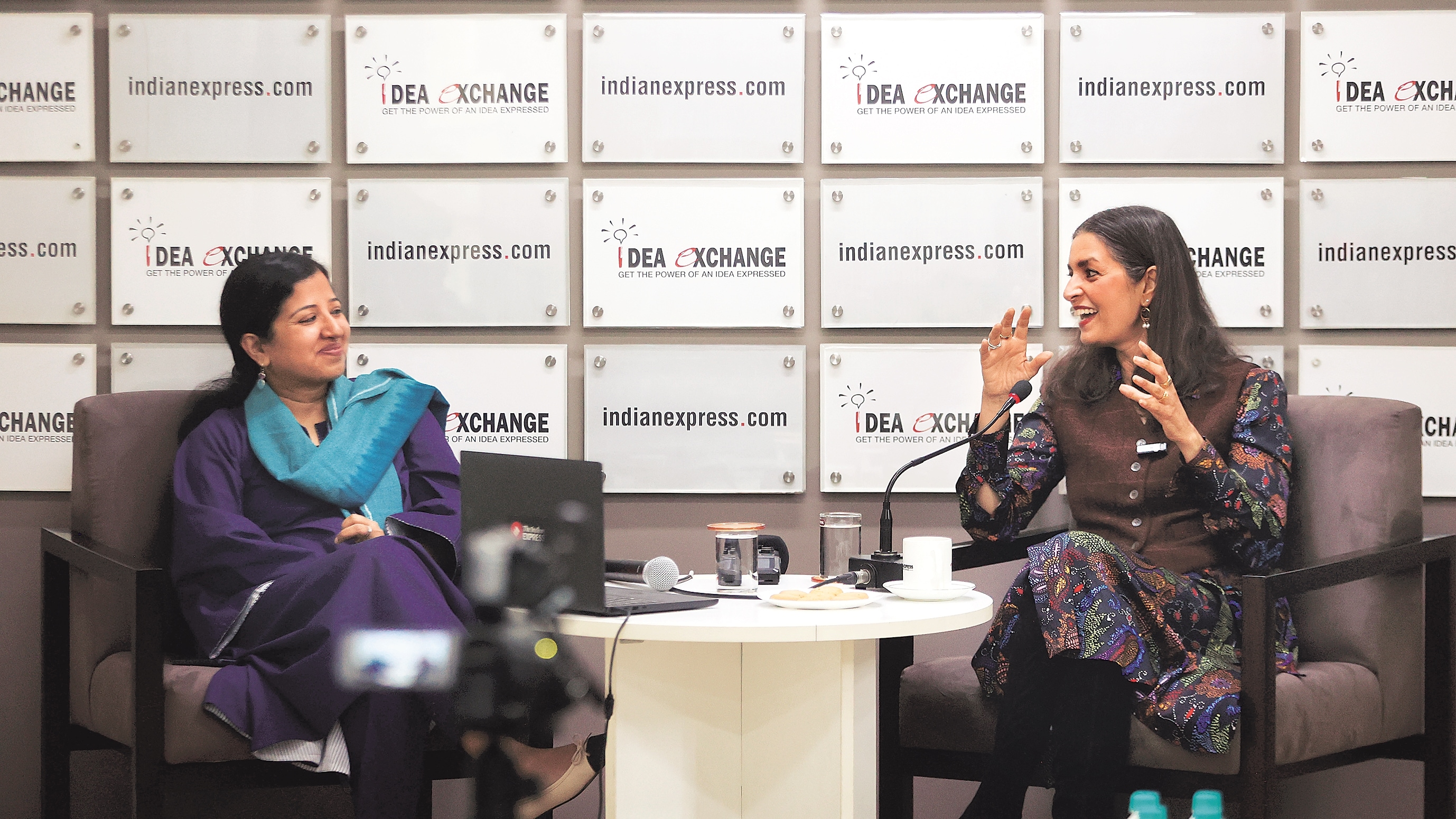
Pulitzer Prize-winning writer Jhumpa Lahiri on identity politics, her approaches to languages, why she’s a born translator and grappling with questions on belonging. The session was moderated by Paromita Chakrabarti, Senior Associate Editor, The Indian Express
Paromita Chakrabarti: I was reading one of your stories recently, The Exchange, about a translator and I was struck by its opening line: ‘There was a woman who wanted to be another woman’. It could also speak for you and the many identities you hold. Could you talk us through the way you have approached language, the way you have inherited them and acquired them.

The Exchange (in her memoir In Other Words) was the very first coherent story that emerged unexpectedly in Italian. This was a few months into my stay in Rome. Something about being able to work and think in Italian enabled me to isolate aspects of my deeper inner self that the English language had not allowed me to access. Even those rudimentary first steps in Italian seemed to make visible this longstanding feeling of being somehow at fault for who I was. This theme of imperfection runs deeply through my thinking. I knew Bangla, the first language I was taught at home, which I spoke and still can speak and understand — but not fully, not in the way my parents do. I always felt that sense of imperfection with Bangla. With English as well — I learned it at a very young age and I learned to speak it without a detectable accent that would mark me as being of foreign heritage. I always feel a little bit at fault if I don’t understand the language that’s being spoken around me. This has driven me to my lifelong quest to learn other languages. I always find the languages I don’t fully understand more exciting than the languages I do.
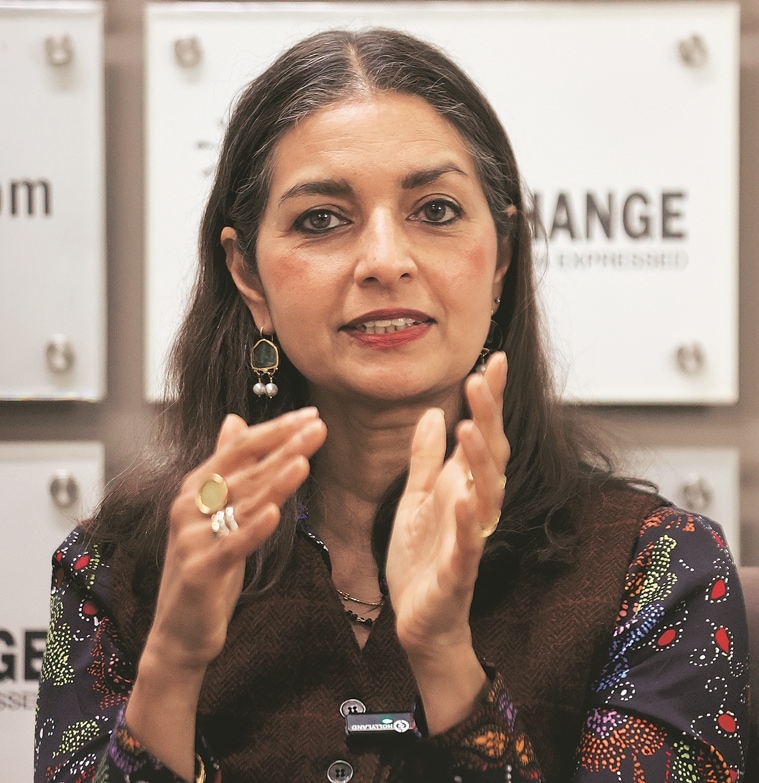 Pulitzer Prize-winning writer Jhumpa Lahiri
Paromita Chakrabarti: Are there different registers to your personality when you speak in these different languages? Are there three Jhumpas — one who speaks English, one who speaks Italian and one who speaks Bangla?
Very much. Bengali is the language of home, family and being a child. I’m a little more guarded in English because that’s how I felt when I first went out into the world. But oddly, in Italian, a language I learned much later in my life, it evolved me. I think I have a little bit more confidence and lightness (in it). I’m not weighted down by the timid English side of me or the eager to please Bangla side of me. The thing about Italian was that nobody was expecting me to have any relationship to the language. It was entirely self-driven and that was also liberating.
Paromita Chakrabarti: How do you look at the homogenisation project that is going on with language in many countries, including in India?
It’s a terrible and dangerous thing. Linguistic difference is one of the most beautiful aspects of the human race. And it’s as miraculous in ways that nature is miraculous at the ocean and the mountains. I think we must strive to not only maintain but to insist on awareness and cultivation of different languages. It’s criminal to force people to speak a certain language, especially in places that are inherently multilingual.
On being multilingual | Linguistic difference is one of the most beautiful aspects of the human race. It’s as miraculous in ways that nature is miraculous at the ocean and the mountains. It’s criminal to force people to speak a certain language
Story continues below this ad
Paromita Chakrabarti: Between mother tongue and foreign languages, you write that there is no mother tongue, that it’s a sort of forced enforcement to have one mother tongue and to be monolingual.
In my case, I can’t point to a specific mother tongue. When people say English is your mother tongue, I say no, and then they’ll say Bengali is your mother tongue, and I’ll say, well, technically yes, but sort of no, because it also falls short of the all-encompassing nature that the mother tongue constructs. It tries to be an airtight container for language, ethnicity, identity, spirit and soul. There are many people in the world who cannot identify in that way, people born to parents who come from different linguistic backgrounds. What is the mother tongue in that case? Then there are people who are drawn to other languages. Some people are like sailors, we want to go out into the sea. We want to see what’s beyond our own borders.
Paromita Chakrabarti: You’ve grown up between cultures, grappling with questions on belonging. Across the world now, there is a hardening of identity politics. How do you see that in the US and in India?
I’ve seen the rise of identity politics in my lifetime. When I was young, Indian-American was not even a word or a term. I was born into a generation without the identity politics toolkit. Now, people are quite proud of their mixed identities. I see this in the recent mayoral elections in New York City. That Zohran (Mamdani) was forward in saying, ‘I am South Asian, I am Muslim, I am going to be the mayor of New Yorkers’ was very explicit and galvanising for all New Yorkers. I know that 40 years ago that wouldn’t have been possible. I was born into a generation where we were trying to always hide who we were. So, there are positive consequences of identity politics. But, there’s also a dangerous side and that is, that inevitably identity means drawing a boundary between us and them.
Story continues below this ad
Paromita Chakrabarti: In 2024, you wrote a letter after the October 7 Hamas attack, urging for freedom on campus to be protected. What do you tell students about speaking up when they come in now?
I teach authors, I teach Ovid, I teach a class on Italian women writers, I teach authors who spoke up, who stood out, who were brave, who faced censorship, who went through all sorts of experiences, vis-a-vis freedom of expression and I let them connect the dots. We do have to be careful on our campuses today. I try to be slightly circuitous, but the students are very bright, and they understand because there is a lot of censorship and academic freedom is under threat in the United States.
Devyani Onial: In Other Words was translated by Ann Goldstein, who is also Elena Ferrante’s translator but you translated Roman Stories and Whereabouts from Italian into English yourself. How is it to see when somebody else has translated your work and how is it when you have?
Italo Calvino had said that he only really understood his work when he read it in translation. I think we need the other to tell us who we are. And this is very powerful also politically. When In Other Words came out and the idea of having an English edition of the book came about, I was not interested in translating myself. I really needed to continue cultivating Italian as a language. I felt it would be dangerous to suddenly move back into English. That was why I was very grateful to Ann Goldstein for translating the book. By the time of Whereabouts, I was at that point more ready and also eager to think about what it would be like for me to translate, to rewrite the book in English. It’s very disorienting to translate oneself and there are a lot of ways it can go. In some sense you have total liberty because you only have to answer to yourself and you can really change things quite radically. But I think what interests me most about translating myself, is the strange blind spots we have in our own languages. Like sometimes I’ll look at something I wrote in Italian, the language I learned to read and write at the age of 45 and onward, and I’ll say to myself, I don’t even know how to say this in English, and that’s really interesting because I think we enter into these mindsets in a certain language.
On dealing with criticism | I started writing to push back against expectations. People would say you’re giving Indian immigrants a bad name. But I’m not telling anybody’s story. I’m not writing to represent groups
Story continues below this ad
Shalini Langer: At a time when multiculturalism seems to have failed, is true assimilation even possible for someone coming from another country or culture?
It really depends. I think assimilation is partly a state of mind and partly shaped by forces we cannot control. A lot of assimilation has to do with physical appearance and assumptions. The question ‘where are you from?’ is often triggered by that. Wherever I go in the world or wherever I have been, someone asks me this. This has been true from my earliest memories. I can say observing my parents, they assimilated in many ways. They had to or chose to assimilate in certain ways. And then there was also huge fortresses of: ‘No, we refuse to assimilate in those ways. We want to maintain our ways.’ I belong to a generation of Indian Americans who I think largely wanted to assimilate. We wanted to hide. We were mortified when on the first day of school, the teacher would call the names, we just wanted to hide, why did we get these names, and why is it so complicated? And yet, the question is, is it possible? Again, it also depends on the place. So a place like New York City, everyone assimilates because the whole ethos of the place is a container of difference. You come to New York and within two weeks you’re a New Yorker. You know how to ride the subway, you’re a New Yorker. You know how to eat a bagel or at least know what a bagel is, you’re a New Yorker. But, wen you step outside of New York and go to Connecticut, it’s like all bets are off. So, this is a very complicated question.
Sameeksha Mishra: AI is changing the production and consumption of literature. How should young writers navigate this?
AI is on everybody’s mind. If you’re asking where do I put AI, I would say put it as far away from yourself as possible. If you go to the Qutub Minar in Delhi, and look at the carvings, know that it was a human hand and time and patience and skill that was able to make design after design, to create that work of beauty. That’s writing, in a different way — working with words on a paper or tablet, it doesn’t matter, the modality. But that is what writing is. It’s akin to that kind of labour. This manuality is something AI can never do. One of the things that really concerns me in terms of what AI can do to kind of replace and obliterate a whole artistic creative practice is translation work. That’s where I get really nervous because the translator is one of the most ethically, creatively, spiritually important figures we have had throughout history. If we lose the human beings who devote themselves to this mission, we lose a crucial component of human society.
Story continues below this ad
Unni Rajen Shanker: Is there a place you call home or is there a language which you call home?
I don’t search for home, I search for the feeling of home. Being around books is home. Finding myself in a library is home. I went to the library of Ghalib in Nizamuddin and I felt at home. My father worked as a librarian for almost 50 years and they were our shrines. Around people I love, I feel at home. It’s a feeling for me. It’s not tied to geographical coordinates. Because deep down, I was raised in the United States, very much aware and being told that we were there as guests, that we needed to be on our best behaviour… my mother would say sometimes, you never know when we are going to be the ones that they’re going to have a problem with. We’re seeing that today. It is literally happening in the United States. Those sort of warnings and when we were kids, we were like, “oh please, that’s never gonna happen!” “We’re assimilating. Oh no, we’re fitting in. We belong here.” This notion, it’s so tenuous and all it takes is a new government to change all the rules.
On what AI cannot do | Writing is akin to labour, that carving, working with words on a paper or tablet, the human hand, time, patience and skill, that ability to make design after design, to create that work of beauty — this manuality is something AI can’t do
Raj Kamal Jha: You talked about growing up in the US as an Indian kid. How do you look at the deeply divided America today, the growing anti-immigrant strain? Did you see it coming? How are you empathetic towards those who don’t vote the way you do?
It’s really important for the writer, for the intellectual, to put ourselves into the minds of all kinds of people… this question of the problematic character — I was at the India Habitat Centre and I was asked to present a film screening of an Italian movie called Il Sorpasso where there’s a very problematic character. He’s sexist, he’s racist, he’s inappropriate. I said to the audience, he’s kind of reminiscent of a certain head of state that I won’t mention by name. But he’s incredibly charming and seductive at the same time. And he’s funny, and we’re laughing along with him. The power of that movie is that why, how do we, even though we can see that this person is representing despicable viewpoints, there’s something that we’re connecting to nevertheless.
Story continues below this ad
For the past five years, I’ve been translating Ovid’s epic poem Metamorphoses. And the theme of the entire work, is transformation, the fact that all of us live on the border in terms of identity. One of the things that is so powerful about this work of literature that I’ve been living inside of, is the question of what is human and what is monstrous.
One of the things that is incredible about the metamorphoses is that you will see the humanisation of the monster and you will see the monstrous qualities of the human. And this is one of the driving energies of Ovid’s poem and why it remains so relevant. I think it’s fundamental that we don’t close ourselves off, even on the people who don’t vote like us.
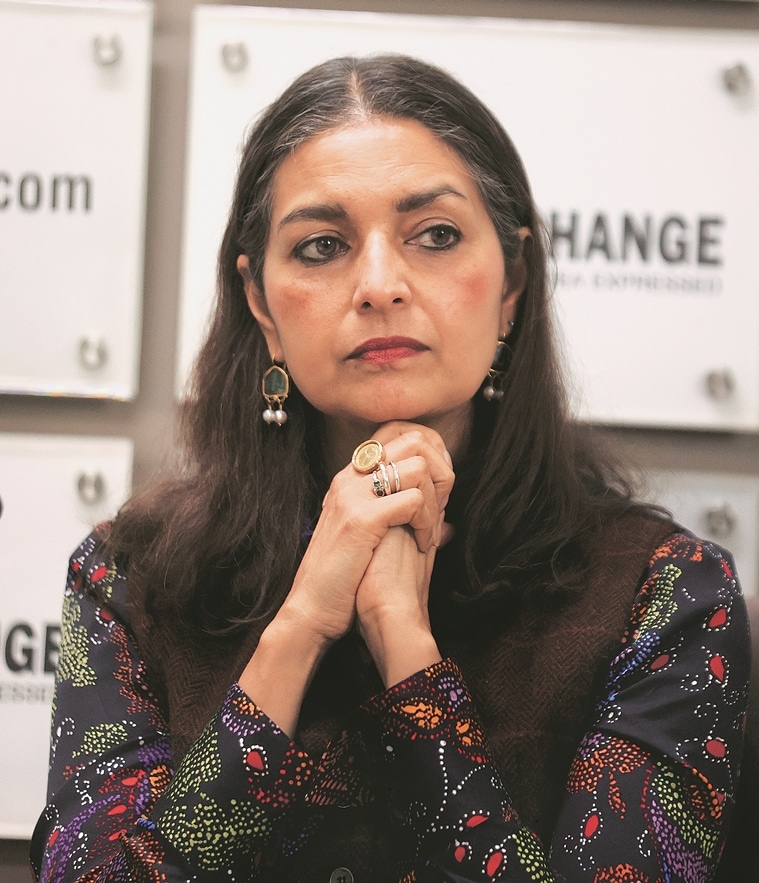 Pulitzer Prize-winning writer Jhumpa Lahiri
Raj Kamal Jha: You are a professor, too. What do you see of yourself in the first-generation Indian-American student in 2026? How are they different from the student Jhumpa?
So she’s living in New York City, she’s really excited. Because (Zohran) Mamdani is our mayor… these things are unimaginable for the young Jhumpa. But it depends on where she is. If she’s in a city, if she’s in an urban centre, if she’s maybe at a university, she feels more confident in who she is and the fact that she has maybe two or three languages in her household and is more comfortable in her skin, literally. But also because of the immigrant backlash, it applies to anybody and everybody, and what’s going on now in the United States. They’re not going to distinguish if you’re a professor… it doesn’t matter because again, it’s the skin colour, it’s appearances, it’s something we can’t take away or alter.
Story continues below this ad
The Indian American student now has more vocabulary. She has the badge. She can call herself a hyphenated creature…That girl has a little bit more confidence of saying, this is who I am, and I’m part this and I’m part that, and that’s also okay.
And she certainly can point to more things in culture, in music, in TV, movies… as well to sort of say, ‘okay, this too is part of the stream of American culture.’ I see it in my own kids. They want to wear things more openly. But it’s also difficult because they feel Indian or half-Indian, half-Bengali, but they also don’t know how to answer the question, where are you from? So if I could have like a fantasy one day, it’d be really interesting to gather together all the people on the planet who cannot answer the question, where are you from? And have a collective handshake and say, ‘let’s just all have a primal scream and just be together because I think it’d be a really big room’. I wish the answer could be: ‘I’m from that room where none of us can answer the question. That’s where I’m from.’
Aishwarya Khosla: I have always been curious about the impact of literary recognition on an artist’s imagination. The praise is superlative and the criticism can be overly harsh. How do you navigate so much noise?
I try to shut myself off as much as possible, and I’ve been moved and touched by certain things people have said to me when they’ve connected with my work. I’ve wept when people have said mean things about me, and that was a learning curve. I started writing to push back against expectations. With recognition came expectations — when are you going to write about us? People would say you’re giving Indian immigrants a bad name. But I’m not telling anybody’s story. I’m writing a story, period. I’m not writing to represent groups.
