

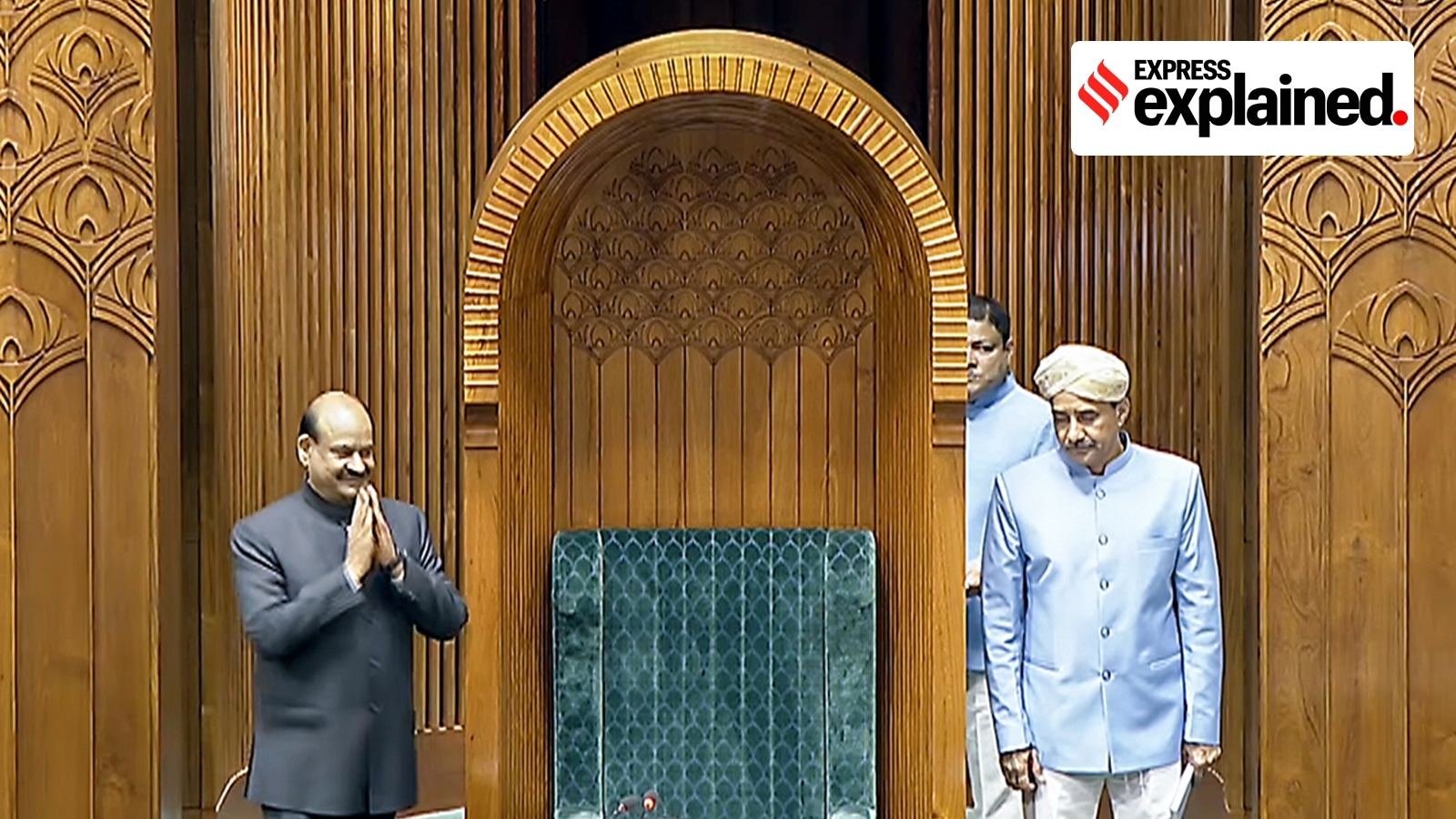
The Congress and other parties have attacked Birla for not allowing Leader of Opposition (LoP) Rahul Gandhi to quote from or speak about former Indian Army Chief General M M Naravane’s unpublished memoir, and for Birla’s claim that Prime Minister Narendra Modi could have been attacked inside the House.
Yes, the process does not apply to the Rajya Sabha or Council of States. According to practices and procedures governing the conduct of legislative business in the House, the Speaker or the Deputy Speaker can be removed from office by a resolution of Lok Sabha passed by a majority of all the then members of the House. This is procedurally possible under Article 94 (c) of the Constitution. Article 94, per se, provides for the vacation, resignation and removal of those occupying the offices of Speaker and Deputy Speaker; the rules in this regard, however, are stringent.
What are the various conditions under which a Speaker of Deputy Speaker can be removed from their respective office?
According to Article 94, a Member of the House who holds office as Speaker or Deputy Speaker of the House of the People shall vacate office if, as per 94 (a), they cease “to be a member of the House of the People”, according to 94 (b), may at any time “by writing under his hand addressed” resign office and, per 94 (c), be removed “by a resolution of the House of the People passed by a majority of all the then members of the House”.
What is the procedure for the removal of a Speaker or Deputy Speaker of the Lok Sabha?
A member wishing to give notice of a resolution for the removal of the Speaker or the Deputy Speaker has to do it in writing to the Secretary-General of the Lok Sabha. This notice may be given by two or more members jointly – but no resolution for the removal of such officials moved under clause (c) can be moved unless at least fourteen days’ notice has been given of the intention to move the resolution.
After such as notice is received, a motion for leave to move the resolution is entered in the List of Business in the name of the members concerned on a day fixed by the Speaker. This day has to be ‘any day after fourteen days from the date of the receipt of notice of the resolutions’.
Story continues below this ad
Has a motion of no-confidence been submitted against a Lok Sabha Speaker or Deputy Speaker in the past? What are the specific conditions which have to be met for the procedure to take place?
Yes, thrice in the past in the years 1954, 1966 and 1987. Such a motion requires to be backed by at least two Members of the House of the People, or the Lok Sabha and “50 members have to stand up” in its favour, that is, the quorum of the House has to be fulfilled for the procedure to take place. The process is governed by Rules 200 to 203 of the Rules of Procedure and Conduct of Business in Lok Sabha.
In 1954, Ganesh Vasudev Mavalankar, the first Speaker of the Lok Sabha, was the first presiding officer to face a no-confidence motion in December, 1954. There were two more – against Hukam Singh in November 1966 and Balram Jakhar in April 1987. None of them lost the Speaker chair because of the motion.
Are there any guidelines a motion of no-confidence requires to adhere to?
Story continues below this ad
According to Rule 200A, such a resolution needs to be “specific with respect to charges”, “be clearly and precisely expressed” and “shall not contain arguments, inferences, ironical expressions, imputations or defamatory statements.” The other points which such a motion needs to adhere to include “no speech” by the Member(s) who submitted it after it is admitted for discussion.
What happens in case such a motion is admitted?
In case such a motion is admitted, members who are in favour of it are required to rise in their places. If ‘not less than fifty’ members rise, the Speaker or the Deputy Speaker or the presiding officer is required to declare that ‘leave has been granted’ and that the resolution will be taken up on a particular day ‘not being more than ten days from the date on which leave is asked for’, as per the presiding officer.
On the appointed day that it is scheduled to be taken up, the resolution ‘shall be included in the list of business’, followed by discussion. In this case, the Member(s) who have moved the motion can be allowed to speak if the presiding officer allows; but such a speech ‘shall not exceed fifteen minutes in duration’. When underway, the discussion on the resolution ‘shall be strictly confined to the charges preferred in the resolution.’
What if less than the required number of Members rises? What are the additional conditions failing which such a motion becomes redundant?
Story continues below this ad
If fewer than 50 members rise, the presiding officer is required to inform the House that the member (who submitted the motion) has ‘not the leave of the House.’ A resolution for the removal of the Speaker or the Deputy Speaker received without due notice is not proceeded with.
What does the Speaker, in their capacity as a Member of the House, do while their removal from office is being discussed?
According to the rules, whenever the House of the Lok Sabha is dissolved, the Speaker ‘shall not vacate his office until immediately before the first meeting of the House of the People after the dissolution.’
The Speaker has the right to speak as well as to take part in the proceedings of Lok Sabha while any resolution for their removal from office is under consideration in the House. They are entitled to vote only in the first instance on such a resolution or any other matter during such proceedings but not in the case of an equality of votes.
