

Preliminary Examination: Current events of national and international importance.
Mains Examination: General Studies-II: Bilateral, regional and global groupings and agreements involving India and/or affecting India’s interests.
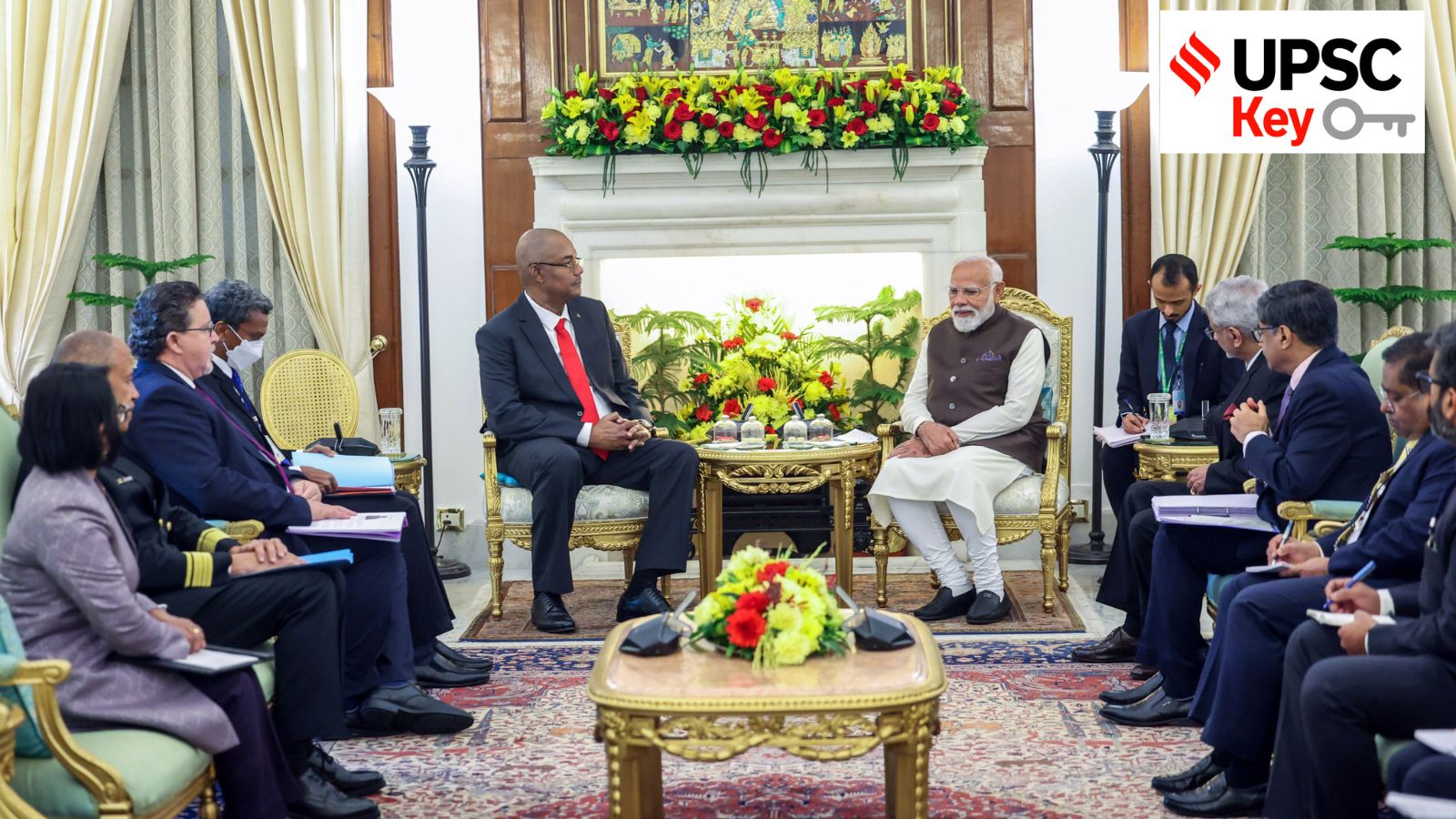
What’s the ongoing story: While stressing that defence and maritime cooperation are important pillars in the relationship between India and Seychelles, Prime Minister Narendra Modi said on Monday that in the coming days, the two countries would also cooperate in renewable energy and climate solutions. He was addressing a joint press meet in New Delhi along with visiting Seychelles President Patrick Herminie.
Key Points to Ponder:
— What is the history of India-Seychelles relations?
— What are the emerging areas of cooperation between India and Seychelles?
— What is the Colombo Security Conclave?
— What is India’s MAHASAGAR (Mutual and Holistic Advancement for Security and Growth Across Regions) Vision?
— What is the strategic significance of Seychelles for India?
— Map work: Locate Seychelles on world map.
Key Takeaways:
— “In the areas of marine research, capacity-building and data-sharing, India will share its expertise with Seychelles. Defence cooperation and maritime security are important pillars of our cooperation,” Modi said. He also welcomed Seychelles as a full member of the Colombo Security Conclave, a regional maritime security grouping formed in 2011 by India, Sri Lanka, and the Maldives – now expanded to include Mauritius and Bangladesh as well.
Story continues below this ad
— “This will strengthen our efforts for peace and stability in the Indian Ocean and deepen our ties. Together we will shape not just bilateral cooperation, but a shared future for the Indian Ocean,” said the Prime Minister.
— After extensive discussions between the two leaders on Monday morning, India and Seychelles adopted a Joint Vision for Sustainability, Economic Growth and Security through Enhanced Linkages (SESEL) and signed a series of key agreements covering health, maritime cooperation, digital transformation, capacity-building and cultural exchange.
— As part of the visit, seven MoUs were signed, including on pharmacopoeial cooperation in the health sector; technical and scientific collaboration between meteorological authorities; a cultural exchange programme for 2026-2030; cooperation on digital transformation; ocean observation, maritime scientific research and data sharing; capacity-building training programmes for Seychelles civil servants and procurement of food items.
— Modi also announced a Special Economic Package of $175 million for Seychelles, comprising $125 million in a rupee-denominated Line of Credit and the rest as grant assistance, the MEA said. The package will support Seychelles’ developmental needs in public housing, mobility, infrastructure, capacity-building and maritime security.
Story continues below this ad
— During their meeting, both leaders underscored that India-Seychelles ties are people-centric and play an important role in ensuring peace, security and stability in the Western Indian Ocean Region.
— Modi also reiterated that Seychelles is a key pillar of India’s Vision MAHASAGAR (Mutual and Holistic Advancement for Security and Growth Across Regions), while Herminie invited the PM to be the Guest of Honour for the 50th anniversary of Seychelles’ Independence. He made the announcement during the joint press meet with Modi on Monday.
Do You Know:
— India and Seychelles have an elaborate architecture of defence and security cooperation that has deepened over the years against the backdrop of the growing menace of piracy and other economic offences in the strategic Indian Ocean region. The fact that President Herminie came to India within the first 100 days of his swearing-in spells out the importance the island nation accords to India.
— The doctrine of MAHASAGAR builds on SAGAR (Security and Growth for All in the Region) and indicates a broadened scope of India’s maritime engagement. This perceptibly includes not only the immediate neighbourhood but also extends to the broader Indo-Pacific space and connects with India’s strategic collaboration with QUAD members—the United States, Japan, and Australia.
UPSC Prelims Practice Question Covering similar theme:
Story continues below this ad
(1) Consider the following statement with regard to the Colombo Security Conclave:
1. It is a regional maritime security grouping formed in 2011.
2. India, Sri Lanka and Maldives are the founding members of Colombo Security Conclave.
Which of the statements given is/are correct?
(a) 1 only
(b) 2 only
(c) Both 1 and 2
(d) Neither 1 nor 2
FRONT
From SMS to graded e-mails, Govt’s tax ‘nudge’ makes a mark
Syllabus:
Preliminary Examination: Current events of national and international importance.
Mains Examination: General Studies-II, III: Government policies and interventions, Indian Economy and issues relating to planning, mobilisation of resources, growth, development and employment.
Story continues below this ad
What’s the ongoing story: Around 60 per cent of the 1.11 crore people who responded to the Income Tax department’s NUDGE campaign to encourage better tax compliance, by revising or updating their returns, were non-filers — a clear sign that the initiative, which involved targeted e-mails, has paid off.
Key Points to Ponder:
— Read about India’s tax system.
— What is the NUDGE campaign of the Income Tax Department?
— How did the NUDGE campaign help improve tax compliance in India?
— What initiatives have been taken by the government to increase the tax base?
Story continues below this ad
— How can the use of technology strengthen voluntary tax compliance?
— What is the difference between preventive tax compliance measures and post-facto tax enforcement?
— Read about the Central Board of Direct Taxes (CBDT).
Key Takeaways:
— The I-T department is now analysing data to find out what kind of “nudging” worked best. “We send three types of emails — some softly worded, some more pointed. The team is analysing the data to see what actually helped in respect of each of these e-mails, where the language was different. The team is analysing the data to see what worked best,” Ravi Agrawal, chairman, Central Board of Direct Taxes (CBDT), told The Indian Express.
— First implemented in late 2024, NUDGE – Non-intrusive Usage of Data to Guide and Encourage — is a tech-driven campaign that uses data analytics, behavioural insights and digital messaging to improve tax compliance.
Story continues below this ad
— The key difference between NUDGE, including the NUDGE 2.0 avatar of late 2025 that focussed on foreign assets and income, and previous efforts to boost compliance is the fact that it is preventive in nature and not post-facto enforcement. The latter would require scrutinising crores of tax returns — an impossible task for the Government.
— So how does the I-T department decide who is to be “nudged”? Ideally, all taxpayers should file returns. For the financial year that ended in March 2025, around 12 crore people paid taxes but only nine crore returns were filed.
— Instead of pursuing all the three crore non-filers — some of whom may have paid a very small sum as tax — the department analysed data to pursue those falling in a so-called ‘A’ category, according to CBDT sources. These taxpayers are those whose incomes are likely more than the minimum threshold of Rs 12 lakh. They were then nudged through e-mails or SMSs, as suitable, officials said.
— Even those who do not directly receive any communication from the I-T department have ended up revising their returns after coming across media reports of the NUDGE campaign.
Story continues below this ad
— Based on the 2008 book Nudge by economist and Nobel laureate Richard Thaler and Professor Cass Sunstein of Harvard Law School, the concept is governments can nudge people to make better decisions by making minor and subtle changes in the environment in which these choices are made. In India, meanwhile, the tax nudges are set to continue.
— According to Agrawal, NUDGE has now become SAKSHAM NUDGE: S for sankalan (compilation of data), A for anusandhan (research and analytics), K for kriyanvyan (identifying whom to nudge), S for sampark (communicating to create awareness and guide behaviour), H for hastak (handholding and facilitation, such as through FAQs), A for adhikaar (allowing revision of returns to foster trust), and M for mulyankan (assessment). This, Agrawal said, is a “scientific process that will get more robust with time”.
— According to the CBDT chairman, tax compliance should be a “collaborative, non-adversarial process” where the inherent assumption is that the taxpayer will comply automatically.
Previous year UPSC Prelims Question Covering similar theme:
(2) Which one of the following effects of creation of black money in India has been the main cause of worry to the Government of India?
(a) Diversion of resources to the purchase of real estate and investment in luxury housing.
(b) Investment in unproductive activities and purchase of precious stones, jewellery, gold, etc.
(c) Large donations to political parties and growth of regionalism.
(d) Loss of revenue to the State Exchequer due to tax evasion.
On flagship skill scheme blacklist: Empty centres, claims, counter-claims, few takers
Syllabus:
Preliminary Examination: Current events of national and international importance.
Mains Examination: General Studies-II: Government policies and interventions for development in various sectors and issues arising out of their design and implementation.
What’s the ongoing story: The Government says that about 27.08 lakh candidates across 38 sectors have been trained in skills, ranging from beauty and wellness, food processing and handicrafts to aerospace and aviation, under the flagship Pradhan Mantri Kaushal Vikas Yojana (PMKVY) 4.0.
Key Points to Ponder:
— What is the objective of the PMKVY?
— What is the National Skill Development Corporation (NSDC)?
— What are the various schemes launched by the government for skill development?
— What are the challenges in the implementation of the PMKVY?
— Know about the CAG report on PMKVY
— What is the significance of skill development to harness India’s demographic dividend?
— What is the Skill India Mission?
Key Takeaways:
— But many of the classrooms and labs that once powered this initiative on the ground, skilling upto 30 job aspirants at a time, have fallen silent, dusty and desolate with no sign of life.
— The reason: they figure in the list of 178 skill training centres blacklisted by the Ministry of Skill Development and Entrepreneurship in October 2025.
— As first reported by The Indian Express on October 30 last year, the Ministry informed all state governments that these 178 Training Partners (TPs) and Training Centres (TCs) were found “non-adhering” to PMKVY norms and that “recovery of penalties” had been initiated.
— The fallout has affected not only the blacklisted centres but also several Skill Sector Councils (SSCs) — autonomous industry-led bodies set up by the National Skill Development Corporation (NSDC), which implements PMKVY.
— Summing up their experience over the past decade after PMKVY was launched in 2010, several NSDC partners said a key challenge was to ensure daily attendance of four to six hours over months. Inspectors, too, told The Indian Express that low attendance and weak capacity-building were common across centres.
Do You Know:
— The Skill India Mission today supports all flagship schemes of the government, such as PM Kaushal Vikas Yojana (PMKVY), PM Vishwakarma, PM JANMAN Yojana, Lakhpati Didi, Solar Mission, Green Hydrogen Mission and AI for India.
— Since its inception in 2015, the Mission has equipped millions of young Indians with the skills needed to thrive in a rapidly evolving job market.
— PMKVY is focused on short-term skill development training. It focuses on the rural youth and has trained over 1.49 crore candidates.
— The Skill India Digital Hub (SIDH) — a platform for all skilling requirements— has been envisaged as an information repository for all government initiatives related to skilling and entrepreneurship.
Other Important Articles Covering the same topic:
📍Skilling India — for the world
Previous year UPSC Prelims Question Covering similar theme:
(3) With reference to Pradhan Mantri Kaushal Vikas Yojana, consider the following statements: (UPSC CSE 2018)
1. It is the flagship scheme of the Ministry of Labour and Employment.
2. It among other things, will also impart training in soft skills, entrepreneurship, and financial and digital literacy.
3. It aims to align the competencies of the unregulated workforce of the country to the National Skill Qualification Framework.
Which of the statements given above is/are correct?
(a) 1 and 3 only
(b) 2 only
(c) 2 and 3 only
(d) 1, 2 and 3
Previous year UPSC Mains Question Covering similar theme:
“Demographic Dividend in India will remain only theoretical unless our manpower becomes more educated, aware, skilled and creative.” What measures have been taken by the government to enhance the capacity of our population to be more productive and employable? (UPSC CSE 2016)
NATION
India, Greece sign joint declaration of intent to strengthen defence cooperation
Syllabus:
Preliminary Examination: Current events of national and international importance.
Mains Examination: General Studies-II: Bilateral, regional and global groupings and agreements involving India and/or affecting India’s interests.
What’s the ongoing story: INDIA AND Greece on Monday signed a Joint Declaration of Intent to strengthen defence industrial cooperation between the countries, which will eventually pave the way for developing a five-year roadmap for the partnership between the two countries, the Ministry of Defence said.
Key Points to Ponder:
— What is the historical background of India and Greece relationship?
— Know about the areas of cooperation between India and Greece?
— What is the Information Fusion Center-Indian Ocean Region (IFC-IOR)?
— What is the significance of the Indian Ocean region for India?
— Map work: Locate Greece on world map
Key Takeaways:
— The agreement was signed following bilateral talks between Defence Minister Rajnath Singh and his Greece counterpart Nikolaos-Georgios Dendias at the Manekshaw Centre.
— Welcoming the announcement from the Greek side, Singh later posted on X that an International Liaison Officer from that country will be positioned at the Information Fusion Center-Indian Ocean Region (IFC-IOR), Gurugram, to enhance maritime cooperation between both seafaring nations.
— According to a statement from the Ministry of Defence, during the meeting, both ministers reiterated that the India-Greece Strategic Partnership is based on shared values of peace, stability, freedom, and mutual respect.
— The two countries decided to expand the capacity of their respective indigenous defence industries through partnership between India’s ‘Aatmanirbhar Bharat’ and Hellenic defence reforms under ‘Agenda 2030’, the statement said.
— A Bilateral Military Cooperation Plan for 2026 was also exchanged, charting the course for military engagements between the armed forces of both countries, it said. The two ministers discussed issues related to regional peace and security and acknowledged the deepening of their bilateral defence cooperation and strategic ties.
Do You Know:
— According to MEA, “Following India’s nuclear weapon test in 1998, while other European powers were calling for sanctions against India, the Greek defence Minister paid a bilateral visit in December 1998 and signed an MoU on Defence Cooperation.
— India has similarly shown consistent support to Greece on its core international interests particularly related to the Cyprus issue, and its positions on maritime issues with Turkey.”
Other Important Articles Covering the same topic:
📍India, Greece agree on deepening ties in defence, space as Modi meets Mitsotakis
📍What India needs to do in the Indian Ocean
Previous year UPSC Prelims Question Covering similar theme:
(4) With reference to ‘Indian Ocean Rim Association for Regional Cooperation (IORARC)’, consider the following statements: (UPSC CSE 2015)
1. It was established very recently in response to incidents of piracy and accidents of oil spills.
2. It is an alliance meant for maritime security only.
Which of the statements given above is/are correct?
(a) 1 only
(b) 2 only
(c) Both 1 and 2
(d) Neither 1 nor 2
EXPLAINED
PMO directive on PM CARES: What questions can Lok Sabha ask?
Syllabus:
Preliminary Examination: Current events of national importance and Polity.
Mains Examination: General Studies-II: Government policies and interventions for development in various sectors and issues arising out of their design and implementation, Functions and responsibilities of the Union and the States.
What’s the ongoing story: The Prime Minister’s Office has recently told the Lok Sabha Secretariat that questions related to PM CARES Fund, the Prime Minister’s National Relief Fund (PMNRF), and the National Defence Fund (NDF) are inadmissible in Lok Sabha.
Key Points to Ponder:
— Read about the PM CARES, PMNRF and NDF in detail.
— Why can’t Parliament question these funds?
— What was the objective of introducing the PM CARES Fund?
— Who can donate to the PM CARES Fund? What are the criticisms related to the PM CARES Fund?
— What are the different funds of the government?
— How is the PM CARES Fund different from the PMNRF?
— What is the criteria for admissible questions laid down in Rules of Procedure and Conduct of Business in Lok Sabha?
— Know about the Consolidated Fund of India, Contingency Fund of India and Public Account of India.
Key Takeaways:
— The PMO’s reasoning is that these funds are made up of voluntary public contributions and not from allocations from the Consolidated Fund of India.
— Questions are asked in the House to hold the government accountable on matters of public interest. The criteria for admissible questions is laid down in Rules of Procedure and Conduct of Business in Lok Sabha. Questions are first sent to the Lok Sabha Secretariat, which is guided by the rulebook in deciding admissibility. The final decision rests with the Speaker.
— Rule 41 says, “…a question may be asked for the purpose of obtaining information on a matter of public importance within the special cognizance of the Minister to whom it is addressed.” It then lists 23 conditions a question must meet, including that they not be about official secrets, or matters that are sub judice, etc.
— The PMO has cited Rule 41(2)(viii) and 41(2)(xvii), which state a question “shall not relate to a matter which is not primarily the concern of the Government of India”; and “it shall not raise matters that are under the control of bodies or persons not primarily responsible to the Government of India”.
— PM CARES is a public charitable trust set up to raise funds for national emergencies such as Covid-19.
— The PMNRF was established in 1948 with public contributions to assist displaced people from Pakistan. Its resources are now utilised primarily to help out families of those killed in natural calamities and to the victims of major accidents and riots.
— The NDF is used for the welfare of members of the Armed Forces and their dependents. The fund is administered by an Executive Committee, with the PM as Chairperson.
— The NDF is under the ambit of the Right to Information Act, 2005. Cases about the status of both PM CARES and PMNRF, are pending in the Delhi High Court. The next hearing in the PM CARES case is on April 1.
— What happens once a question is deemed admissible?: It is then sent to the ministry concerned, which gets 15 days to respond. “If a ministry thinks that a particular question violates any rule governing admissibility, or it deals with highly confidential matter involving national security, or the answer can affect India’s relationship with another country etc., it should politely point it out to the Secretariat and request that it may be disallowed,” PDT Achary, former Secretary General of Lok Sabha, said. The LS Secretariat publishes data about the questions received and answered, Roy said.
Do You Know:
— Article 266 of the Constitution of India contains provisions relating to the Consolidated Fund of India (CFI). It is made up of all of the Union Government’s revenues, loans, and receipts from loan recoveries. All Union Government expenditure is incurred through the CFI, and no funds can be drawn from the CFI without prior authorisation from Parliament.
Other Important Articles Covering the same topic:
UPSC Prelims Practice Question Covering similar theme:
(5) Consider the following statements with reference to the PM CARES Fund:
1. It has been registered as a Public Charitable Trust
2. It receives budgetary support from the Consolidated Fund of India.
3. Donations to the fund qualify as CSR expenditure under the Companies Act, 2013.
Which of the statements given above is/are correct?
(a) 1 only
(b) 1 and 3 only
(c) 2 and 3 only
(d) 1, 2 and 3
How US trade deal may alter India’s feed market
Syllabus:
Preliminary Examination: Current events of national and international importance.
Mains Examination: General Studies-II: Government policies and interventions for development in various sectors and issues arising out of their design and implementation; Bilateral, regional and global groupings and agreements involving India and/or affecting India’s interests.
What’s the ongoing story: In March 2025, barely two months after Donald Trump assumed office as president for his second term, the United States Department of Agriculture (USDA) released a report titled ‘The Growing Demand for Animal Products and Feed in India’.
Key Points to Ponder:
— What are the favourable conditions for the growth of maize and soybean?
— What are genetically modified (GM) crops?
— What are the concerns related to GM crops?
— Why has India not opened its market for American GM corn and soyabean?
— What are the major outcomes of the India-US deal related to agriculture?
— What are the arguments around food-feed security?
— With domestic production of maize and soybean not keeping pace with the demand growth, it would call for large-scale imports. What steps need to be taken to address this?
Key Takeaways:
— The report projected India’s domestic corn (maize) consumption to increase from an estimated 34.7 million tonnes (mt) in 2022-23 to 62.8 mt in 2040 and 93 mt in 2050 under a “moderate” GDP growth scenario of 4.6% per year. The consumption of soyabean meal would correspondingly go up from 6.2 mt to 17.7 mt and 28.3 mt for these years.
— The consumption would be even higher in a “rapid” GDP growth scenario of 6.6% per year – at 98 mt in 2040 and 200.2 mt in 2050 for maize and, likewise, 30.9 mt and 68.3 mt for soyabean meal.
— With domestic production not keeping pace with the above demand growth, it would call for large-scale imports. The USDA report projected these at 11 mt and 26 mt for maize and 6 mt and 13 mt for soyabean meal in 2040 and 2050 respectively under the “moderate” scenario.
— The significance of the report lay both in the context and timing. Maize and soyabean meal are basically feed ingredients.
— Maize, wheat, rice, sorghum and other cereal grains are sources of carbohydrates that supply the energy needs of poultry birds, livestock and aqua animals. Soyabean contains 18-22% oil.
— The residual cake after the oil is extracted is the so-called meal, which is high in protein. The protein in poultry, livestock and aqua feed comes from the meal of soyabean, rapeseed (mustard), cotton seed, groundnut and other oilseeds, as well as the bran or outer layer of rice and wheat grains removed during milling.
— Broiler chicken feed, for instance, typically contains 55-65% maize by weight, with these at 50-60% for egg-layer bird feed and 15-20% for cattle feed.
— With rising incomes, urbanisation and a population of at least 1.5 billion by 2050, India is likely to see a significant diversification of diets away from cereals and staples to foods rich in proteins and micronutrients.
— Take maize, where out of India’s total expected production of 43 mt in 2025-26, about 24 mt would go towards feed use. The accompanying table shows the supply of different raw materials/ingredients used as animal feed. For now, the bulk of this material is supplied from domestic crop production.
— The total production of compound feed (formulated using the various above-mentioned ingredients) in India is pegged at some 60 mt. That includes 40 mt of poultry, 18 mt of cattle and 2 mt of aqua/shrimp feed.
— While the organised feed industry mostly uses indigenous raw material/ingredients, it has, of late, also been seeking access to imported maize and soyabean. The major roadblock there, though, has been the fact that the maize and soyabean grown in the US (and also Brazil and Argentina) is predominantly genetically modified (GM).
— Under the bilateral trade agreement virtually sealed with the US, India has retained the ban on imports of GM maize and soyabean. At the same time, it has opened up imports of two other feed ingredients.
— The first is red sorghum. The US is the world’s largest producer and exporter of sorghum, with estimated volumes of 11 mt and 5.4 mt in 2025-26.
— The second is distiller’s dried grains with solubles or DDGS. Maize contains roughly 70% starch, 8-10% protein and 3-4% oil content and balance pericarp (husk).
— The starch is first broken down into sugar (glucose), which is fermented into alcohol using yeast and further distilled into 99.9% pure ethanol. After the ethanol is separated, what remains is the wet fermented grain mash that is dried to yield DDGS.
— Grain-based ethanol distilleries in India are already supplying over 3 mt of DDGS to the feed industry and is forecast at 4.2 mt in 2025-26. The imports from the US would add to that, notwithstanding its DDGS being derived from GM corn.
— Simply put, India has not opened up to American GM corn and soyabean or meal yet. But it has provided a small window through sorghum and DDGS.
Do You Know:
— Genetically modified organisms (GMOs) involve the modification of the genetic material of the host by the introduction of foreign genetic material. In the case of agriculture, soil bacteria is the best mining source for such genes, which are then inserted into the host genome using genetic engineering.
— Notably, GMOs is a broader term that includes GM crops as a subset. GM crops are plants used in agriculture whose DNA has been altered to add desired properties. They are usually developed to increase yield, resist pests/herbicides, and withstand extreme weather conditions.
— Only one GM crop, Bt cotton, is approved for cultivation. No GM food crop is commercially grown, although experimental trials continue.
Other Important Articles Covering the same topic:
📍What India has really given on agriculture in India-US trade deal
Previous year UPSC Prelims Question Covering similar theme:
(6) Bollgard I and Bollgard II technologies are mentioned in the context of (UPSC CSE 2021)
(a) clonal propagation of crop plants
(b) developing genetically modified crop plants
(c) production of plant growth substances
(d) production of biofertilizers
Previous year UPSC Mains Question Covering similar theme:
How can biotechnology help to improve the living standards of farmers? (UPSC CSE 2019)
THE EDITORIAL PAGE
Trade framework gives India room to navigate but tilts ground in US favour
Syllabus:
Preliminary Examination: Current events of national and international importance.
Mains Examination: General Studies-II: Bilateral, regional and global groupings and agreements involving India and/or affecting India’s interests.
What’s the ongoing story: Pratap Bhanu Mehta writes: The line between pragmatism, giving in to the art of the possible, and abdication, abandoning judgement, accountability, or principle, is very thin. The Indo-US framework agreement on trade is a case in point.
Key Points to Ponder:
— What is the significance of the India-US trade deal?
— What are the major trade agreements signed by India in recent times?
— Economics and security are no longer distinct domains but interlocking theatres of competition and cooperation. Elaborate.
— Understand the evolution of India’s foreign policy
— What are the challenges facing India in the current geopolitical challenges?
— Why is India signing so many Free Trade Agreements?
Key Takeaways:
— But two framings undergird its defence. The first is the triumphalist America lobby, which believes that India’s future is hitched to the United States.
— The second is the economic pragmatists. The agreement is better than the status quo. It removes Russia-related punitive tariffs. It gives India renewed access to the US market, potentially restoring competitiveness for Indian exports.
— As a bonus, it might even induce reforms, shaking up entrenched positions on GMOs and non-food agriculture. How all this plays out is anyone’s guess.
— But even if we acknowledge that the agreement has some pragmatic economic potential, it does not pass the smell test. For starters, this is not a reciprocal free-trade agreement.
— Even on its own terms, the agreement reflects this asymmetry. The new tariff regime is worse for India than what existed before Trump came to power.
— In a manner reminiscent of 19th-century imperial trade, the tariff structure favours the United States: India cuts tariffs to zero, while the US imposes rates as high as 18 per cent. More astonishing still, India has committed to purchasing $500 billion worth of American goods over five years. Which free-trade agreement contains a one-way obligation by one party to massively purchase goods from the other?
— This commitment can also distort India’s policy choices. Purchase targets of this magnitude risk reshaping industrial strategy and building resilience by fiat rather than design.
— India’s position on the Ukraine war was a classic case of evasion. But being compelled under duress to do what one might have chosen on principle, namely, to stop purchases of Russian oil, is something else altogether.
— Does anyone remember when our government proudly declared that no power would be allowed to define India’s relations with third countries? That claim now rings hollow. We routinely allow it to happen.
— The United States does not see India as a strategic partner in the arenas that matter most to India’s security, its immediate neighbourhood. On Pakistan, Washington has repeatedly subordinated Indian concerns to short-term American objectives, and will continue to do so.
— Historically, the United States has frequently had an interest in managing, rather than resolving, regional conflict, keeping them below the threshold of explosion while retaining leverage over all parties.
— Even on China, the supposed cornerstone of Indo-US convergence, the jury remains out. The United States’ primary objective is not to secure India’s rise, but to manage China’s power on terms favourable to itself.
— American agreements are no longer anchored in stable institutional commitments. The framework agreement reflects this reality. Formally, it gives both sides room to renegotiate. Substantively, however, it embeds asymmetries that favour American leverage.
— Acknowledging power asymmetry is realism. To internalise it so completely that one relinquishes independent judgement is something else. We might want to, in the name of pragmatism, give in; we could even make the best of this deal in a way that the consequences are not bad. But this is not a triumph.
From the Ideas Page: Neither surrender nor triumph, trade pacts mark India’s growth as negotiator
— Nirupama Rao writes: India’s TRADE pacts with the US and EU have triggered predictable commentary. Some see concessions under pressure, particularly on the question of Russian oil imports. Others view the deals as a pragmatic recalibration in a world where economic statecraft increasingly shapes geopolitical outcomes.
— The truth, as often in diplomacy, lies not in rhetorical extremes but in the evolving realities of power, markets and interdependence.
— The rollback of the additional US tariff on Indian exports — initially imposed in response to continued purchases of discounted Russian crude — is best understood as part of a wider geoeconomic negotiation.
— This shift is not unique to India. Supply chains, technology flows, financial access and energy sourcing now sit alongside traditional diplomacy as tools of influence. India’s experience reflects a broader structural change in international relations: Economics and security are no longer distinct domains but interlocking theatres of competition and cooperation.
— For India, this moment inevitably raises the familiar question of strategic autonomy. Historically, India’s foreign policy sought to maximise freedom of manoeuvre through diversified partnerships, rather than formal alliances.
— The debate over Russian oil imports illustrates this pragmatic tradition. Discounted crude provided short-term economic advantages for India, helping manage inflation and fiscal pressures. But longer-term considerations — access to Western markets, capital flows, advanced technologies, and defence collaboration — inevitably factor into policy choices.
— Critics sometimes interpret these adjustments as evidence of diminished autonomy. Yet autonomy is less about distance from power centres than about capability within them. Economic strength, technological depth, resilient supply chains and diversified partnerships generate real strategic choice. Isolation rarely does.
— India’s growing weight is evident in the fact that tariffs imposed by the US were reversed. Washington chose negotiation rather than prolonged economic confrontation. Reciprocity — the US seeking India as a strategic partner even as India values access to Western markets and technology — defines the relationship.
— India’s parallel engagement with the EU reinforces the importance of diversification. The trade agreement deepens access to high-value manufacturing markets and advanced technologies. Taken together, strengthened ties with both the US and the EU enhance India’s negotiating space.
— As the multilateral trading system weakens and the WTO struggles to function effectively, bilateral and plurilateral arrangements are likely to dominate. India’s active participation in this evolving architecture reflects adaptation rather than acquiescence.
— The post-Cold War era of relatively frictionless globalisation is giving way to what might be called geoeconomic competition. Technology ecosystems, energy corridors, access to critical minerals, semiconductor supply chains and digital infrastructure have become arenas of contestation.
— The domestic dimension is equally significant. Trade agreements affect employment, industrial competitiveness, energy costs and technological development. A transparent public conversation about these trade-offs is essential.
— The recent trade pacts, therefore, mark neither surrender nor triumph. They represent the continuing evolution of India’s engagement with a complex international system where economic and strategic interests intersect more closely than before.
— India’s task is to navigate this environment with pragmatism: Expanding economic capability, diversifying partnerships, preserving decision-making flexibility, and avoiding binary alignments wherever possible.
— These understandings thus underline a larger reality: Trade has become geopolitics by other means. Strategic autonomy today rests less on distance and more on capability; diversification of partners strengthens leverage; interdependence inevitably brings both opportunity and conditionality; and economic strength remains the true currency of sovereign choice.
— For India, this means that sustained opening up, regulatory reform, competitiveness in manufacturing, technology depth and energy resilience will matter far more than any single trade negotiation.
Other Important Articles Covering the same topic:
📍Why is India signing so many FTAs? It’s not economics, stupid
📍Signing of FTAs is a start. Their success will be judged by gains in global market
Previous year UPSC Mains Question Covering similar theme:
How would the recent phenomena of protectionism and currency manipulations in world trade affect macroeconomic stability of India? (UPSC CSE 2018)
ECONOMY
25 transmission projects face delays due to land acquisition; 24 RE-focused
Syllabus:
Preliminary Examination: Current events of national importance.
Mains Examination: General Studies-II, III: Government policies and interventions, Infrastructure, Energy.
What’s the ongoing story: Twenty-five out of at least 164 under-construction transmission line projects under the Inter State Transmission System (ISTS) have been facing land acquisition and clearances-related hurdles, leading to delays. Out of these, 24 projects are related to evacuation of renewable energy.
Key Points to Ponder:
— What is Right of Way (RoW)?
— What is the significance of RoW?
— What is Inter State Transmission System and how does it work?
— How has RoW become a major challenge in expanding transmission networks?
— What is the Green Energy Corridor (GEC) programme?
— What are the initiatives related to green energy taken by the government?
Key Takeaways:
— “Delays due to Right of Way issues have affected project timelines,” Ministry of Power told the Parliament while sharing data of ISTS projects with Scheduled Commissioning Date (SCOD) upto March 2026, which are facing RoW issues or clearances.
— RoW refers to the strip of land beneath and adjacent to a transmission line that utilities require to construct, maintain and safeguard the infrastructure.
— Known as the transmission corridor, it is the minimum safety zone around power lines to meet the requisite safety clearances as well as the electromagnetic field exposure limits.
— It allows the utility to keep the power lines clear of tall trees, buildings and other obstacles that may interfere with line operation and to ensure safety of the public and environment.
— However, RoW has emerged as a major bottleneck in expanding transmission networks needed to evacuate power from generating stations.
— The challenge is more acute for renewable energy as capacity addition accelerates in line with India’s target of achieving net-zero emissions by 2070.
— Renewable energy capacity additions reached 44.51 GW during this financial year till November which is nearly double as compared to the 24.72 GW during the same period last year.
— In December, the Parliamentary Standing Committee on Energy also flagged RoW issues as a key hurdle in laying transmission lines under the government’s Green Energy Corridor (GEC) programme.
— In January, Santosh Kumar Sarangi, Secretary at the Ministry of New and Renewable Energy (MNRE), told The Indian Express that renewable energy curtailment is largely driven by a mismatch between the pace of project commissioning and the time required to build transmission infrastructure.
— The ministry also said that building ISTS networks from renewable-rich states such as Gujarat, Rajasthan, Karnataka and Tamil Nadu faces hurdles, which includes land acquisition and RoW issues, resulting in significant delays in transmission infrastructure creation.
Other Important Articles Covering the same topic:
📍Energy transition will need more than chasing the sun and harnessing the wind
|
ALSO IN NEWS |
|
| To strengthen tsunami monitoring, Andaman and Nicobar to get regional service centre | India is working towards setting up a Regional Service Centre (RSC) in the Andaman and Nicobar islands, aiming to strengthen its existing tsunami monitoring and warning system.Globally, 80% of tsunamis are triggered by undersea earthquakes and the remaining occur following non-seismic causes like landslides, submarine volcanic activity and mudslides. As a first step towards upgrading the existing system, India plans to implement a Rs 300-crore project in the Andaman and Nicobar islands. INCOIS has proposed to establish the RSC — the first-of-its-kind in India in terms of a tsunami-related coordination centre — at Vijaynagar along the Swaraj Dweep in the Andaman and Nicobar. |
| Developed nations must bridge $6.5 trillion gap in India’s net-zero push: NITI Aayog | India can achieve its net-zero emissions target by 2070 while remaining on track to become a developed economy by 2047, but doing so will require an additional $6.5 trillion in investment from developed nations over current policy pathways, Niti Aayog said in a report on Monday. The report, titled Scenarios Towards Viksit Bharat and Net Zero, said achieving net zero demands unprecedented capital mobilisation, rapid deployment of clean energy, and sustained policy reforms across sectors. |
| Tamil’s tryst with Malaysia: When culture and commerce travelled over time | When Prime Minister Narendra Modi landed in Malaysia for his first foreign visit of 2026, the language he chose to emphasise was not Hindi or English, but Tamil.“India and Malaysia are also united by a shared love for the Tamil language. For most diplomatic speeches, such a line might pass as a gesture to the diaspora. In Malaysia’s case, it was something else: a simple statement of fact. Tamil is not merely a migrant language here. It is a public language: heard in schools, temples, television, newspapers, and cinema halls. It is older than the Malaysian nation-state itself, older even than colonial rule. It arrived not by policy but by tide. And that long history – trade, labour, settlement, survival – helps explain why nearly three million people of Indian origin, overwhelmingly Tamil, form one of Southeast Asia’s most visible and rooted diasporas. |
| Report card for the officer is a good idea | Since Independence, India has faced a challenge with respect to the bureaucracy. The civil services, designed for the needs of an extractive and imperious colonial power, needed to be transformed to a “steel frame” that serves the needs of a young democracy. Civil service reforms began with the Constitution, continued with the first Administrative Reforms Commission (1966), focused on reforming training and promotions with the second ARC (2009) and the Right to Information Act. The “administrative scorecards” sent by the Cabinet Secretariat to secretaries in the central government must be viewed through this prism of making the civil services more efficient and responsive. As this newspaper reported, the scorecards assess officers and their departments out of 100, with a special emphasis on “file disposal”, “Output/Activities” and “expenditure on schemes/ capital expenditure”. |
| PRELIMS ANSWER KEY |
| 1. (c) 2. (d) 3. (c) 4. (d) 5. (b) 6. (b) |
Subscribe to ourUPSC newsletter.Stay updated with the latest UPSC articles by joining our Telegram channel – Indian ExpressUPSC Hub, and follow us onInstagramand X.
🚨Click Hereto read the UPSC Essentials magazine forJanuary 2026.Share your views and suggestions in the comment box or at manas.srivastava@indianexpress.com🚨
