

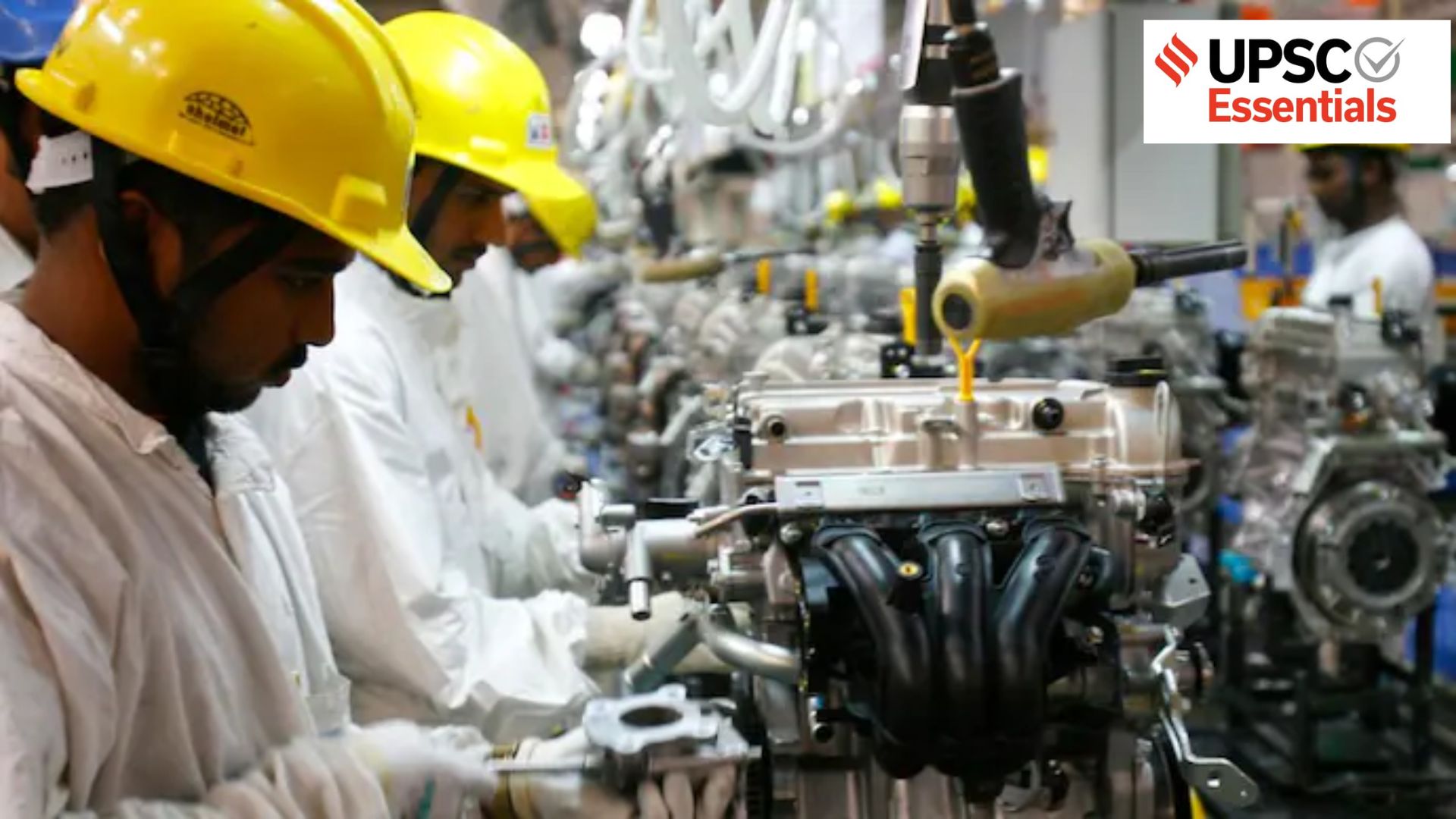
But analysts note that the budget largely signals policy continuity rather than a shift in manufacturing strategy. As a result, the long-standing gap between growth and employment generation persists. Therefore, the key question is whether policy efforts, especially those reflected in the budget, are sufficient to narrow this gap. Let’s explore.
It’s been more than three decades since the 1991 liberalisation, and manufacturing remains India’s unfinished task. Its share in Gross Domestic Product (GDP) has stayed stuck between 14 to 17 per cent for years. This is not a short-term slowdown. It has persisted through different governments, business cycles, and repeated industrial pushes. Countries that successfully industrialised saw manufacturing rise to 25-30 per cent of GDP before stabilising. India has never crossed that threshold.
This matters because manufacturing was expected to play at least two major roles: raise productivity and absorb surplus labour. It has done neither at scale. The output has grown in phases, but employment generation have not kept pace. The organised manufacturing sector employs less than two crore workers, while most of the manufacturing jobs remain largely small, informal, and insecure.
The pattern is familiar. Manufacturing has grown, but the economy has not shifted. Jobs have been created, but not enough to absorb workers leaving farms and informal services. Productivity has improved in pockets, but wages and job quality continue to lag. The gap between growth and employment lies at the heart of India’s manufacturing problem.
PLI Schemes Performance
Investment
₹2L Cr
Actual investment
Production
₹18L Cr
Incremental output
Total jobs created (direct + indirect)
MSME Credit Push
Manufacturing output share
Focus: Liquidity not capabilityMissing: Technology adoption, skill formation, supply chain links
Infrastructure Push
Better roads ≠ Automatic job creation
Low-Skill, Low-Wage Trap
Uneven productivity gains insufficient to support higher wages, reinforcing manufacturing stagnation
Indian Express InfoGenIE
Employment and limits of absorption
In 2023-24, organised manufacturing employed about 1.96 crore workers, according to the Annual Survey of Industries. Over the last decade, it added around 57 lakh jobs, reflecting steady but modest growth.
Story continues below this ad
However, the unorganised manufacturing employs a larger workforce. The Annual Survey of Unincorporated Sector Enterprises estimates employment at 3.48 crore workers in 2023-24. Taken together, total manufacturing employment stands at about 5.44 crore workers.
The structure of this employment explains the problem. Only about one-third of manufacturing workers are employed in organised factories. The rest remain in low-productivity, informal units. This is why manufacturing growth has not translated into broad-based employment.
Even in organised manufacturing, output has grown faster than employment. Firms have expanded production through capital deepening and automation rather than large-scale hiring. As a result, manufacturing has fallen short of playing its expected role of absorbing surplus labour moving out of agriculture and informal services.
Why manufacturing has lagged
Moreover, manufacturing in India has lagged because growth has not led to structural changes. For over three decades, its share in GDP has remained broadly unchanged. This reflects a failure of industrialisation, not a lack of policy effort.
Story continues below this ad
One important reason remains the structural cost of the economy. Rising wages in the public sector and organised services haveraised wage expectations without a parallel increase in manufacturing productivity. Manufacturing firms, operating at a relatively low-level of productivity, have struggled to compete in the labour market and remain cost-competitive. This has constrained their ability to expand productivity and create jobs in manufacturing, which in turn reinforced structural stagnation.
But the pressure of cost alone cannot explain the stagnation in this sector. In other industrialising economies, rising wages incentivised firms to invest in technology and skill upgradation. In India, the response remains limited. Still, firms have continued to rely on the old structure of manufacturing without adequate upgradation, resulting in uneven gains from the production that are insufficient to support higher wage rates. The outcome has been a low-skill and low-wage equilibrium.
Private sector growth has reinforced this pattern. Expansion has shifted towards services and platform-based work, which utilise labour withoutconsiderablyraising productivity. Whereas manufacturing firms that have invested in technology have often done so through labour-replacing automation rather than labour-augmenting upgrades, especially in the absence of adequate skills. The productivity output has grown, job elasticity has declined
The result is a divided manufacturing sector. Organised factories are relatively productive but create few jobs. Whereas, unorganised units absorb large numbers of workers but remain trapped in low productivity. This divide has constrained manufacturing’s role in raising wages, creating jobs, and driving broad-based growth.
Story continues below this ad
A comparison with East Asian economies
A comparison with East Asian economies will help illustrate this. For instance, South Korea followed a different path: as manufacturing expanded, firms trained workers on the shop floor. Skills were built inside factories, closely tied to production processes, and upgraded as technology evolved. The state supported this by sharing training costs and setting standards, but training remained the responsibility of firms as per their requirement.
Rising wages did not hurt manufacturing. Instead, it pushed firms to invest in skills and technology. Further, automation worked with labour, not against it. As a result, productivity rose alongside wages, and manufacturing continued to create jobs even as output grew.
India’s experience has been different. Firms relied on abundant labour and invested little in training. Skill development was largely pushed into fragmented public programmes with weak links to industry needs. The result was growth, but without deep industrialisation.
Skills and employability constraints
As a result, India’s growth has been lopsided, marked by rising inequality and weak employment quality rooted in structural constraints. The most important is the skills mismatch. The Economic Survey 2025-26 notes that firms struggle to find job-ready workers despite the abundance of labour. The problem is not numbers, but preparedness.
Story continues below this ad
Further, formal skill training remains limited. Firm-level training and apprenticeships are weak, especially among micro, small, and medium enterprises (MSMEs). Most workers enter factories without the skills required for sustained employment and upward mobility.
The labour-intensive segments also suffer from low technological depth. Firms rely on cheap labour rather than investing in technology and skills together. This keeps productivity and wages low, visible in the MSME sector. While MSMEs employ a large share of the workforce, weak linkages with training systems and supply chains prevent small firms from scaling up and creating stable jobs.
Budget 2026 and the manufacturing push
The Union Budget 2026 largely continues the existing manufacturing strategy, with the Production Linked Incentive (PLI) schemes remaining the central instrument. Across 14 sectors, PLIs have attracted around 2 lakh crore in actual investment and generated incremental production of over 18 lakh crore.
These outcomes matter. Electronics production more than doubled between FY2021 and FY2025, and India has emerged as a major mobile phone manufacturing base. In pharmaceuticals and auto components, domestic value addition has improved and import dependence has reduced.
Story continues below this ad
The employment impact, however, remains limited. Total direct and indirect jobs created under the PLI schemes are estimated at about 12.6 lakh. This is small relative to the scale of investment and the size of India’s labour force. The reason lies in design. PLIs prioritise scale, efficiency, and capital intensity. As a result, output rises faster than employment.
Budget 2026 appears to reinforce this approach. Allocations remain concentrated in large, technology-intensive sectors. These sectors are important for competitiveness and exports, but they are not labour-intensive. Manufacturing output expands, but job creation remains modest.
Support for MSMEs is extended primarily through finance. MSMEs account for about 35 per cent of manufacturing output and approximately half of merchandise exports. The budget expands credit guarantees, raises lending limits, and proposes new funds to address equity gaps.
This improves liquidity, but it does not address the manufacturing sector’s core constraints. Most MSMEs remain small and low productivity. Without stronger linkages to technology adoption, skill formation and integrated supply chains, easier credit helps firms survive rather than scale. And as a result, employment outcomes remain weak.
Story continues below this ad
Infrastructure, finance, and the fiscal stance
Infrastructure remains a key enabler of manufacturing growth. Budget 2026 sustains the public investment push through PM Gati Shakti and related programmes. Effective capital expenditure for 2026-27 is budgeted at 15.4 lakh crore, up from 13.2 lakh crore in the previous year.
This investment has improved logistics, reduced costs, and supported capital goods production. But infrastructure support is a necessary condition, not a sufficient driver, of manufacturing-led employment generation. Better roads and ports do not automatically create factories or jobs. Manufacturing investment remains concentrated in a few sectors and regions, reflecting deeper constraints related to skills, demand, and firm capability.
On the fiscal side, the deficit target for 2026-27 is set at about 4.3 per cent of GDP, while gross market borrowing remains high at over 15.6 lakh crore. This supports macro stability and investor confidence, but it limits the space for large, employment-focused interventions.
What budget leaves unaddressed
Budget 2026 signals policy continuity rather than a shift in manufacturing strategy. The core instruments largely remain unchanged. PLI schemes continue to prioritise scale and output. The credit support to MSMEs focuses on liquidity rather than capability building. Infrastructure investment remains the main enabler, not a direct lever for employment.
Story continues below this ad
These choices support stability and investor confidence, improve logistics, reduce costs, and sustain output growth. But they do not address the core constraints that limit manufacturing’s role as a large-scale employer. Employment absorption remains weak and skills mismatches persist. Firm-level training and technology diffusion receive limited attention.
The Budget assumes that growth will eventually deliver jobs. India’s experience suggests otherwise. Without a stronger link between incentives, skills, and employment, manufacturing will continue to grow without absorbing surplus labour at scale. That is why Budget 2026 reflects continuity, not a course correction, in India’s manufacturing strategy.
Post read questions
Despite three decades of economic reforms, the manufacturing sector in India has not emerged as a large-scale employer. Critically examine structural reasons behind this.
Why has India failed to raise manufacturing’s share in GDP beyond 17 per cent? Discuss the implications of this stagnation for employment and income growth.
MSMEs are central to India’s manufacturing employment but remain trapped in low productivity. Examine the constraints faced by MSMEs and suggest measures to enable their scaling up. Is credit expansion alone insufficient to address the challenges faced by it?
Infrastructure is a necessary but not sufficient condition for manufacturing-led growth. Discuss in the context of India’s public investment-led growth strategy.
Examine the role of skill development and firm-level training in successful industrialisation. Why has India struggled in this area? Evaluate the effectiveness of the Production Linked Incentive (PLI) schemes in strengthening India’s manufacturing sector.
(Pushpendra Singh is an Assistant Professor of Economics at Somaiya Vidyavihar University, Mumbai, and Archana Singh is an Assistant Professor of Gender and Economics at the International Institute for Population Sciences, Mumbai.)
Share your thoughts and ideas on UPSC Special articles withashiya.parveen@indianexpress.com.
Click Hereto read the UPSC Essentials magazine forJanuary 2026.Subscribeto ourUPSC newsletterand stay updated with the news cues from the past week.
Stay updatedwith the latestUPSC articlesby joining ourTelegram channel–IndianExpressUPSC Hub, and follow us onInstagramandX.
