

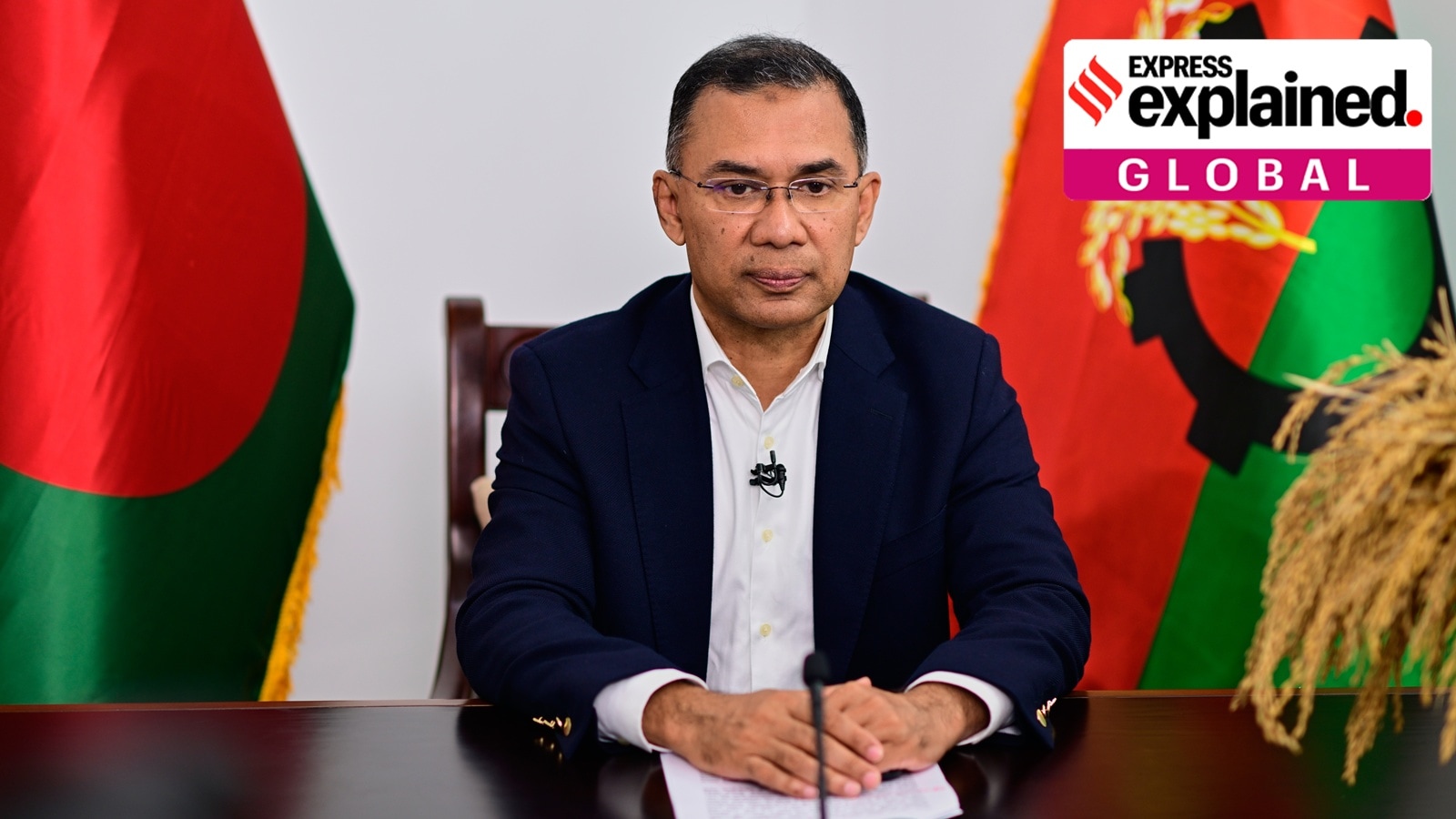
Prime Minister Narendra Modi became the first leader to call and greet BNP chief Tarique Rahman Friday after it became clear that his centre-right party had secured a landslide two-thirds majority in elections to the Bangladesh parliament, one of the most watched elections in South Asia in recent years.
Modi’s outreach assumes significance given the acrimony and strain in ties between Delhi and Dhaka after the dramatic August 2024 ouster of Prime Minister Sheikh Hasina, one of India’s closest partners in the neighbourhood. Her presence in India will frame a diplomatic challenge for two countries, apart from irritants that include water-sharing, border, connectivity and illegals.

Modi dialled Rahman even before the official results were announced by the Election Commission of Bangladesh.
The first post by Modi came at 9.32 am Bangladesh time (9.02 am IST). In posts in English and Bangla, he said, “I convey my warm congratulations to Mr Tarique Rahman on leading BNP to a decisive victory in the Parliamentary elections in Bangladesh.” The fact that he called it a “decisive” victory showed acknowledgement of the mandate of the people of Bangladesh.
India had called for “inclusive elections”, apart from it being “free, fair and credible” – essentially meaning that the Awami League should be allowed to participate in the elections. But the Hasina-led party Awami League was banned from contesting the elections.
“This victory shows the trust of the people of Bangladesh in your leadership,” Modi said, again an endorsement of Rahman’s “leadership” trusted by a large section of the population – the voting percentage was 60 per cent, despite boycott calls by Hasina.
Modi said “India will continue to stand in support of a democratic, progressive and inclusive Bangladesh.” This is an important framing since India has called for the security of Hindu minorities. This one issue contributed to strain in Delhi’s relations with the Mohammad Yunus-led interim government in Dhaka. At that time, Modi had directly mentioned Hindu minorities, but on Friday he just made an oblique reference with the words “progressive and inclusive”.
Story continues below this ad
“I look forward to working with you to strengthen our multifaceted relations and advance our common development goals,” he said, tagging the X handles of Rahman and BNP.
Delighted to speak with Mr. Tarique Rahman. I congratulated him on the remarkable victory in the Bangladesh elections.
I conveyed my best wishes and support in his endeavour to fulfil the aspirations of the people of Bangladesh.
As two close neighbours with deep-rooted…
— Narendra Modi (@narendramodi) February 13, 2026
Later, at 4.01 pm, in another post on X, he said, “Delighted to speak with Mr. Tarique Rahman. I congratulated him on the remarkable victory in the Bangladesh elections. I conveyed my best wishes and support in his endeavour to fulfil the aspirations of the people of Bangladesh. As two close neighbours with deep-rooted historical and cultural ties, I reaffirmed India’s continued commitment to the peace, progress, and prosperity of both our peoples.”
Speaking to The Indian Express, Mahdi Amin, BNP leader and advisor to Rahman, called the messages by Modi a “gracious gesture”.
But the mending of ties is not going to be easy. On Friday, senior BNP leaders called for the extradition of Hasina from India.
BNP’s international relations advisor Humayun Kabir called Hasina a “terrorist”, and said she should be extradited.
Story continues below this ad
The presence of Hasina and senior leaders and activists of the Awami League in India will pose a challenge. She is considered a fugitive under law by the Bangladesh government and the political parties here.
Any softening by the BNP on this issue will become a potentially hot-button political issue, and will draw criticism from the Opposition, especially Jamaat-e-Islami, and the National Citizen Party led by student leaders who toppled the Hasina government in August 2024.
The ousted Prime Minister’s statements addressed to party workers in Bangladesh are viewed in Dhaka as provocative, and there is a demand from the BNP to put a check on her statements.
Apart from the extradition of Hasina, the issues of water-sharing on Ganga and Teesta, border killings, the Adani power project and connectivity and transit through Bangladesh are some of the thorny issues between India and Bangladesh.
Story continues below this ad
For Rahman, the emergence of Jamaat will be a challenge if it poses a threat to India, and Delhi will be looking at how he manages to put a lid on anti-India activities from Bangladesh. When the BNP-Jamaat combine was in power in 2001-2006, India had to bear the brunt of terrorism from Bangladesh soil, and it sowed distrust.
This election, the BNP’s poll manifesto stated “Bangladesh will not interfere in other states’ internal matters and will not allow interference in its own matters”. It was read as an euphemism for no anti-India activities in Bangladesh.
While BNP doesn’t need Jamaat for power sharing, the Islamist party is much stronger in parliament and could prove to be an important challenger to Rahman’s authority and governance. Delhi will watch out for that as well.
India’s biggest apprehension is that Bangladesh could go back to the 2001-2006 days. It now expects Rahman to demonstrate good faith and actions.
Story continues below this ad
India had reached out to Rahman after his mother and former PM Khaleda Zia’s death in December 2025. External Affairs Minister S Jaishankar had travelled to Dhaka to convey condolences. Defence Minister Rajnath Singh had gone to the Bangladesh High Commission in New Delhi to pay tribute to the former PM.
Rashed Al Mahmud Titumir, a Professor of Economics at the Department of Development Studies in the University of Dhaka, said, “The Indian government sending Jaishankar for Begum Zia’s funeral was seen as a good gesture.”
Rahman also did not make any anti-India statement during his poll campaign. For that matter, neither did the top leaders of the BNP, This set a positive tone for revival of bilateral ties.
The BNP manifesto did say “‘Friend Yes, Master No’ – Establishing Relations with Other States Based on Equality and Self-Dignity.” This was an oblique reference to India, widely perceived to have a dominant influence over Bangladesh and considered a “big brother”.
Story continues below this ad
Both BNP and Jamaat did not mention Pakistan in their manifesto document, but have spoken about building ties with the “Muslim world”.
While the BNP said “Building a ‘Strategic Partnership’ with the Muslim World” is one of its commitments, Jamaat said, “The strengthening of relations with countries of the Muslim world shall be a key foreign policy priority.”
India will watch how the new BNP government develops ties with Pakistan, China and Turkey.
