

Women on Death Row: Of the 571 people on death row in India, 21 are women, with their cases spanning from terrorism to familial violence and from honour killings to other heinous crimes. While four of them have remained on death row for over a decade, nearly all await the conclusion of their cases.
These women come from different states, different circumstances, and different moments in time. While the oldest case dates back to the 2003 blasts near Mumbai’s Gateway of India and Zaveri Bazaar when Fehmida Sayyed was arrested, the most recent capital punishments were handed down just last year, in 2025.
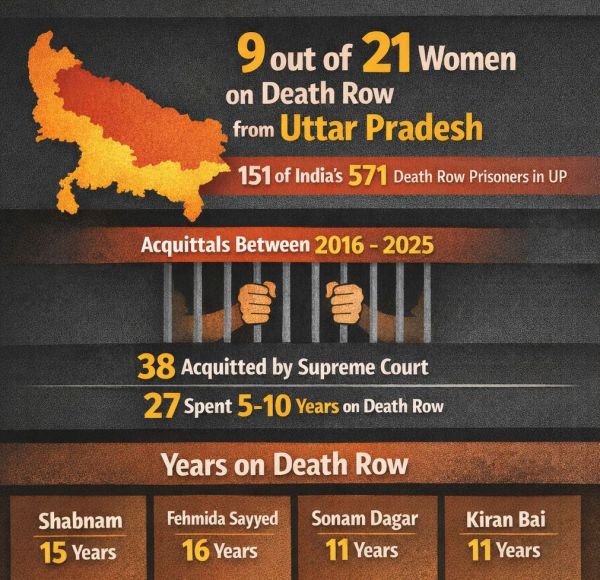
Shabnam, convicted in 2010, has now been on death row for 15 years. Fehmida, sentenced in 2009, has waited 16 years. Sonam Dagar and Kiran Bai have been under the death sentence for 11 years.
In one case from Uttar Pradesh, the convict Shabnam has exhausted nearly every legal remedy, her mercy petitions already rejected.
Nine out of the total women are from Uttar Pradesh alone, nearly half the total. This concentration is not coincidental.
According to the National Academy of Legal Studies and Research (NALSAR) University’s Square Circle Clinic’s report, the state accounts for 151 of the total 571 death row prisoners, which is more than a quarter of the national total.
The rest of the women convicts are scattered across Kerala, Haryana, Maharashtra, Karnataka, Punjab, Bihar, Madhya Pradesh, and Chhattisgarh.
Story continues below this ad
The information provided by the criminal advocacy group Square Circle Clinic is of a population that exists largely in the shadows of public consciousness.
1. Fehmida Mohd Hanif Sayyed
State: Maharashtra
Year of offence: 2003
Year of sentencing: 2009
Nature of offence: Terror-related bomb blasts
Sections convicted under: Indian Penal Code (IPC) sections 302 (murder), 307 (attempt to murder), 427 (mischief); Section 3(2)(a) (terrorist act resulting in death), Prevention of Terrorism Act; sections 3 (damage to public property) and 4 (damage to public property by fire or explosive), Prevention of Damage to Public Property Act, 1984; Section 5 (power to make rules as to licensing of the manufacture, possession, use, sale, transport and importation of explosive), read with Section 9-B, Explosives Act; and Section 3 (causing explosion), Explosive Substances Act
High Court confirmation: Confirmed by Bombay High Court (2012)
Current status: Appeal pending before Supreme Court
Case snapshot: Fehmida Sayyed was convicted for her role in the 2003 serial bomb blasts near Mumbai’s Gateway of India and Zaveri Bazaar. The Bombay High Court confirmed the death sentence, making her one of the few women whose capital punishment has crossed the confirmation stage. The matter is now pending final adjudication before the Supreme Court.
2. Shabnam
State: Uttar Pradesh
Year of offence: 2008
Year of sentencing: 2010
Nature of offence: Murder of seven family members
Sections convicted under: IPC sections 302 (murder), 34 (common intention)
High Court confirmation: Confirmed by Allahabad High Court (2013)
Current status: Death sentence upheld by Supreme Court; review dismissed
Story continues below this ad
Case snapshot: Shabnam was convicted for the murder of seven members of her family, including her parents, with the help of her partner. The Supreme Court upheld the death sentence and dismissed her review petition. Her mercy petition has also been rejected, placing her among the rare cases where a woman’s death sentence has attained near finality.
3. Sonam Dagar
State: Haryana
Year of offence: 2009
Year of sentencing: 2014
Nature of offence: Multiple murders of family members
Sections convicted under: IPC sections 302 (murder), 34 (common intention)
High Court confirmation: Confirmed by Punjab and Haryana High Court (2018)
Current status: Death sentence stayed by Supreme Court
Case snapshot: Sonam Dagar was sentenced to death for the murder of several family members along with her partner. While the High Court confirmed the sentence, the Supreme Court subsequently stayed the execution in 2018.
4. Kiran Bai
State: Chhattisgarh
Year of offence: 2010
Year of sentencing: 2014
Nature of offence: Kidnapping and murder of a child
Sections convicted under: IPC sections 302 (murder), 34 (common intention), 120B (criminal conspiracy)
High Court confirmation: Confirmed by Chhattisgarh High Court (2016)
Story continues below this ad
Current status: Death sentence upheld by Supreme Court; mercy plea pending before Governor
Case snapshot: Kiran Bai was convicted for the kidnapping and murder of a two-year-old child, allegedly as part of a ritual sacrifice. After the High Court confirmed the death sentence, the Supreme Court dismissed her appeal. Her mercy petition is presently pending.
5. Geeta Devi
State: Uttar Pradesh
Year of offence: 2010
Year of sentencing: 2021
Nature of offence: Murder of daughter-in-law and granddaughter
Sections convicted under: IPC Section 302 (murder)
High Court confirmation: Pending before Allahabad High Court
Current status: Awaiting High Court’s decision
Case snapshot: Geeta Devi was sentenced to death for strangling her daughter-in-law and granddaughter. Her death sentence is currently under consideration before the Allahabad High Court.
6. Punikumari Dholaram Bishnoi
State: Maharashtra
Year of offence: 2022
Year of sentencing: 2022
Nature of offence: Abetment of rape and murder of an infant
Story continues below this ad
Sections convicted under: IPC sections 302 (murder), 201 (disappearance of evidence), 511 (attempt to commit offences); Section 21 (failure to report or record a case), Protection of Children from Sexual Offences (POCSO) Act; sections 147 (trespass) & 165 (unlawfully bringing offensive goods on a railway), Railways Act.
High Court confirmation: Pending before Bombay High Court
Current status: Awaiting High Court’s decision
Case snapshot: Punikumari Bishnoi was convicted for abetting the rape and murder of her 16-month-old child. The death sentence awarded by the trial court awaits confirmation by the Bombay High Court.
7. Jaldhara
State: Uttar Pradesh
Year of offence: 2017
Year of sentencing: 2022
Nature of offence: Honour killing
Sections convicted under: IPC sections 302 (murder), 147 (rioting), 148 (rioting with deadly weapon)
High Court confirmation: Pending before Allahabad High Court
Current status: Awaiting High Court’s decision
Case snapshot: Jaldhara was convicted of killing her daughter and the daughter’s partner for being in an inter-caste relationship. Her case is pending before the Allahabad High Court for confirmation of the death sentence.
8. Roopa Singh
State: Uttar Pradesh
Year of offence: 2020
Year of sentencing: 2025
Story continues below this ad
Nature of offence: Murder of six family members over property dispute
Sections convicted under: IPC sections 302 (murder), 34 (common intention), 120B (criminal conspiracy)
High Court confirmation: Pending before Allahabad High Court
Current status: Awaiting High Court’s decision
Case snapshot: Roopa Singh was sentenced to death over the murder of six members of her family in a property dispute. The matter is currently awaiting adjudication before the Allahabad High Court.
9. Najima
State: Uttar Pradesh
Year of Offence: 2014
Year of Sentencing: 2024
Offence: Dacoity with murder of mother, brother and sister-in-law of an income tax officer
Story continues below this ad
Sections Convicted Under: IPC sections 396 (dacoity with murder), 412 (receiving property stolen), 404 (dishonest misappropriation of property possessed by deceased), 120B (criminal conspiracy)
High Court Confirmation: Pending
Current Status: Appeal pending before the Allahabad High Court
Case snapshot: Najima was sentenced to death by a sessions court for her role in a dacoity that resulted in the murder of three members of an income tax officer’s family. The offence dates back to 2014. The death sentence is subject to confirmation by the high court.
10. Hasima
State: Uttar Pradesh
Year of Offence: 2014
Year of Sentencing: 2024
Offence: Dacoity with murder of mother, brother and sister-in-law of an income tax officer
Sections Convicted Under: IPC sections 396 (dacoity with murder), 412 (receiving property stolen), 404 (dishonest misappropriation of property possessed by deceased), 120B (criminal conspiracy)
High Court Confirmation: Pending
Current Status: Appeal pending before the Allahabad High Court
Story continues below this ad
Case snapshot: Hasima was awarded the death sentence by the trial court for her involvement in the same dacoity-cum-murder case as Najima, involving the killing of three relatives of an income tax officer. Her death sentence is yet to be confirmed.
11. Neelam
State: Punjab
Year of offence: 2021
Year of sentencing: 2024
Nature of offence: Kidnapping and murder of a two-year-old child
Sections convicted under: IPC sections 302 (murder), 364 (kidnapping), 201 (disappearance of evidence)
High Court confirmation: Pending before Punjab and Haryana High Court
Current status: Awaiting High Court’s decision
Case snapshot: Neelam was convicted and sentenced to death over the kidnapping and murder of the two-year-old daughter of her neighbour. Her case is pending before the High Court.
12. Rafeeka
State: Kerala
Year of offence: 2022
Year of sentencing: 2024
Nature of offence: Murder during attempted robbery
Sections convicted under: IPC sections 302 (murder), 120B (criminal conspiracy), 342 (wrongful confinement), 397 (robbery, dacoity), 201
High Court confirmation: Pending before Kerala High Court
Current status: Awaiting High Court’s decision
Case snapshot: Rafeeka was convicted and sentenced to death over the murder of a 71-year-old neighbour with the intention of committing robbery.
13. Kanchan Kol
State: Madhya Pradesh
Year of offence: 2022
Year of sentencing: 2024
Nature of offence: Murder of mother-in-law
Sections convicted under: IPC Section 302 (murder)
High Court confirmation: Pending before Madhya Pradesh High Court
Current status: Awaiting High Court’s decision
Case snapshot: Kanchan Kol was awarded the death penalty for the murder of her mother-in-law by attacking her with a sickle 95 times.
14. Greeshma
State: Kerala
Year of offence: 2022
Year of sentencing: 2025
Nature of offence: Murder of boyfriend by poisoning
Sections convicted under: IPC sections 364 (kidnapping), 302 (murder), 328 (causing hurt by poison), 203 (giving false information)
High Court confirmation: Pending before Kerala High Court
Current status: Awaiting High Court’s decision
Case snapshot: Greeshma was convicted and sentenced to death for the murder of her boyfriend with poison. Her appeal against conviction and death sentence is pending before the Kerala High Court.
15. Masitan
State: Uttar Pradesh
Year of offence: 2024
Year of sentencing: 2025
Nature of offence: Dowry-related murder
Sections convicted under: IPC sections 302 (murder), 34, 498A (cruelty); sections 3 (penalty for taking dowry) and 4 (penalty for demanding dowry), Dowry Prohibition Act
High Court confirmation: Pending before Allahabad High Court
Current status: Awaiting confirmation
Case snapshot: Masitan was sentenced to death by a trial court in Uttar Pradesh for the murder of her daughter-in-law in a dowry-related case. The court found her guilty under murder and dowry prohibition laws. Her death sentence is presently pending confirmation before the Allahabad High Court.
16. Manu
State: Uttar Pradesh
Year of offence: 2024
Year of sentencing: 2025
Nature of offence: Murder over objection to personal relationship
Sections convicted under: IPC sections 302 (murder), 201 (disappearance of evidence)
High Court confirmation: Pending before Allahabad High Court
Current status: Case pending
Case snapshot: Manu was awarded the death sentence for murdering a man who had objected to her relationship. The trial court convicted her under provisions relating to murder and destruction of evidence. The case is currently pending before the Allahabad High Court.
17. Priyanka
State: Uttar Pradesh
Year of offence: 2024
Year of sentencing: 2025
Nature of offence: Murder of three children by drowning
Sections convicted under: IPC sections 302 (murder), 120B (criminal conspiracy), 307 (attempt to murder)
High Court confirmation: Pending before Allahabad High Court
Current status: Case pending
Case snapshot: Priyanka was sentenced to death for allegedly drowning her three sons. Her fourth child survived the incident. The case is pending before the Allahabad High Court.
18. Lakshmi
State: Karnataka
Year of offence: 2016
Year of sentencing: 2025
Nature of offence: Murder of husband
Sections convicted under: IPC sections 302 (murder), 120B (criminal conspiracy), 201 (disappearance of evidence)
High Court confirmation: Pending before Karnataka High Court
Current status: Case pending
Case snapshot: Lakshmi was sentenced to death after being convicted of the murder of her husband. The death sentence is subject to confirmation by the Karnataka High Court.
19. Poonam Devi
State: Bihar
Year of offence: 2023
Year of sentencing: 2025
Nature of offence: Murder of minor daughter
Sections convicted under: IPC sections 302 (murder), 201 (disappearance of evidence), 328 (causing hurt by poison)
High Court confirmation: Yet to be confirmed by Patna High Court
Current status: Awaiting High Court decision
Case snapshot: Poonam Devi was awarded the death penalty after a trial court found her guilty of murdering her minor daughter.
20. Rejani
State: Kerala
Year of offence: 2021
Year of sentencing: 2025
Nature of offence: Murder of a pregnant woman and her foetus
Sections convicted under: IPC sections 302 (murder), 201 (disappearance of evidence), 316 (causing death of unborn child by act amounting to culpable homicide), 34 (common intention), 120B (criminal conspiracy)
High Court confirmation: Yet to be confirmed by Kerala High Court
High Court Current status: Awaiting High Court’s decision
Case snapshot: Rejani was sentenced to death for her role in the murder of a pregnant woman and the unborn child, allegedly committed along with her paramour. Her death sentence is subject to confirmation by the Kerala High Court.
21. Poonam
State: Haryana
Year of offence: 2023
Year of sentencing: 2025
Nature of offence: Dacoity with murder
Sections convicted under: IPC sections 302 (murder), 396 (dacoity with murder), 120B (criminal conspiracy), 323 (voluntarily causing hurt), 395 (dacoity), 397 (robbery or dacoity with attempt to cause death of grievous hurt), 407 (criminal breach of trust), 201 (disappearance of evidence)
High Court confirmation: Yet to be confirmed by Punjab and Haryana High Court
Current status: Awaiting High Court’s decision
Case snapshot: Poonam was sentenced to death along with other co-accused for committing dacoity at a doctor’s residence, during which the victim was murdered. While the trial court awarded capital punishment to some accused, two co-accused were acquitted due to lack of evidence. The death sentence is currently pending confirmation before the Punjab and Haryana High Court.
‘Hanging sword of death sentence’
Former Supreme Court judge, Justice Abhay S Oka, who has adjudicated death penalty cases during his long career, stressed that it is necessary to reconsider the issue of the constitutionality of the death sentence in the context of the violation of Article 21 of the Constitution, which pertains to the Protection of Life and Personal Liberty.
“There is another issue which needs deeper study. The issue is whether the imposition of capital punishment had any deterrent effect. Since our Constitution is inherently transformative and progressive, it is necessary to reconsider the issue of the validity of the death sentence,” he said.
The former top court judge underlined the constitutional framework of 76 years. He argued that Article 21 has never remained static, and it cannot remain static, for the Supreme Court resorted to transformative constitutionalism.
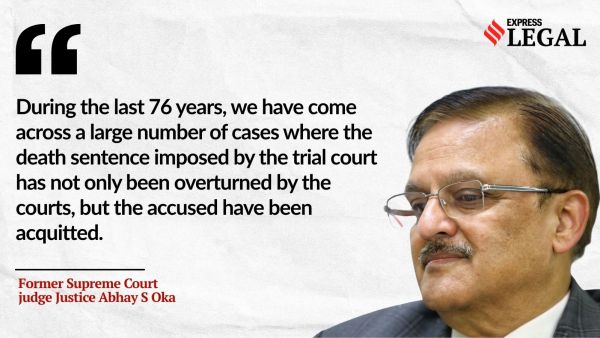
“During the last 76 years, we have come across a large number of cases where the death sentence imposed by the trial court has not only been overturned by the courts, but the accused have been acquitted. There are cases where death sentences were confirmed by the courts, but the Supreme Court has granted acquittal,” Justice Oka told The Indian Express.
In these cases, he underscored, the accused persons “had to stay under the hanging sword of death sentence for a number of years”.
“The reason is that in our system, the death sentence references and appeals remain pending for a long time. It is possible to argue that this itself violates Article 21. When our judicial system is capable of committing errors, the issue that needs consideration is whether the State can take away the life of a person on the basis of a death sentence provided in law,” the former Supreme Court judge said.
Justice Oka has seen cases where the death sentence was not executed promptly, and there was an inordinate delay in execution.
In such cases, he said, the constitutional courts have invoked Article 21 and have converted a death penalty into a life sentence.
‘Cobra waiting to strike’
Dr Yug Mohit Chaudhry, who has been representing death row prisoners across the country and spearheads the death penalty abolitionist movement, says for the “entire duration of his existence on death row, the prisoner is totally stripped of his dignity and is constantly swinging between hope and despair”.
“This causes such physical, emotional and psychological depredation as to leave him a shadow of his former self. One of my clients told me that even now, when he tries to rest, he feels that there is a cobra coiled on his stomach, waiting to strike,” he said.
Dr Chaudhry underlined the “permanent scarring” from which the death row prisoner never recovers, even if he is ultimately released.
“He is unable to sleep, work or even digest his food. If he eats, he has indigestion; his body is too broken to work; his mind cannot process simple things. As a survival tactic, he simply adopts the path of least resistance in every situation, hoping that if no one is threatened by his existence, he will be able to somehow eke out the time left to him in this life. We saw this in the Nazi concentration camps. We see it now on death row. It is unthinkable that human beings can devise and inflict such torment on a person at their mercy. If people only knew how death-row prisoners are treated in our names, they would be horrified,” he added.
Mental health support for death row inmates
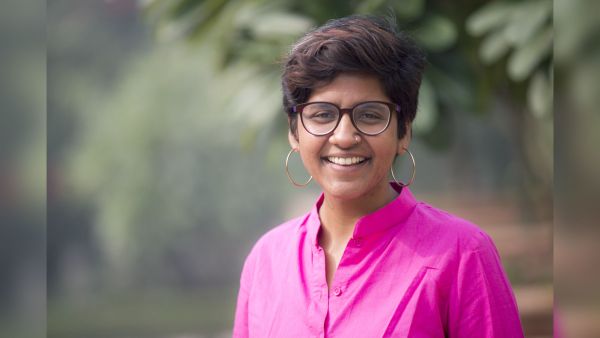 Maitreyi Misra, Director of Mitigation, Mental Health and Criminal Justice.
Speaking to The Indian Express, Maitreyi Misra, Director of Mitigation, Mental Health and Criminal Justice at the Square Circle Clinic, threw light on the mental health care and support in prisons for death row inmates, highlighting the lack of mental health professionals in prisons.
“In 2014, in Shatrughan Chauhan v Union of India, the Supreme Court recognised that due to the ‘prolonged anxiety and suffering experienced on death row’, death row prisoners are especially vulnerable to mental illness. It, therefore, required regular mental health evaluation of death row prisoners. However, there are hardly any mental health professionals in prisons, where there may be a psychiatrist or a psychologist,” she said.
A study titled Deathworthy, led by Misra, found that more than 60 per cent of death row prisoners suffer from at least one mental illness, most commonly major depressive disorder, generalised anxiety disorder, and substance use disorder.
“A death row prisoner I met said that he stopped praying because every time he would close his eyes to pray, he would see the noose. Death row prisoners often described themselves as the ‘living dead’, and that phrasing speaks volumes about the psychological effect of living under a sentence of death,” she recalled.
She claimed that mental health concerns of death row prisoners were correlated with violence in prison, social isolation, lack of work and differential treatment.
“If the system is disabling,” Misra argues, “the solution must address the system.”
‘Women prisoners face isolation’
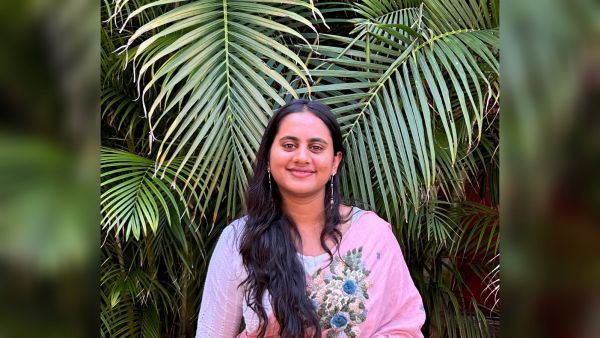 C P Shruthi, Senior Associate (Mitigation) at The Square Circle Clinic.
“Hope among death row prisoners, particularly women, often emerges from small, everyday, ordinary acts rather than from certainty about legal outcomes,” shared CP Shruthi, Senior Associate (Mitigation) at The Square Circle Clinic.
Shruthi, who meets death row survivors as a part of her work, pointed out that in many prisons, women sentenced to death are frequently the only individuals on death row within the entire facility, facing isolation and discrimination. Despite this, Shruthi observed, many women find ways to construct support systems within the limits of incarceration.
“Wherever the family is supportive, letters, visits, or even sporadic communication become deeply significant, and they draw a lot of hope from it. The knowledge that someone outside continues to care about their existence can serve as a powerful anchor in an otherwise uncertain future,” Shruthi said.
Some maintain hope through engagement in daily routines, such as participating in various cultural activities held in jail, enrolling in different courses, and learning new skills, she added.
Shruthi listed multiple structural and procedural factors at play over the delay in filing appeals in death row cases.
“One major factor is the seriousness of the sentence, which demands a detailed re-evaluation of evidence, trial procedure, quality of legal representation the accused had access to, and the requirement of collection and presentation of detailed information on sentencing. This extensive review process naturally requires considerable time,” she said.
Delays, according to Shruthi, are not understood solely as a slower pace of adjudication in the death penalty but as a “conscious commitment to due process by the courts”.
Death penalty in India
India retains the death penalty in law, but its use is circumscribed by strict judicial standards and layered procedural safeguards. The Supreme Court has consistently held that capital punishment may be imposed only in the “rarest of rare” cases where the crime is of exceptional gravity and life imprisonment is deemed inadequate.
Even when a trial court awards the death sentence, it does not automatically attain finality. Under the Code of Criminal Procedure, every death sentence must be confirmed by the concerned High Court, which re-examines both the conviction and the sentence.
The death row punishment remains deeply contentious in India as those in favour of capital punishment argue that it serves as a necessary deterrent for heinous crimes and provides justice to victims’ families. In contrast, some reject this idea on the grounds of a lack of conclusive evidence that death row punishment deters crime more effectively than life imprisonment.
For those on death row, the wait could be many years. The report by Square Circle Clinic reveals that of the 38 people acquitted by the Supreme Court between 2016 and 2025, as many as 27 spent between five and 10 years on death row before their convictions were overturned.
Over 80 per cent of the cases discussed above are at the confirmation stage, where, according to data released last week by The Square Circle Clinic at NALSAR University of Law, the acquittal rate over the past decade at the high court is four times higher than the confirmation rate.
Nazra became part of that statistic.
A death row survivor’s story
The Allahabad High Court acquitted Nazra in 2018, overturning a death row punishment handed down by a trial court after she and a few others, including her husband, were arrested for the murder of their family members. But before that reprieve came, she spent years living under the shadow of execution.
She recounted the day when the trial court’s judge pronounced her death sentence: she felt a wave of dread rushing through her.
In prison, the stigma was immediate. Other inmates whispered about her: “She has done this or that number of murders.” Few wanted to associate with a woman sentenced to die. Some would taunt, saying, “No one comes to meet her.”
Yet, unlike many women she saw crying in their cells, Nazra maintained an unshakeable belief in her innocence. “I had complete hope that I would come out because I had not committed the crime,” she told The Indian Express.
Her days followed a grinding routine, cooking rotis, reading namaz, and praying. Years passed in this rhythm. Then, finally, the high court acquitted her.
Walking out of prison, Nazra’s overwhelming emotion was gratitude at reuniting with her children, parents, and siblings. “I felt good,” she said.
“The biggest joy of my life is that I get to spend time with my children and my family.”
