

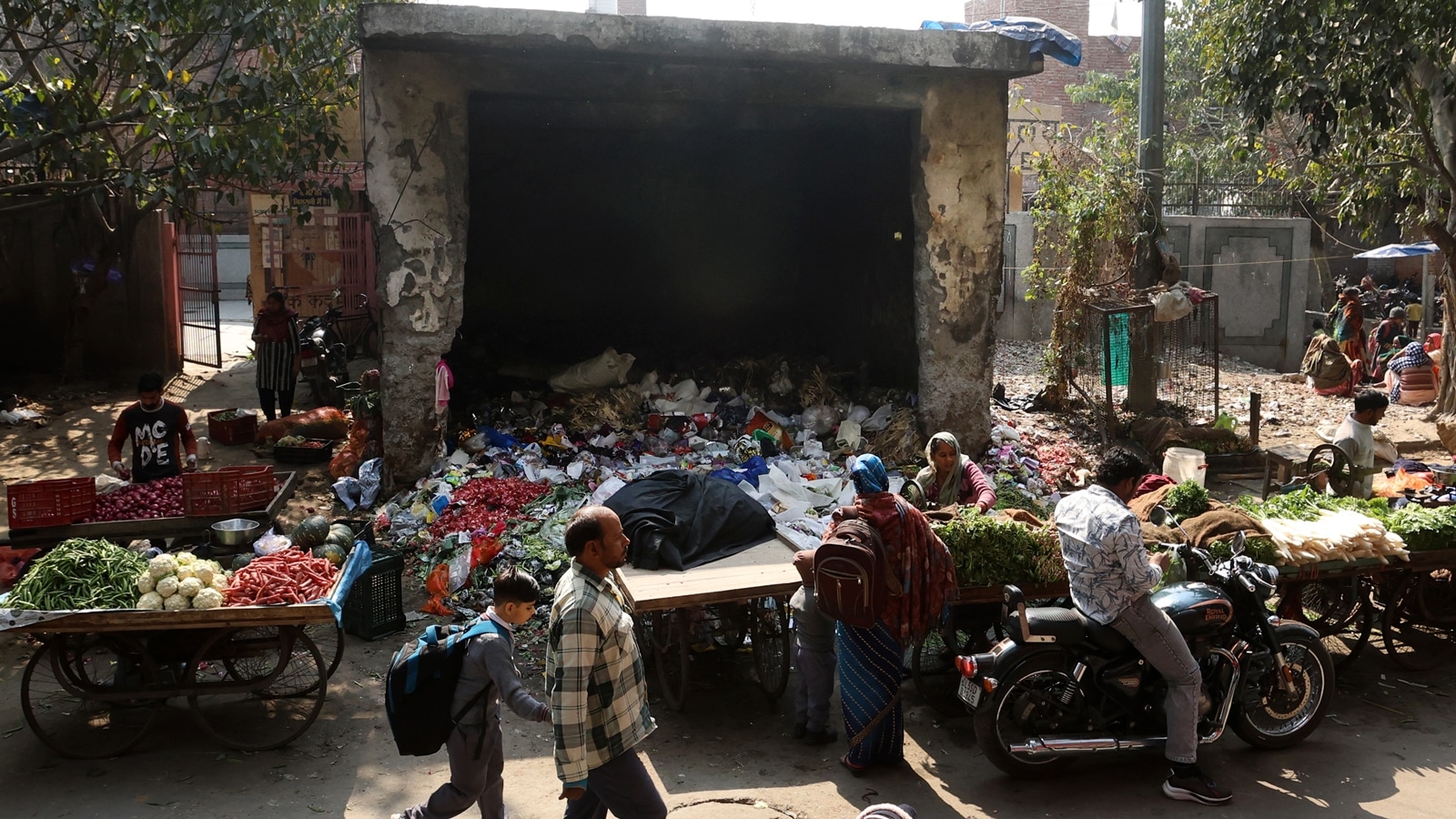
It’s a sunny February afternoon. A seven-year-old girl in a school uniform accompanies her mother to buy vegetables at a local market in Sunder Nagri.
The market in this Northeast Delhi locality, which falls under the Municipal Corporation of Delhi’s (MCD) Shahdara North Zone, is dotted with small pushcarts. Poultry shops are on one side, and garment shops on the other.
Picking up onions, the mother pauses to quickly unpin her daughter’s handkerchief from her uniform and asks her to cover her face as a stench wafts towards them.
The source of the smell is behind the vegetable carts — large heaps of garbage, overflowing onto the road from a dilapidated three-walled structure.
Several such structures, in similar states of disrepair, dot Delhi’s neighbourhoods. These are dhalaos.
Run by the MCD, these secondary waste collection points are meant to receive waste collected door-to-door by tippers. From here, the waste is transported to landfills or waste-to-energy plants for disposal (see graphic).
The concept was simple — on paper. On the ground, dhalaos have turned into mini dumpyards. The crisis stems from a combination of processing gaps, weak segregation, administrative delays and population pressures.
Story continues below this ad
Delhi generates roughly 11,000 tonnes of municipal solid waste each day, while existing facilities can process only about 8,000 tonnes, according to the Commission for Air Quality Management in NCR. The Commission, set up to address air pollution in the region, has flagged solid waste mismanagement as a contributor to environmental risk.
Starting April 1, the Solid Waste Management (SWM) Rules, 2026, are also set to come into force. These replace the 2016 framework but retain its core mandates of complete door-to-door collection, segregation at source and scientific processing of waste.
The Capital, meanwhile, is yet to fully meet the 2016 Rules. Segregation at source remains incomplete, with MCD reporting an average of 59% across its 250 wards, official documents show.
The Indian Express visits five dhalaos to assess the ground situation.
Story continues below this ad
Spot check
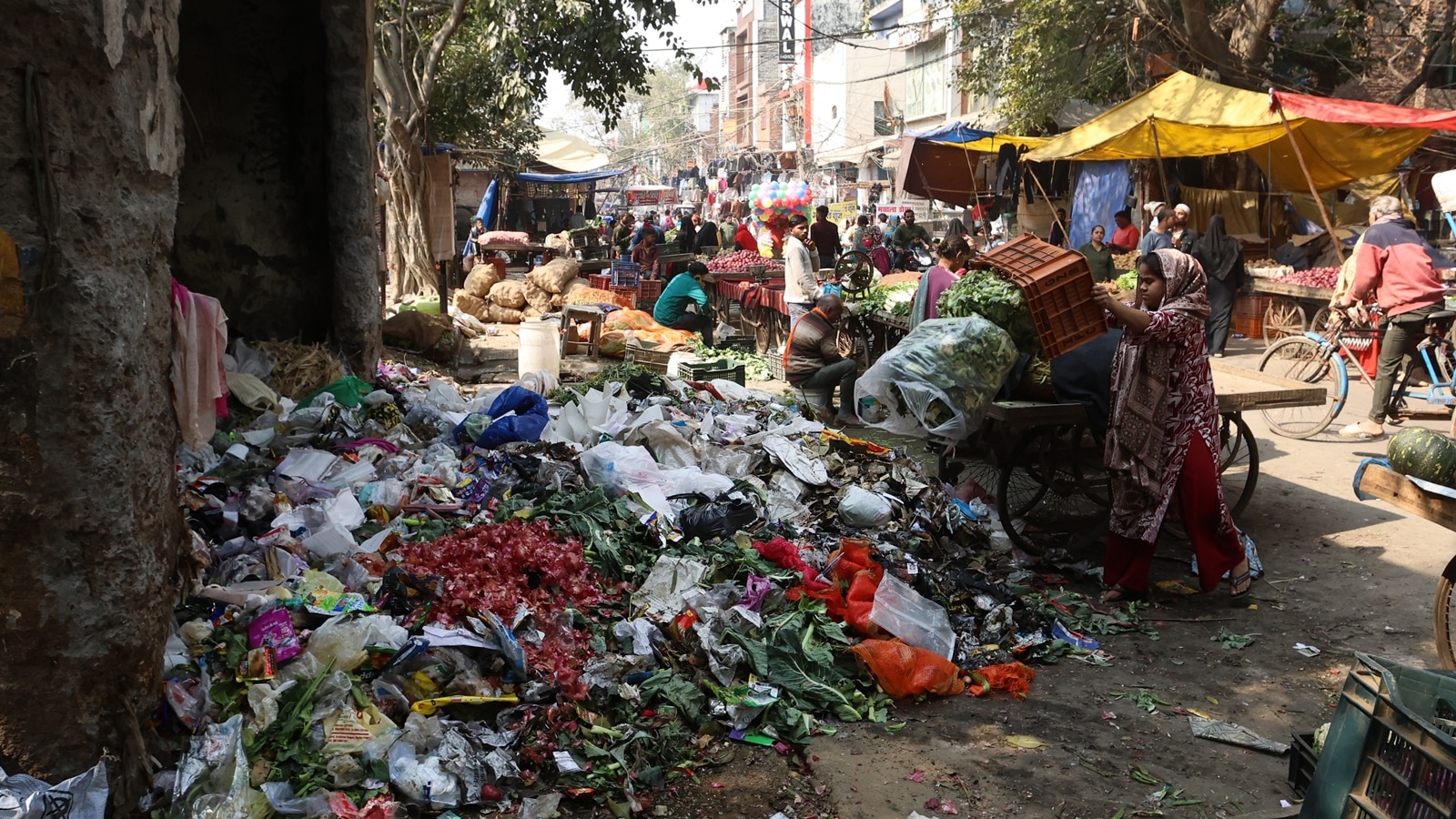 Shaniwar Bazar Road, Sunder Nagri. (Express Photo by Gajendra Yadav)
Location: Shaniwar Bazar Road, Sunder Nagri Shahdara North Zone (MCD ward no. 218)
Time: Feb 10, 12.20 pm
What we found: Located in a densely packed vegetable market, garbage from the dhalao overflowed onto the road. Distinct layers of waste were visible — one that had accumulated over weeks and had now dried and hardened, followed by a layer of relatively fresher waste, and finally the topmost layer where new garbage was currently being dumped.
Shopkeepers complain that the dhalao, located beside a public toilet, has always been neglected. “It was cleared just twice completely — when MP Manoj Tiwari and former Delhi CM Atishi visited this area,” says Shahdir Ali (50), who sells onions.
“Even when staff come, they only push the garbage inside and clear it once in 15 days,” he adds.
When it rains, it gets worse, says Pradeep Kumar (36), a vegetable vendor. “There were discussions last year that a file to close the dhalao and convert it into a milk parlour had been made — officials even came to inspect the area — but nothing was done.”
Story continues below this ad
A local sanitation worker says, “We make around 12 trips here, but the dhalao should be closed as it is hard to maintain.”
Locals say working beside the site has become normal. “We eat our food here… The smell has taken up permanent space in our minds,” says Kumar.
Contractor: Metro Waste. An official tasked with maintaining the collection point says, “The waste is picked up each night because the lane is very narrow for vehicles to pass through during the day. The dhalao should be closed because it is very tough to maintain; it receives more waste than its storage capacity.”
MCD councillor, AAP’s Mohini Jeenwal, says, “I want my ward to be dhalao-free. The structure needs repair and I planned to allocate funds for it under the councillor’s fund two months ago. I had also proposed setting up an Amul Booth at the site… the BJP only talks and does not work.”
Story continues below this ad
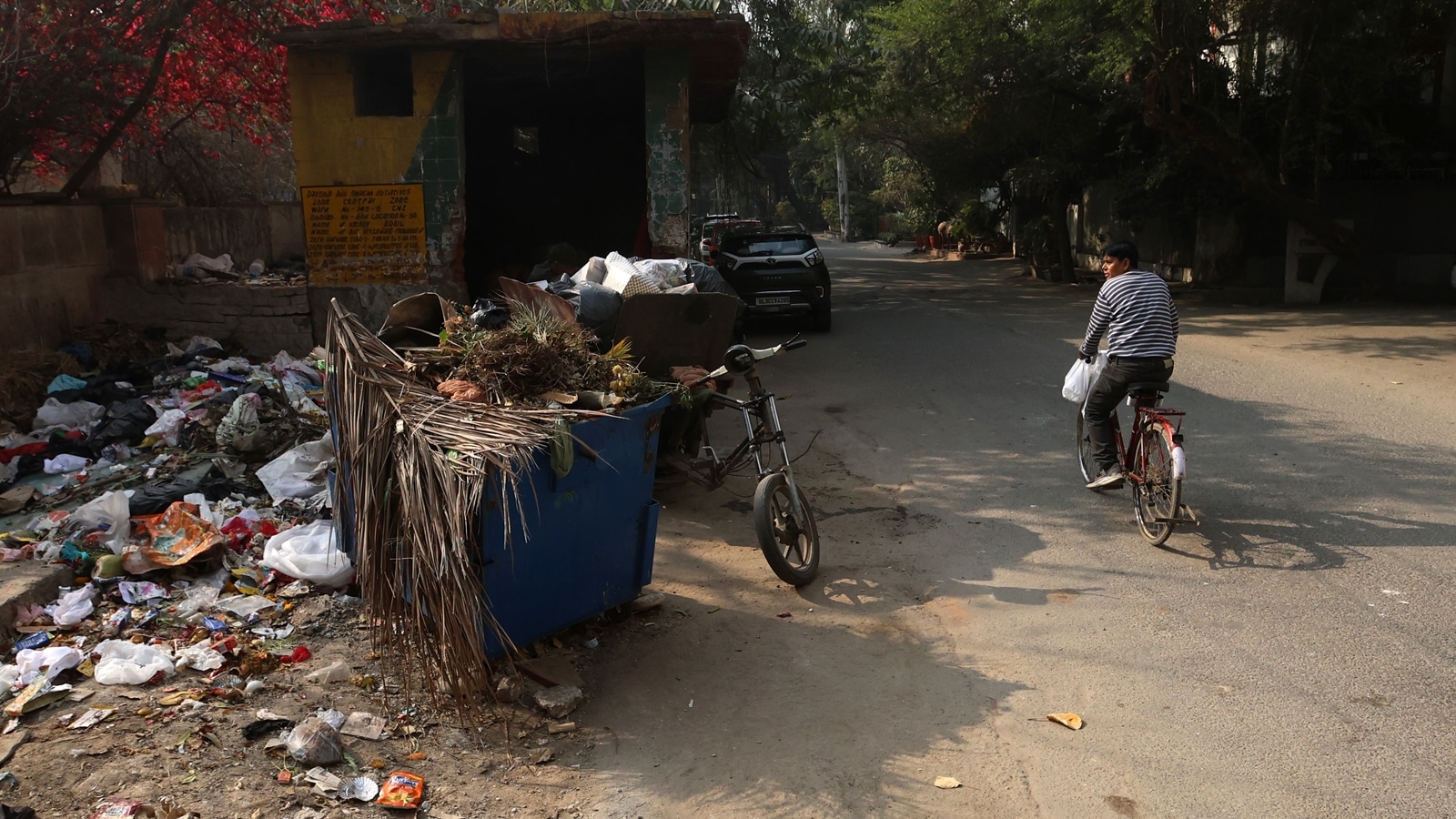 Block C, Defence Colony. (Express Photo by Gajendra Yadav)
Location: Block C, Defence Colony Central Zone (Ward no. 145)
Time: Feb 11, 11 am
What we found: Twenty-five km away, in this upscale residential area with large, spacious houses lined with plants, a contrasting scene unfolds across the lane — a dilapidated dhalao. Iron rods jut out from the chipped roof, and nearly twice as much garbage is dumped outside the storage unit as is kept within it. The blue and green bins overflow, swollen with mixed waste.
There are 14 dhalaos in the neighbourhood, which falls under the MCD’s Central Zone, all overflowing with garbage.
The Block C dhalao is looked after by a family of four from Assam — a couple and their two sons, aged 14 and 18.
The husband earlier served as a supervisor under the previous waste collection concessionaire. The concessionaire changed about eight months ago but the family says they have continued working at the site informally, without being officially hired.
Story continues below this ad
From 6 am to 7 am, they segregate wet and dry waste and keep the area clean, earning their livelihood by selling recyclable material recovered from the garbage.
The 18-year-old says, “Even if we segregate wet and dry waste, the loader mixes it up. People dump garbage in plastic bags because we have been given very few dustbins.”
Contractor: JS Enviro. Sandeep Gaur, General Manager, JS Enviro, says, “The MCD will have to repair this; we facilitated their visits for inspections. We got a short-term tender for six months last August and now for an extended period of three months… We needed time to undo the poor maintenance of the garbage collection point since the last concessionaire left. Earlier, waste used to decompose after lying for days, but now we have fixed bins with a 11,000-litre capacity.”
MCD councillor, BJP’s Anita Baisoya, says, “We have prepared tenders for all 14 dhalaos in Defence Colony. I had spoken to the MCD’s Department of Environmental Management Services last week to expedite the work. The delay in forming the Standing Committee and special committees delayed work repairs.”
Story continues below this ad
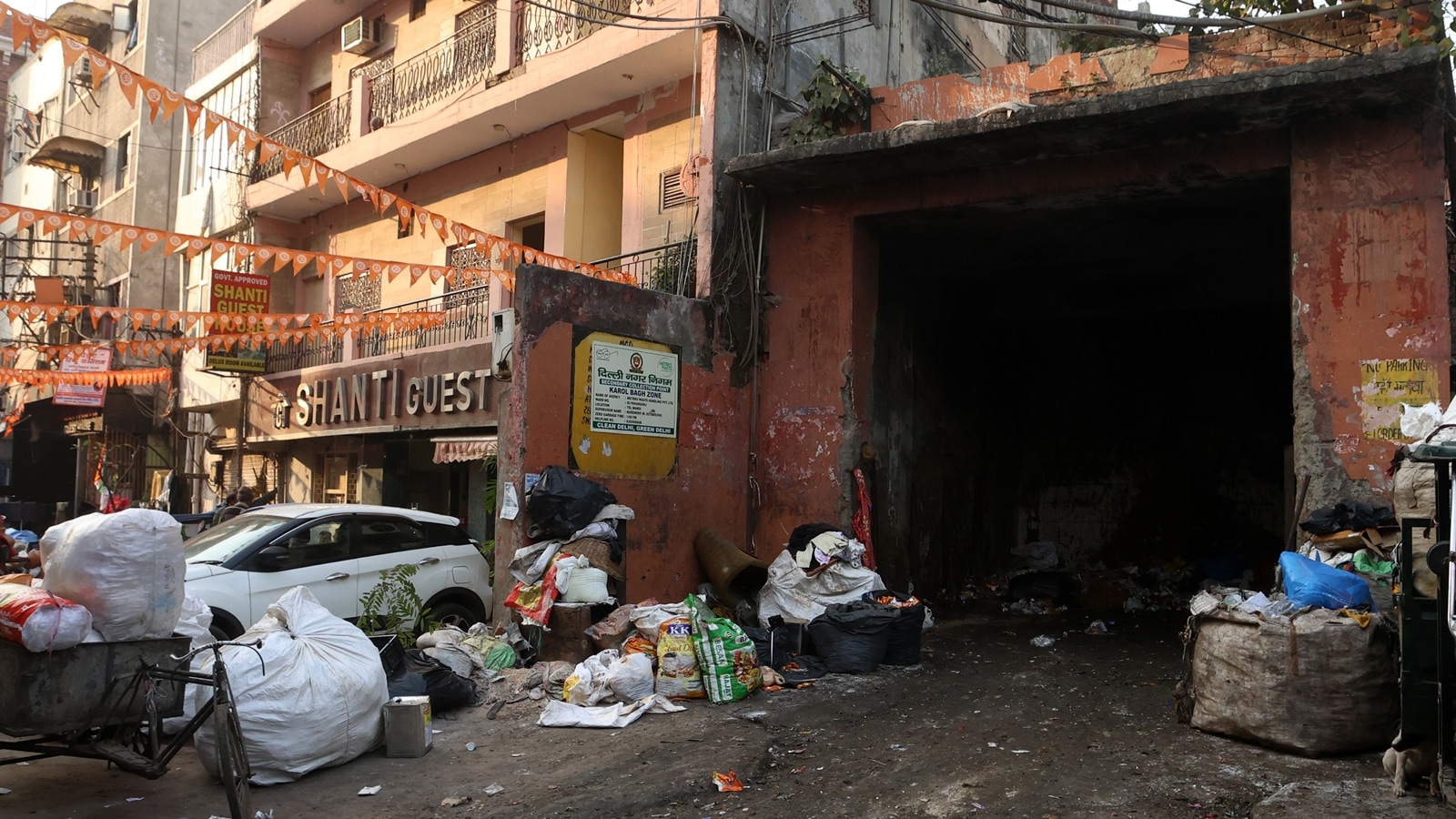 Tel Mandi, Paharganj. (Express Photo by Gajendra Yadav)
Location: Tel Mandi, Paharganj Karolbagh Zone (Ward no. 82)
Time: Feb 10, 4.30 pm
What we found: In the narrow lanes of Tel Mandi in Paharganj, another such poorly maintained dhalao — its roof and walls chipped and crumbling — adjacent to multiple hotels and lodges, has been a source of trouble for the local hotel business.
A strong, pungent smell lingered in the air as rickshaws arrived to dump waste, while several bags of garbage already lay scattered outside the dhalao.
“Guests tell us that the area, and sometimes the rooms, smell. We have complained but nobody listens,” says Santosh Kumar, the manager of a nearby hotel.
Another hotel owner, on condition of anonymity, says the garbage is not picked up at a fixed time. “Sometimes it’s 10 am… on other days, it lies till afternoon… The area is now called ‘koodaganj instead of Paharganj.”
Story continues below this ad
Contractor: Metro Waste. “Garbage is lifted twice a day. The dhalao needs repair and whitewashing but having multiple dhalaos to handle, it takes time,” says an official tasked with maintaining the collection point.
MCD councillor, BJP’s Manish Chadda, says, “In the last three years during the AAP’s tenure in the MCD, we never got funds to repair the dhalao. Even if funds were given, tenders for [for repair] never floated. There is a shortage of dhalaos, so most garbage is dumped here and we don’t have funds to install a compactor.”
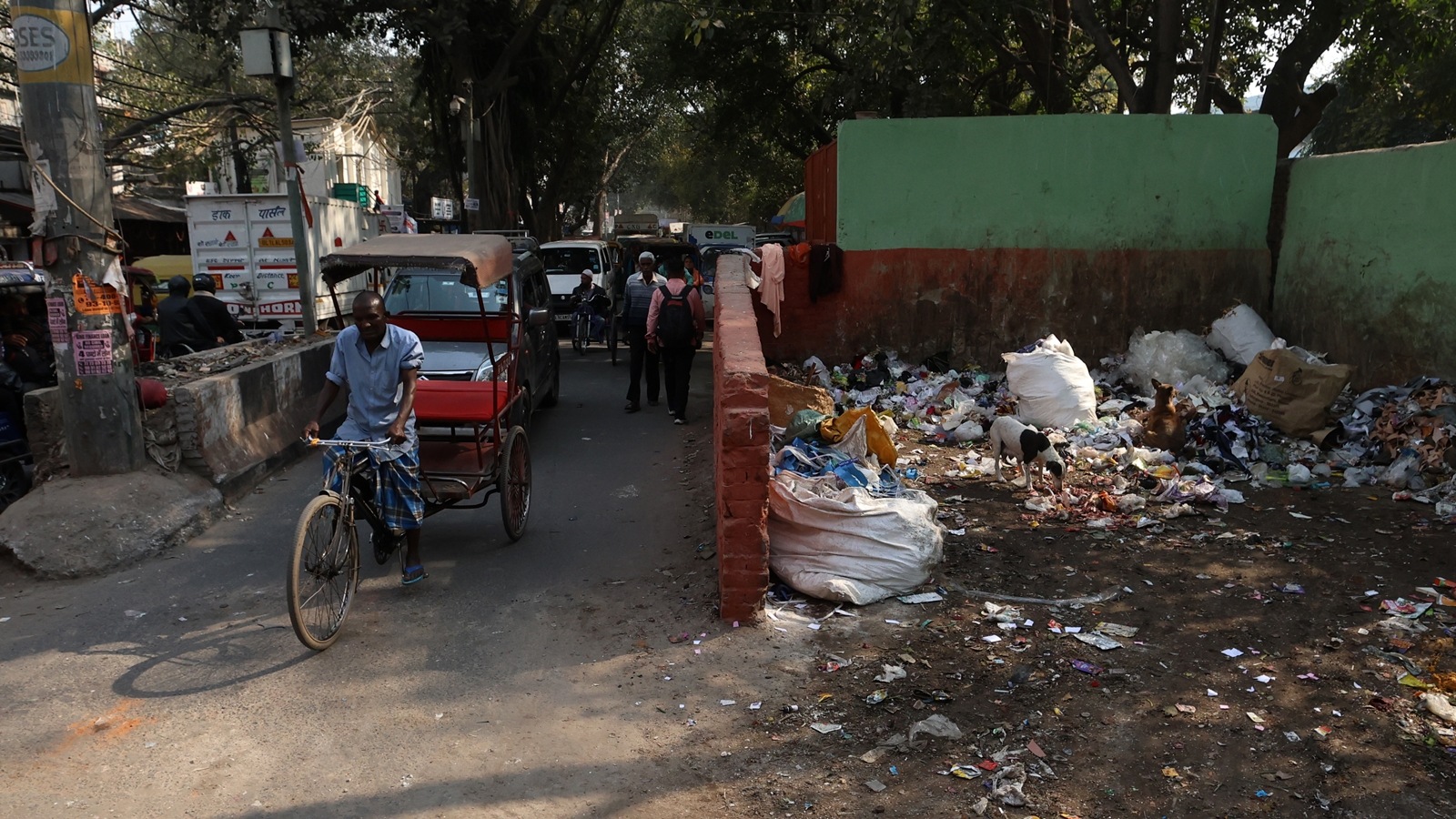 Shradhanand Marg, GB Road. (Express Photo by Gajendra Yadav)
Location: Shradhanand Marg (GB Road) City SP Zone (ward no. 78)
Time: Feb 10, 2.30 pm
What we found: Located in a corner along a busy road, the dhalao had no roof and its walls were broken on all three sides. Waste spilled onto the road and was scattered further by passing vehicles. Stray dogs were seen rummaging through the piles in search of food.
Contractor: AG Enviro. A representative says, “The structure was dilapidated when we got the contract. It is not entirely a dhalao now, it was demolished earlier… We place mobile compactors in the morning, but people still continue to dump garbage here.”
MCD councillor, AAP’s Rafia Mahir, says, “Initially, it was not a designated place to dump waste, but with the volume of waste now being generated, it [the dhalao] has become a large one. I have tried all options, but there are no funds with the MCD. However, I’ll try to make it better.”
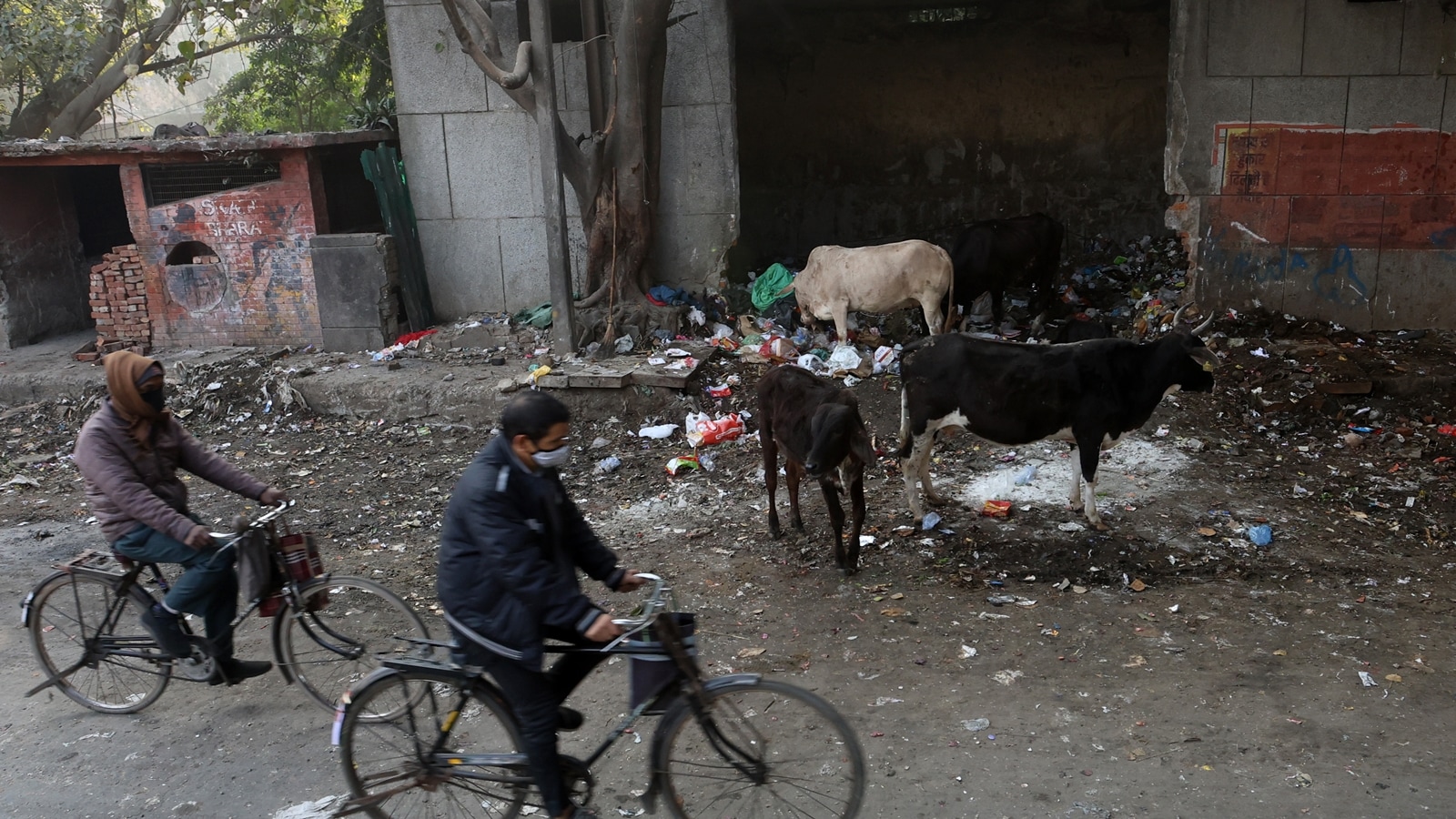 Madanpur K Road, Sarita Vihar
Central Zone (Ward 186). (Express Photo by Gajendra Yadav)
Location: Madanpur Khadar Road, Sarita Vihar Central Zone (ward no. 186)
Time: Feb 11, 8.50 am
What we found: At the dhalao located beside a DDA flat, a herd of cows looked for food. The road was covered in a thick layer of garbage. Sanjeeda Khatana (40), a resident, said, “We usually don’t step out of our house unless it’s absolutely necessary. We feel ashamed when guests come over. We had requested MCD to remove it [the dhalao] from here.”
Contractor: JS Enviro. “Residents complain, but we don’t have an alternative spot. People passing by on bikes often throw waste outside the dhalao. Residents also need to cooperate,” said an official tasked with maintaining the site.
MCD councillor, BJP’s Brahma Singh, says, “We are in the process of placing barricades at the entrance to the dhalao so cattle cannot enter. This will be done by next week. The quantity of garbage has increased because nearby dhalaos have shut… the walls get damaged when earthmovers come to lift the waste.”
Action taken
Over the past few years, the National Green Tribunal (NGT), in several orders, has directed the shutdown of various dhalaos.
In a long-running matter since 2018, titled ‘Compliance of Municipal Solid Waste Management Rules, 2016, and other Environmental Issues’, the Tribunal has highlighted the continued failure of the state to ensure proper solid waste handling.
In an order dated February 16, 2023, issued following NGT proceedings, the Delhi Chief Secretary recorded that all dhalaos would be closed by December 31, 2024, to maintain a garbage-free city and for “functional and aesthetic reasons”.
In another order in September 2023, the NGT had ordered MCD to make Delhi a ‘dhalao-free’ city by eliminating all existing dhalaos by December 2024 and ensuring compliance with the Solid Waste Management Rules, 2016. The order noted that the dhalaos can be replaced by milk booths, EV infrastructure (IGL), library, reading room, training centre for women and children or a senior citizen recreation centre.
In its reply to the NGT in July 2025, the MCD said 989 of the total 1,494 dhalaos in the city have been put to alternative use, while around 505 remain operational.
The MCD, meanwhile, has come up with an alternative to dhalaos — fixed compactor transfer stations (FCTS), a machine designed to compact segregated municipal solid waste.
Located on larger plots, these facilities receive waste from tippers, compact it, and transport it to waste-to-energy plants or landfills. Unlike dhalaos, they prevent garbage from lying exposed or spilling onto roads. Each station can serve areas within a 3-km radius and can compress around 12-13 tonnes of waste daily.
In its reply to the NGT last year, MCD said that it had set up 309 FCTSes. Officials said there are now 325 such units, with each FCTS functioning as a collection and storage unit equivalent to at least four dhalaos.
But space has proved to be a problem. While some FCTS have come up on larger dhalao sites, others have been installed on vacant land. “The size of existing dhalaos vary from 20-40 sq m, making it impossible to either set up material recovery facilities or secondary storage facilities as per the Delhi Master Plan or to even set up more FCTS. As many as 250 of the 505 existing dhalaos (one per ward) are being utilised to store waste swept from the streets and silt,” an MCD official says.
Official speak
MCD Mayor Raja Iqbal Singh says, “We’re aiming for a dhalao-free city in the next few months and will set up FCTS. In places where we cannot, we’ll try to repair and maintain the dhalaos, ensuring they do not cause problems to residents.”
Asked about the maintenance and repair of existing dhalaos, MCD cites the high costs involved.
“Repairing each dhalao would cost around Rs 4-5 lakh. The MCD has outsourced them to contractors, but since the contractors are not taking proper action, these dhalaos are now largely left unattended,” an official says.
A representative of a private concessionaire handling waste collection in two MCD zones, however, says funding approvals have been slow. “Even for small amounts, files move through multiple layers… We repair some dhalaos using our own funds, but for larger repairs, we seek approvals from MCD. In the last few months, there has been more responsiveness,” he says.
Another problem he cites is lack of planning. “Population has been increasing rapidly, especially in unauthorised colonies with inadequate sewage systems. If a dhalao is designed to handle waste from 1,000 people and ends up serving 5,000, it will inevitably deteriorate.”
To tackle the Capital’s waste problem, the MCD on Friday passed a Rs 17,583 crore budget for 2026-27, allocating Rs 4,797 crore to sanitation — the highest sectoral share. Iqbal says MCD received Rs 500 crore from the Delhi government in January, “and a large chunk, Rs 300, will be utilised in this work [proper waste management]”.
He acknowledges that there is a problem of increasing population and unauthorised colonies generating a lot of waste. “However, we are working on this and it will be [fixed] in a few months.”
