

UPSC Essentials brings to you its initiative of subject-wise quizzes. These quizzes are designed to help you revise some of the most important topics from the static part of the syllabus. Attempt today’s subject quiz on History & Cultureto check your progress.
🚨Click Hereto read the UPSC Essentials magazine forFebruary2026.Share your views and suggestions in the comment box or at manas.srivastava@indianexpress.com🚨
(c) A peasant revolt in Assam during the Non-Cooperation Movement
(d) A reform movement for women’s education in Bengal Presidency
Relevance:
Story continues below this ad
This question is relevant because UPSC increasingly focuses on regional movements and women-led resistances within the broader freedom struggle. It is probable since Prelims often highlights lesser-known North-East historical events, testing depth beyond mainstream national movements.
Explanation
President Droupadi Murmu paid tributes at a memorial in Manipur’s Imphal on the occasion of the 86th Nupi Lan Day in December 2025.
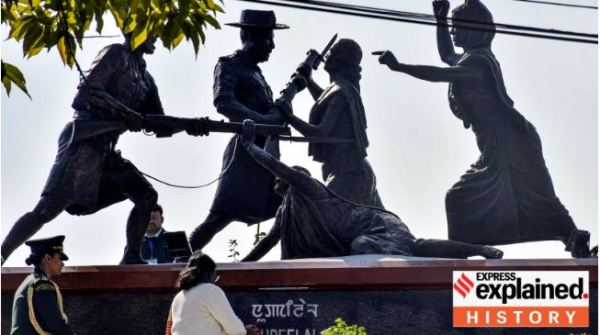 President Droupadi Murmu pays tribute at the Nupi Lan Memorial Complex on the occasion of the 86th Nupi Lan Day, in Imphal in December 2025. PTI
Nupi Lan, literally ‘Women’s War’ in the Meitei language, refers to two women-led movements against British colonial policies, the first in 1908 and the second in 1939.
While Nupi Lan Day is associated with both uprisings, it is observed on the day the second movement broke out, December 12.
Story continues below this ad
The second movement started as an agitation by Manipuri women against the economic policies of the Maharaja and exploitation by Marwari businessmen under British rule. It then transformed into a movement for constitutional and administrative reform in Manipur.
Therefore, option (a) is the correct answer.
QUESTION 2
The statement, “For in the absence of a magistrate (dandadharabhave), the strong will swallow the weak; but under his protection, the weak resist the strong,” reflects the idea of justice and governance in ancient Indian political thought.
The above statement is attributed to which one of the following ancient Indian texts?
(a) Manusmriti
(b) Arthashastra
(c) Shanti Parva
(d) Mundaka Upanishad
Relevance:
Explanation
Story continues below this ad
It is drawn from the Arthashastra of Kautilya (also known as Chanakya). It reflects Kautilya’s doctrine of Danda (state authority/punishment) — that without enforcement of law, society descends into matsya nyaya (law of the fish), where the strong prey upon the weak.
Therefore, option (b) is the correct answer.
QUESTION 3
With reference to the history of Delhi, which one of the following was the first to be built by Alauddin Khilji?
(a) Siri Fort
(b) Tughlaqabad Fort
(c) Feroz Shah Kotla
(d) Purana Qila
Relevance:
This question is relevant because UPSC often tests the chronological development of the seven cities of Delhi and their association with specific rulers. It is probable since Prelims frequently links medieval architecture with ruling dynasties, especially in Art and Culture and History sections.
Explanation
Located in the heart of the capital, Siri is the second among the seven cities of Delhi and the first to be built by a Muslim ruler — Alauddin Khilji.
Story continues below this ad
“Siri Fort stands among the numerous monuments and palaces which Ala-ud-din had constructed. Built in 1311 AD, the fort served as a seat of Ala-ud-din’s administration. Among a host of administrative buildings and palaces, the construction, which deserves most credit was the Hazar Sutun, a magnificent palace comprising one thousand pillars. Housed within Siri, was Hauz-e-Alai, a marvellous reservoir…” writes Rajiv Tiwari in his book Delhi: A Travel Guide.
According to the book, when Khilji ascended the throne in 1296 AD, he found his empire the target of foreign attacks and thus, Siri was constructed with the motive to fortify his kingdom. Tiwari further writes: “The fort was indeed a solid, stable construction which succeeded in guarding its royal residents from any external disturbance. Although the Fort stands in ruins today, one can decipher from the relics how strong and well equipped it had been in the past.”
Therefore, option (a) is the correct answer.
QUESTION 4
With reference to the Allahabad (Prayagaraj) Pillar of Ashoka, consider the following statements:
1. It represents a single monument spanning the Mauryan, Gupta, and Mughal periods.
Story continues below this ad
2. Originally at Meerut, it was transported to Allahabad during the Mughal period.
Which of the statements given above is/are correct?
(a) 1 only
(b) 2 only
(c) Both 1 and 2
(d) Neither 1 nor 2
Relevance:
Such a question is relevant because UPSC frequently tests interlinkages between ancient and medieval history, especially the reuse or relocation of monuments across dynasties. It is probable since Prelims often focuses on factual details about inscriptions, pillars, and their historical movement, a recurring theme in Art and Culture.
Explanation
In 2018, historian and professor emerita at the Jawaharlal Nehru University, Romila Thapar, presented a lecture titled ‘Encapsulating the World: Ashoka’s pillar at Allahabad’ as a part of the special lecture series, ‘India & the World: A History in Nine Stories’, organised by the Chhatrapati Shivaji Maharaj Vastu Sangrahalaya (CSMVS). The Allahabad Ashoka Pillar is a unique monument that carries three particularly significant edicts that describe Ashoka’s 27th ruling year, the achievements of Samudragupta as eulogised by Hari Sena, and Jahangir’s family tree.
“There are many pillars in India that carry the occasional inscriptions, but the Allahabad Pillar of Ashoka is remarkable for the particular inscriptions that it carries and the very different inscriptions that it carries, with wide-ranging references. These are a reflection of the diverse period of history extending across three millennia with each later inscription registering a change,” Thapar said.
Story continues below this ad
The edicts on the pillar are all in different languages, using different scripts. Ashoka’s edict was written in Prakrit, Samudragupta’s in Brahmi and Jahangir’s in the Nastalik (a Persian script). Thapar said it was unlikely that the successive authors could read the scripts in with the previous edicts were inscribed or even knew the identity of the preceding authors. Yet, they all seemed to think that the pillar was an effective way in which to “proclaim the legitimacy of their rule”.
The Ashokan Pillar of Meerut was transported to Delhi during the reign of Firoz Shah Tughlaq.
The Ashokan Pillar of Topra was shifted to Delhi by Firoz Shah Tughlaq in the 14th century and installed at Feroz Shah Kotla.
Therefore, option (a) is the correct answer.
QUESTION 5
With reference to their sources of the following Sanskrit phrases, which of the following statements is/are correct?
1. Ahimsa Paramo Dharmah is mentioned in the Mahabharata.
2. Vasudhaiva Kutumbakam occurs in the Maha Upanishad.
3. Satyameva Jayate is taken from the Mundaka Upanishad.
Select the correct answer using the code given below:
(a) 1 and 2 only
(b) 2 and 3 only
(c) 1 and 3 only
(d) 1, 2 and 3
Relevance:
Story continues below this ad
This question is relevant because UPSC often tests the exact textual sources of commonly quoted civilisational phrases, especially those frequently used in state policy, diplomacy, and national symbols. It is probable since such themes connect ancient texts with contemporary relevance, a pattern repeatedly seen in Prelims under culture and philosophy.
Explanation
The Mahabharata has multiple mentions of the phrase Ahimsa Paramo Dharma, which literally means: non-violence is the highest moral virtue.
The phrase Vasudhaiva Kutumbakam is made up of three Sanskrit words, Vasudhaa (earth/world), iva (like) and kutumbakam (large/extended family). The verse finds mention in Maha Upanishad and is further referred to in the Hitopadesha and other literary works of India.
Satyameva Jayate or ‘Truth Alone Triumphs’ is a part of Mundaka Upanishad. Following the independence of India, it was adopted as the national motto of India on 26 January 1950, the day India became a republic. In the national emblem of India, it is inscribed in the Devanagari script below the Lion Capital of Ashoka and forms an integral part of the emblem.
Therefore, option (d) is the correct answer.
Previous Daily Subject-Wise-Quiz
Daily subject-wise quiz – International Relations (Week 149)
Daily Subject-wise quiz — History, Culture, and Social Issues (Week 144)
Daily subject-wise quiz — Polity and Governance (Week 149)
Daily subject-wise quiz — Science and Technology (Week 149)
Daily subject-wise quiz — Economy (Week 149)
Daily subject-wise quiz — Environment and Geography (Week 149)
Subscribeto ourUPSC newsletterand stay updated with the news cues from the past week.
Stay updatedwith the latestUPSC articlesby joining ourTelegram channel–IndianExpressUPSC Hub, and follow us onInstagramandX.
