

Amid heightened military activity in the Gulf, Iran’s Supreme Leader Ayatollah Ali Khamenei warned the United States and President Donald Trump that even the “strongest military force in the world” can be struck so hard “that it cannot get up again,” adding that a warship can be sent “to the bottom of the sea.”The remarks, directed at Washington’s military posture in the region, raise a strategic question: could Iran actually sink a modern US aircraft carrier such as the USS Gerald R Ford?
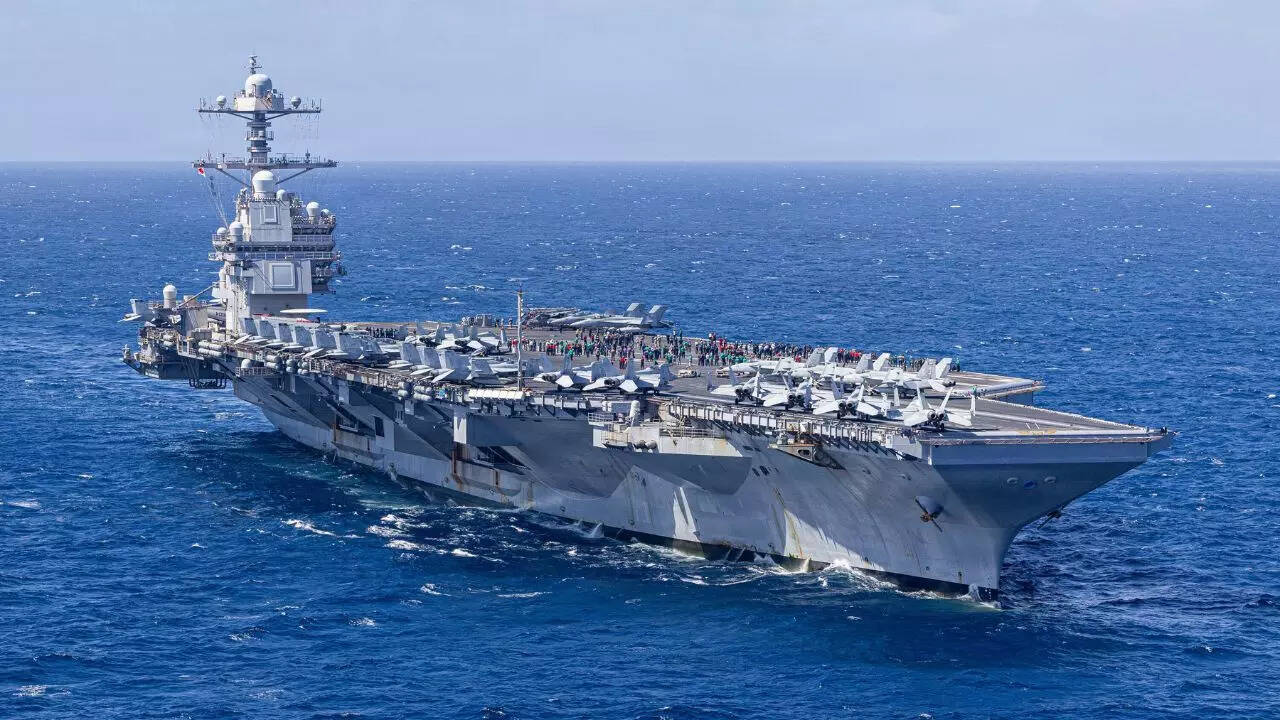
Here is what we know.
The scale of the challenge
The USS Gerald R. Ford (CVN-78) is a 100,000-tonne nuclear-powered supercarrier — the lead ship of the Ford-class and the most technologically advanced aircraft carrier ever built by the US Navy. It represents decades of evolution in naval architecture, survivability engineering and damage-control doctrine.
The vessel is designed with extensive compartmentalisation. This means the hull is divided into numerous watertight sections so that even if one or more compartments are breached, flooding can be contained. Its internal systems — power distribution, firefighting networks, aircraft launch and recovery equipment — are built with redundancy, allowing operations to continue even after sustaining damage.
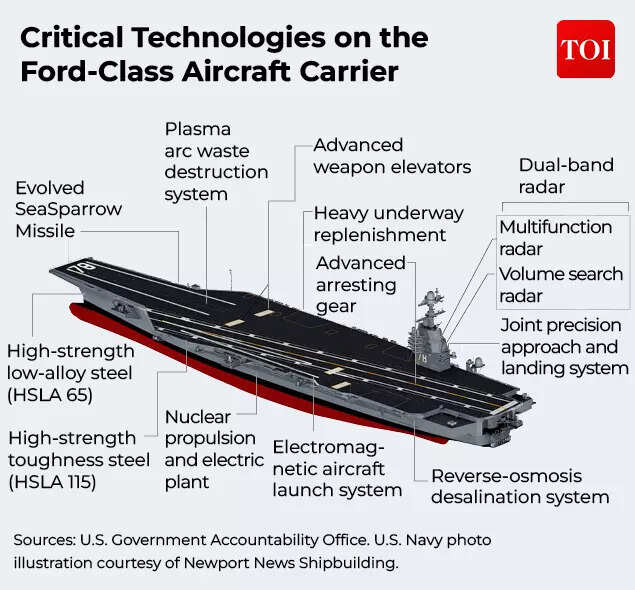
In 2021, the US Navy conducted Full Ship Shock Trials on the Ford. During these tests, 40,000 pounds of explosives were detonated underwater near the hull to simulate combat conditions. The carrier remained structurally sound, with no catastrophic flooding or uncontrolled fires. The trials were intended to validate the ship’s ability to survive severe underwater blasts, including those from mines or torpedoes.Naval analysts widely argue that the idea of a single missile strike instantly sinking a supercarrier is more myth than reality. Modern carriers are engineered not merely to float, but to fight through damage.
Why a ‘single missile’ is unlikely to sink a Ford-class carrier
A common public perception is that a powerful anti-ship missile — particularly a hypersonic one — could simply punch through the deck and send the carrier to the seabed. In practice, the picture is far more complex.The Ford-class displaces roughly 100,000 tonnes of steel and composite materials. Its sheer size and buoyancy make it extremely difficult to sink quickly. A single missile, even if it caused serious localised destruction, would not necessarily compromise the ship’s overall stability.Damage-control teams aboard US carriers train intensively for combat scenarios involving fires, flooding and structural breaches. Modern carriers are built with layered firefighting systems, armoured magazines and protected fuel storage to prevent secondary explosions.That does not mean they are invulnerable. A successful hit could disable flight operations or temporarily degrade combat effectiveness. But sinking the ship outright would almost certainly require multiple strikes in critical areas, combined with overwhelming damage that exceeds onboard containment capacity.
Iran’s ‘carrier-killer’ doctrine
Iran does not operate aircraft carriers, but it has invested heavily in asymmetric naval capabilities. Its strategy centres on anti-access and area denial — attempting to complicate or deter US naval operations in confined waterways such as the Strait of Hormuz.Tehran fields a mix of anti-ship cruise missiles, anti-ship ballistic missiles, armed drones, naval mines and fast-attack craft. Iranian military rhetoric often references so-called “carrier-killer” missiles developed elsewhere, such as China’s DF-21D and DF-26 systems, as examples of how large naval platforms might be targeted.However, striking a moving carrier in the open ocean is among the most difficult military tasks. A carrier strike group can travel at high speed and alter course unpredictably. To hit it with a ballistic or long-range cruise missile, an adversary requires real-time intelligence, persistent surveillance — potentially via satellites, maritime patrol aircraft or drones — and secure data links to update the missile’s targeting during flight.Without continuous tracking, even an advanced missile may arrive at empty ocean.
The real threat: hypersonics and saturation attacks
The more plausible danger lies not in a lone missile but in a coordinated saturation attack.Hypersonic missiles — travelling at speeds exceeding Mach 5 — reduce reaction times for defenders and can manoeuvre unpredictably. Even without a high-explosive warhead, the kinetic energy generated by such velocity could inflict severe structural damage.Yet speed alone does not guarantee success. Hypersonic systems still require accurate targeting data and must penetrate layered air and missile defences.A saturation attack would involve launching dozens of ballistic and cruise missiles simultaneously, potentially accompanied by drone swarms and electronic warfare measures designed to jam radars and confuse interceptors. The objective would be to overwhelm the defensive envelope protecting the carrier rather than rely on a single decisive hit.Even in such a scenario, multiple impacts on vital compartments — such as ammunition storage, aviation fuel reserves or key structural nodes — would likely be required to sink the ship.
Inside the Carrier Strike Group’s layered shield
A US supercarrier never deploys alone. It sails as the centrepiece of a Carrier Strike Group (CSG), which forms concentric layers of defence.Guided-missile destroyers, particularly the Arleigh Burke-class equipped with the Aegis combat system, provide long-range missile interception using SM-2 and SM-6 interceptors. Submarines operating with the group offer additional deterrence and offensive capability.Closer to the carrier, systems such as the Phalanx Close-In Weapon System (CIWS) — a rapid-fire, radar-guided Gatling gun — and Rolling Airframe Missile (RAM) launchers act as last-ditch defences against incoming threats that penetrate outer layers.Electronic warfare capabilities add another dimension. US vessels can attempt to jam, spoof or decoy incoming missile guidance systems, reducing accuracy and disrupting coordinated attacks.To breach all these layers simultaneously would require a high degree of coordination, timing and technological sophistication..
What it would take to ‘drown it to the seabed’
For Iran or any adversary — to sink a Ford-class carrier outright, several conditions would likely need to align:
- Successful, real-time tracking of the carrier’s precise location and movement.
- A large-scale, synchronised missile salvo to overwhelm Aegis interceptors and close-in systems.
- Multiple direct hits on critical compartments causing uncontrollable flooding or secondary internal explosions.
- Sustained follow-up strikes to prevent damage control from stabilising the vessel.
