

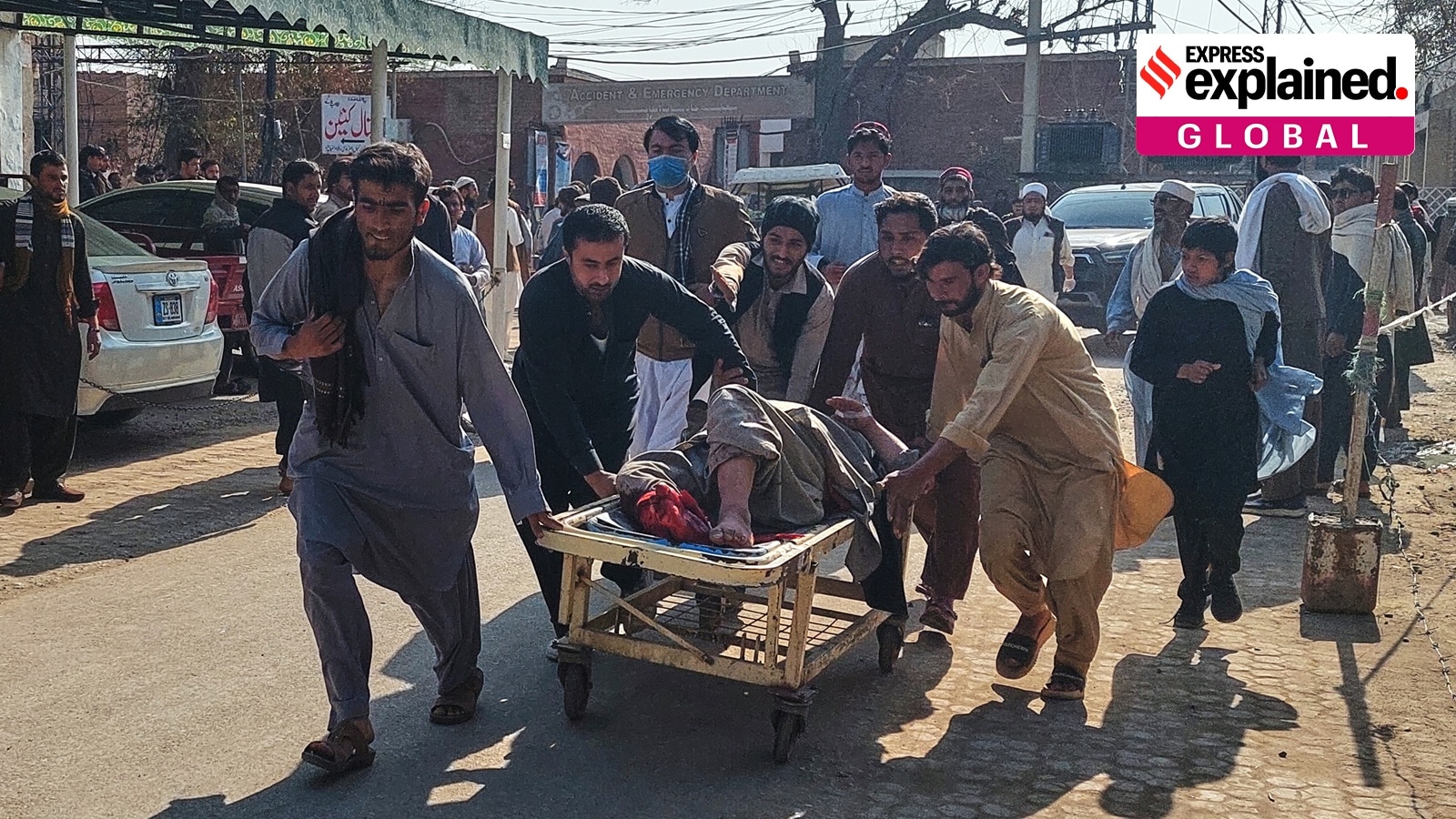
Before this, three major headlines came out of Islamabad on Thursday (February 19), together underlining the paradox Pakistan today faces: more international relevance than it has been used to, and more internal instability than it can handle. For India, all these developments have implications.
First, Pakistan Prime Minister Shehbaz Sharif travelled to Washington DC for the inaugural meeting of the Donald Trump-led Board of Peace. Second, Islamabad issued a demarche to the Taliban regime in Afghanistan, after 11 soldiers and a child were killed in a vehicle blast in Khyber-Pakhtunkhwa’s Bajaur region on February 16. Pakistan blames Afghanistan for harbouring terrorists. Third, the government announced compensation for the families of the 40 people killed in a suicide attack at a Shia imambargah on February 6.
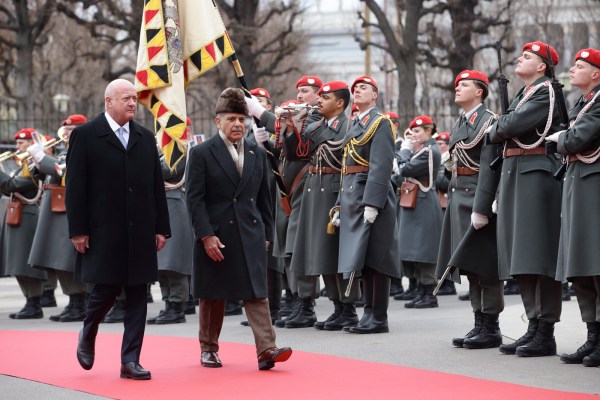 Pakistan’s Prime Minister Shehbaz Sharif and Austria’s Chancellor Christian Stocker review the honour guard in Vienna, Austria, on Feb 16. (AP Photo)
Amid all this, Imran Khan, cricket legend, former PM, and now main Opposition figure in Pakistan, languishes in jail, prompting former cricketers from around the world to issue an appeal for “humane” treatment to him.
Pakistan’s rising international profile
For the past few years, New Delhi’s approach to Pakistan had been one of determined ignoring. The idea was that that terror and talks can’t go together, and India, a stable democracy and rising economic power, should not be engaging with Pakistan, with its economy collapsing and its international reputation dented.
Yet, today, Pakistan is among the few countries that can count both Donald Trump and Xi Jinping among friends. Trump singled out Shehbaz Sharif for thanks at the Gaza ceasefire summit at Sharm El-Shaikh last year, and has called the head of Pakistani military, Asim Munir, his “favourite field marshal”. In December, the Trump administration announced it would invest $1.3 billion in Balochistan’s Reko Diq mine, which has copper and gold reserves. Geopolitically, the US has signalled it sees a role for Pakistan in the Gaza as well as the Iran conflict.
Also, in the past few months, Pakistan has signed a mutual defence pact with Saudi Arabia, and has agreed to or is in talks with to supply arms to Sudan, Libya, and Bangladesh, in deals worth billions.
Story continues below this ad
This rise can be attributed to Islamabad’s successful wooing of Trump, and its successful selling of its Operation Sindoor performance as impressive, however far from the truth that may be.
“All the defence deals that Pakistan has signed recently will not help it with domestic terrorism. But they do make Islamabad look like a relevant actor globally. On the home front, Pakistan’s policy of nurturing terror networks has backfired, as the attacks are now happening within its territory,” TCA Raghavan, India’s former High Commissioner to Pakistan, told The Indian Express.
At home, one battle after another
The Bajaur attack on Monday is far from isolated. And while attacks in the restive Balochistan and Khyber Panktunkhwa are common, even the fortified Islamabad has seen two attacks in the past four months — the mosque attack earlier this month and a suicide attack outside a court in November 2025 that killed 12.
Attacks in Pakistan are generally carried out by the Tehrik-e-Taliban (TTP), also called the Pakistan Taliban, Baloch militants, and occasionally other groups like the Islamic State splinter factions. There has been a rise in terror attacks in the last two years. Pakistani thinktank Center for Research and Security Studies calculated last September that, “In just three quarters, 2025 has proven nearly as deadly as all of 2024, with 2414 fatalities recorded compared to the entire tally of 2024 (2546).”
Story continues below this ad
The TTP wants Pakistan run on a strict interpretation of Islamic law. It wishes to overthrow the current government, which it believes is not Islamic enough. The TTP also opposes the Pakistan government’s assistance to the US ‘war on terror’.
The Baloch Liberation Army, meanwhile, launched ‘phase 2 of Operation Herof’ in January (the first phase was in August 2024). Balochistan — where the US recently announced investment — is the most resource-rich of Pakistan’s four provinces, but lags in development and economic growth. It has witnessed a long separatist movement, with grievances including unfair treatment economically and brutalities by security agencies.
Pakistan blames Afghanistan for encouraging the TTP and India for supporting the Baloch.
Muhammad Amir Rana, president of the Pakistani thinktank Pak Institute for Peace Studies, told The Indian Express, “The latest surge in terrorist attacks began in 2021, following the Taliban’s capture of power in Afghanistan. The spillover of leftover NATO weapons contributed to this escalation, while the ideological triumph of the Taliban emboldened groups such as the TTP. Pakistan’s strategic calculus, that the Taliban would help contain religiously motivated militant groups, proved flawed and instead, the opposite occurred. In Balochistan, a major factor is the alienation of youth, driven by multiple grievances, most notably the long-standing issue of missing persons [after security operations], which has deepened mistrust and fueled radicalisation.”
Story continues below this ad
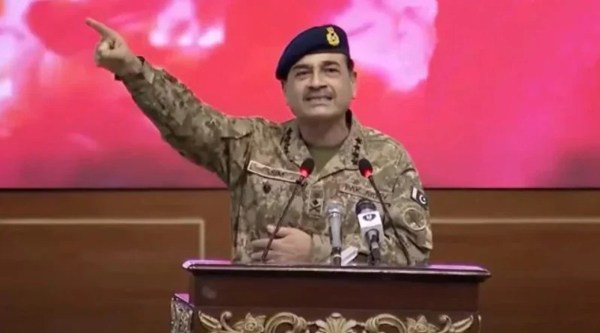 The current Pakistani paradox has at its heart the rise and rise of Asim Munir. (File)
A United Nations Security Council report on IS, Al Qaeda and other terror groups published this month notes, “…TTP used advanced assault rifles, night-vision devices, thermal-imaging devices, sniper systems and drone attack systems.”
There is significant violence by the Pakistani State too. This month, the Human Rights Commission of Pakistan released a report stating the Punjab police had carried out 670 encounters “over the course of eight months in 2025, resulting in the deaths of 924 suspects, with only two police officers killed during the same period.”
On the economy front, the International Monetary Fund, which in 2024 loaned $7 billion to Pakistan, pegs its 2026 Projected Real GDP at 3.2%, and World Bank President Ajay Banga this month said Pakistan needs to generate 2.5 million to 3 million jobs a year to avoid a domestic crisis.
What India needs to watch out for
Even a quick scan at the decades post Independence shows that Pakistan has attacked India — officially or through proxies — irrespective of how things were going for it. The 1965 war came when Pakistan was going through a golden period economically and had earned respect abroad. The Kargil war came when its affairs were collapsing on all fronts. What stands out is that Pakistan’s military in ascendance is never good news for India. Major terror attacks have come when the civilian leadership has pushed for better ties with India.
Story continues below this ad
And the current Pakistani paradox has at its heart the rise and rise of Asim Munir. While he has flexed muscle abroad, internally, there has been a brutal crackdown on insurgents, worsening instability.
Pakistan’s closer ties with the US have come when the military has been in power: before Munir, under General Zia-ul-Haq in the 1980s, and under Pervez Musharraf in the 2000s. If improved ties lead to more arms sales, India will be concerned. Also, hobnobbing with the US has generally meant internal consequences for Pakistan, exacerbating faultlines.
For India, the best case scenario is a relatively stable Pakistan with a civilian leadership in control. But with Shehbaz Sharif happily playing second fiddle to the field marshal, that doesn’t seem likely soon.
