

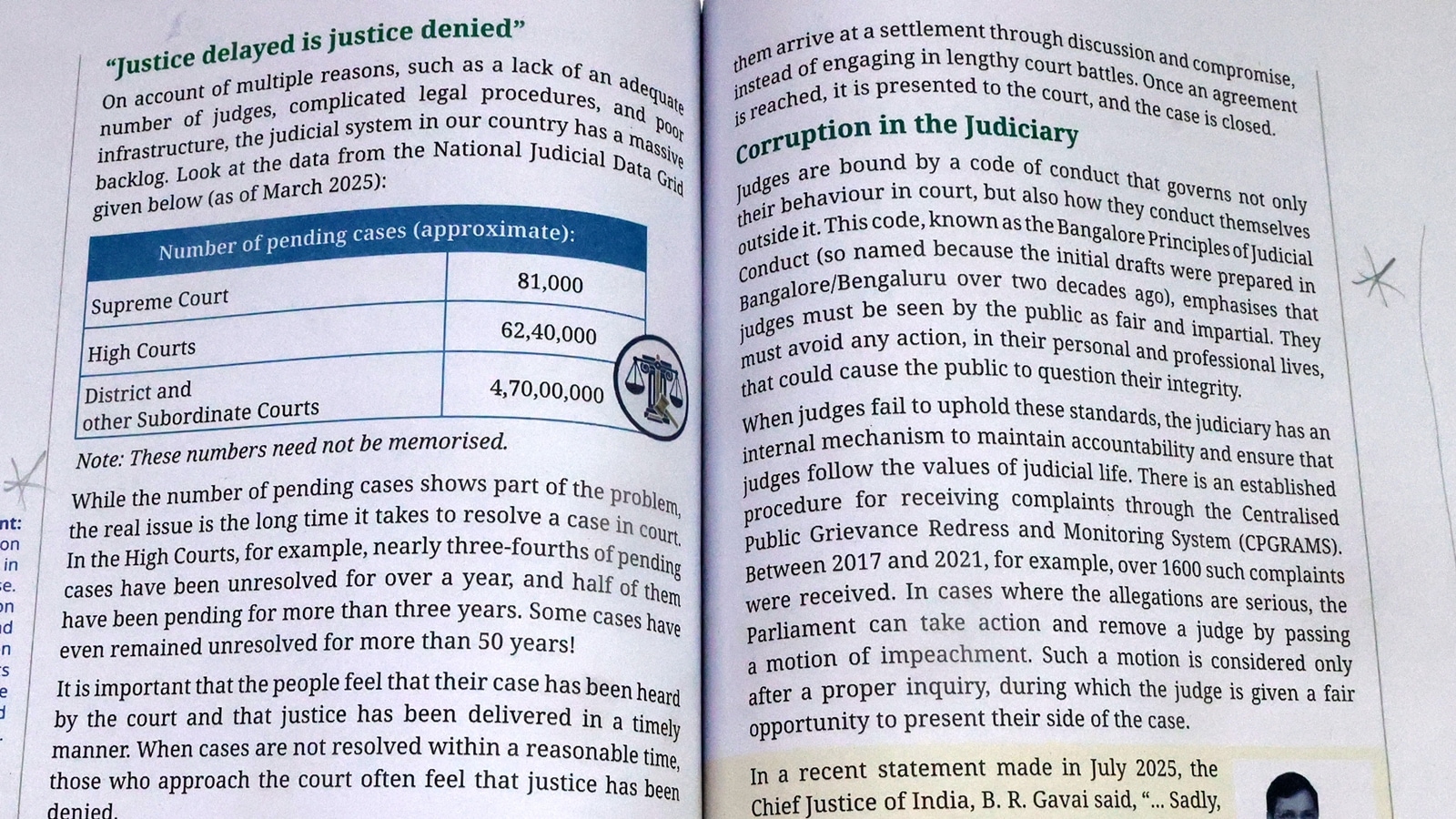
The new Social Science textbook for Class 8, released by the National Council of Educational Research and Training (NCERT) on Monday, includes a section on “corruption in the judiciary” as part of a chapter on “The role of the judiciary in our society”.
The chapter lists “corruption at various levels of the judiciary” and “massive backlog…on account of multiple reasons, such as a lack of an adequate number of judges, complicated legal procedures, and poor infrastructure” as among the “challenges” faced by the judicial system.
The old textbook only described the role of the judiciary, what an independent judiciary is, the structure of the courts, and access to them, without any mention of corruption. It did, however, have a paragraph that said an issue that affects the common person’s access to justice is the number of years that courts take to hear a case. “The phrase ‘justice delayed is justice denied’ is often used to characterise this extended time period that courts take,” it said.
ALSO READ | Thousands waiting 30 years: Why Rajasthan High Court freed NDPS convict citing backlog
Pending cases in SC and HCs
The new book lists the approximate number of pending cases in the Supreme Court (81,000), High Courts (62,40,000), and District and Subordinate Courts (4,70,00,000).
NCERT Director D P Saklani did not respond to a request for comment on the new section. He also didn’t respond to a question on the delay in releasing the textbook, since the academic session is nearing its end.
The section on “corruption in the judiciary”, in the new book, states that judges are bound by a code of conduct that governs not only their behaviour in court, but also how they conduct themselves outside it. It refers to the judiciary’s internal mechanism to maintain accountability, and an “established procedure for receiving complaints through the Centralised Public Grievance Redress and Monitoring System (CPGRAMS)”, adding that over 1,600 such complaints were received between 2017 and 2021.
Story continues below this ad
“In cases where the allegations are serious, the Parliament can take action and remove a judge by passing a motion of impeachment. Such a motion is considered only after a proper inquiry, during which the judge is given a fair opportunity to present their side of the case,” it states.
“Nevertheless, people do experience corruption at various levels of the judiciary. For the poor and the disadvantaged, this can worsen the issue of access to justice. Hence, efforts are constantly being made at the State and Union levels to build faith and increase transparency in the judicial system, including through the use of technology, and to take swift and decisive action against instances of corruption wherever they may arise,” it states.
It also quotes former Chief Justice of India B R Gavai as having said in July 2025: “…Sadly, there have been instances of corruption and misconduct that have surfaced even within the judiciary. Such occurrences inevitably have a negative impact on public confidence, potentially eroding faith in the integrity of the system as a whole. However, the path to rebuilding this trust lies in the swift, decisive and transparent action taken to address and resolve these issues… Any erosion of this confidence risks weakening the judiciary’s constitutional role as the ultimate arbiter of rights. Transparency and accountability are democratic virtues.”
ALSO READ | 30 years and counting: A look at oldest cases awaiting trial at Delhi courts
Story continues below this ad
Electoral Bonds, Information Technology Act
Following a section on “Why is an independent judiciary needed for justice?”, the book asks students to discuss two examples — on electoral bonds and the Information Technology Act.
It states that in 2018, the government introduced electoral bonds as a way for political parties to raise funds, allowing individuals and corporations to donate money anonymously.
“Issued by banks, they could be redeemed only by registered political parties that met certain criteria. However, the Supreme Court struck this provision down as being unconstitutional, stating that voters have a right to know who is funding political parties,” it states.
On the ‘Information Technology Act, 2009’, the book explains that a few years after it was implemented, the government added a clause that allowed people to be imprisoned for posts made on the internet or on social media. In 2015, a law student challenged this clause in court, arguing that it violated freedom of speech, and the Supreme Court agreed, declaring the new clause unconstitutional, and directing the government to remove it from the Act.
Story continues below this ad
The section asks students what the Supreme Court did in each of these instances, and why.
The NCERT has been developing new textbooks for all classes in line with the National Education Policy, 2020, and the National Curriculum Framework (NCF) for School Education. So far, new books for Classes 1 to 8 have been released. The first part of the Social Science textbook for Class 8 was released in July last year.
ALSO READ | Congress leaders accepted Partition as only way forward: New NCERT book
The old textbooks, based on the NCF of 2005, were “rationalised” and the content load was reduced following the Covid pandemic.
