

AI startup Anthropic has accused Chinese AI companies DeepSeek, Moonshot AI, and MiniMax of orchestrating “industrial-scale” distillation attacks on its AI models. The maker of Claude said in a post on X that the Chinese labs created more than 24,000 fraudulent accounts and generated over 16 million exchanges with Claude, effectively extracting its capabilities to improve their own models.
However, Elon Musk soon weighed in, claiming that the US startup itself is “guilty” over past training data practices, escalating a broader dispute over AI copying and data ethics.
Anthropic, in a post on its official blog on Monday, February 23, said that the three AI laboratories had illicitly extracted Claude’s capabilities to enhance their own models.
We’ve identified industrial-scale distillation attacks on our models by DeepSeek, Moonshot AI, and MiniMax.
These labs created over 24,000 fraudulent accounts and generated over 16 million exchanges with Claude, extracting its capabilities to train and improve their own models.
— Anthropic (@AnthropicAI) February 23, 2026
According to the company, the labs used a technique called distillation, meaning training less capable or smaller models on the outputs of a stronger one. This technique is widely used and is a legitimate way to train AI models, and frontier AI labs occasionally distill their own models to create smaller, cheaper versions for their customers.
However, the company warned that this method can also be used for ‘illicit purposes’. For instance, competitors can use it to extract advanced capabilities from other labs in a ‘fraction of time, at a fraction of the cost’ than it would take to develop them independently.
Why does this matter?
The company said that such methods are growing in intensity and sophistication and that the window to counter them is narrowing. The threat of distillation attacks, Anthropic said, has been growing beyond a single company and region. To address the issue, it called for rapid, coordinated action among industry players, policymakers, and the global AI community.
Anthropic’s blog post went on to describe ‘illicitly distilled models’ as posing significant national security concerns. According to the company, US companies and they build systems that prevent state and non-state actors from using AI for a range of malicious cyber activities; however, the illegally distilled models are unlikely to retain these safeguards. This means that these distilled models and their dangerous capabilities will further proliferate without any protections.
The frontier AI lab said that foreign labs distill American models and then feed the unprotected capabilities into military, intelligence, and surveillance systems, allowing authoritarian governments to deploy frontier AI for a variety of offensive operations.
Story continues below this ad
It needs to be noted that Anthropic does not offer commercial access to Claude in China, so all the mentioned labs seemingly circumvented it. They essentially used what Anthropic describes as ‘Hydra Cluster architectures,’ or networks of fraudulent accounts spread across Anthropic’s API and third-party cloud platforms.
The frontier AI lab makes two arguments on why this is a bigger problem beyond mere IP theft, the first is about safety and the second is about export controls, as the US restricts chip exports to China, reportedly to slow down frontier AI development. The San Francisco-based AI company essentially argues that these kinds of attacks strengthen the case for chip controls, as running distillation at this scale still requires significant compute.
The pushback
Meanwhile, Elon Musk took to his X profile to claim that the Dario Amodei-led AI lab is itself guilty of stealing training data at massive scale. “Anthropic is guilty of stealing training data at a massive scale and has had to pay multi-billion-dollar settlements for their theft. This is just a fact,” he wrote.
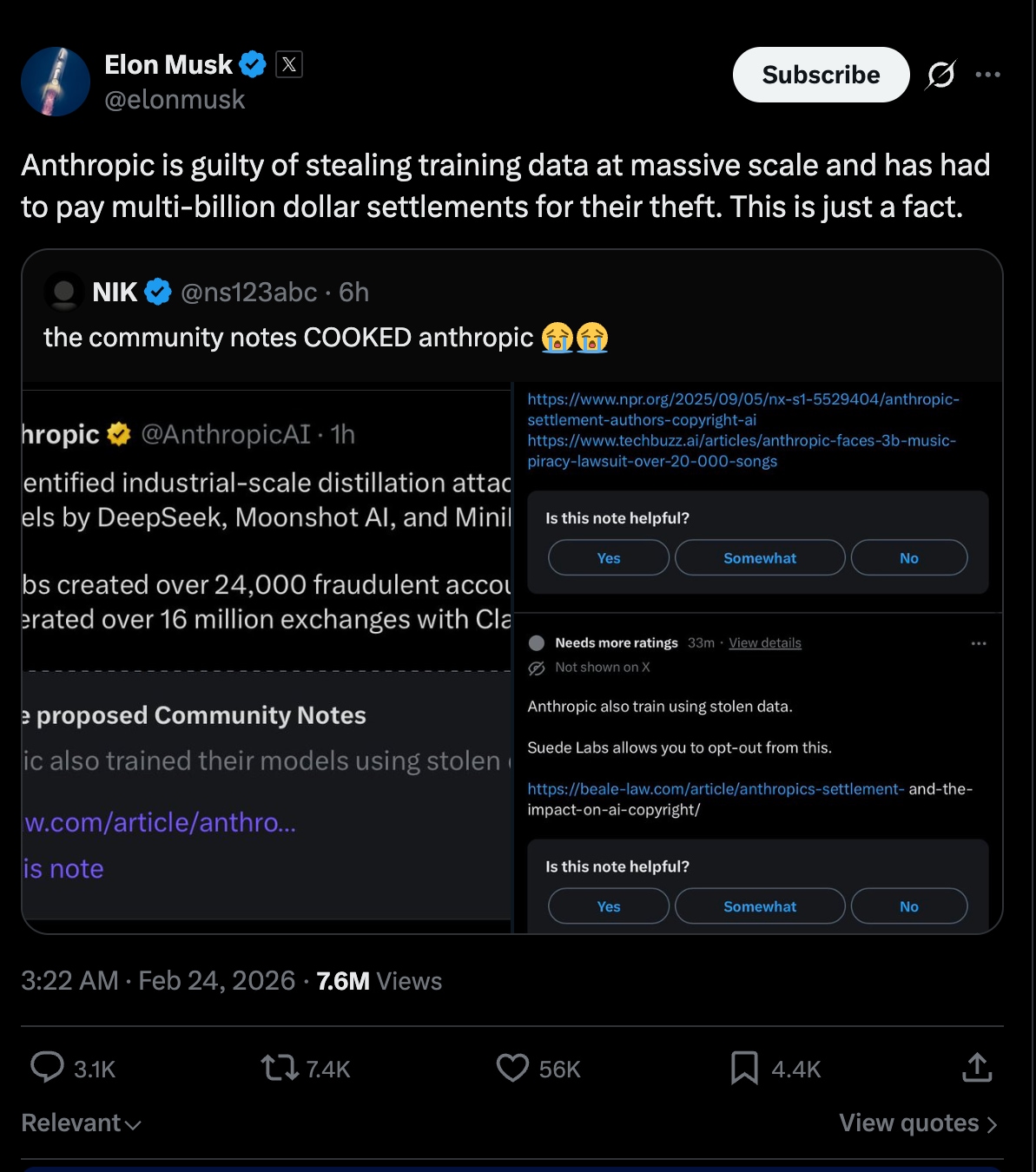 A screegrab of Elon Musk’s post on X slamming Anthropic’s report.
Anthropic has levelled serious accusations, even as its own models have been trained on pirated and stolen data. In December last year, the frontier AI lab settled a first-of-its-kind AI copyright infringement lawsuit with authors, agreeing to pay $1.5 billion. The Claude maker had reportedly used around 500,000 books to train its models without compensating authors or creators.
Story continues below this ad
Every major AI lab has trained its models on vast amounts of internet data without explicit permission from creators. This makes Anthropic’s argument appear somewhat shallow. AI labs have largely prevailed in arguing that scraping public data for training is legal or, at minimum, tolerable.
On the same day Anthropic accused Chinese AI labs of distilling its models, Axios reported that US Defence Secretary Pete Hegseth had summoned Anthropic CEO Dario Amodei to the Pentagon. A senior defence official said the meeting was not routine but focused on pushing Anthropic to allow Claude’s use by the military.
The timing is notable – Anthropic was facing pressure to prove its value as a national security asset while releasing a report warning that Chinese labs were undermining US AI capabilities and export controls.
Earlier this year, media reports said the US military used Claude during an operation that led to the capture of Venezuelan President Nicolás Maduro, though Anthropic has not confirmed this.
Story continues below this ad
The distillation claims may be credible, but their timing underscores how frontier AI companies increasingly rely on defence ties and government backing.
