


6 min readNew DelhiUpdated: Feb 24, 2026 10:35 AM IST
Punjab and Haryana High Court news: Observing that criminals are not born but made and no individual is beyond redemption, the Punjab and Haryana High Court granted bail to a man booked under the Unlawful Activities (Prevention) Act (UAPA) and who has alleged links to Gurpatwant Singh Pannun, a designated terrorist of the US-based banned outfit Sikhs for Justice (SFJ).
A bench of Justices Anupinder Singh Grewal and Deepak Manchanda was hearing a plea of one Harvinder Singh alias Prince and set aside the April 2, 2024, order of the trial court which had declined the bail.

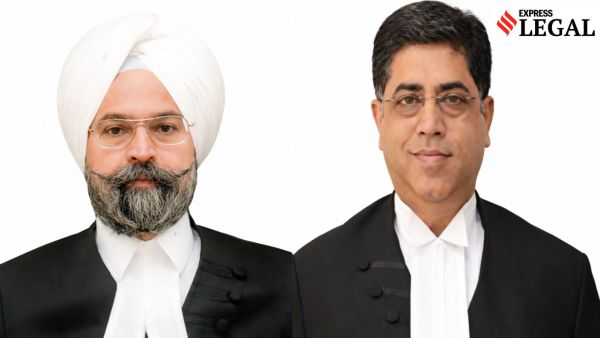 A bench of Justices Anupinder Singh Grewal and Deepak Manchanda set aside the trial court’s order denying bail to the accused.
“Criminals are not born out but made. The human potential in everyone is good and so, never write off any criminal as beyond redemption. This humanist fundamental is often missed when dealing with delinquents, juvenile and adult. Indeed, every saint has a past and every sinner a future,” said the court, referring to a Supreme Court verdict.
The high court’s decision came after noting that he had spent more than three years in custody and that the trial was far from completion.
Right to liberty is sacrosanct
- When a crime is committed, a variety of factors are responsible for making the offender commit it.
- Those factors may be social and economic, the result of value erosion or parental neglect, because of the stress of circumstances, or the manifestation of temptations in a milieu of affluence contrasted with indigence or other privations.
- Article 21 of the Constitution of India enshrines the fundamental right to Protection of Life and Liberty which also includes the right to speedy trial, which is sacrosanct.
- It has been held by the Supreme Court in a catena of judgments that long custody by itself would entitle the accused under UAPA to the grant of bail by invoking Article 21.
- Right to Life and Personal Liberty is overarching and sacrosanct.
- A constitutional court cannot be restrained from granting bail to an accused on account of restrictive statutory provisions in a penal statute if it finds that the right of the accused-undertrial under Article 21 has been infringed.
- In that event, such statutory restrictions would not come in the way.
- Even in the case of interpretation of a penal statute, however stringent it may be, a constitutional court has to lean in favour of constitutionalism and the rule of law, of which liberty is an intrinsic part.
- The constitutional court would like to prevent a situation where the lengthy and arduous process of trial becomes a punishment in itself.
- Howsoever serious a crime may be, an accused has a right to a speedy trial as enshrined under the Constitution.
FIR registered in 2022
- The case stems from an FIR dated July 28, 2022, registered at Baldev Nagar Police Station in Ambala under Indian Penal Code (IPC) sections 153A (promoting disharmony, enmity, or hatred between different groups based on religion, race, place of birth, residence, or language), 120B (criminal conspiracy) and Section 13 of the UAPA.
- The prosecution alleged that the appellant, along with a co-accused, affixed an objectionable banner on a tree.
- Notably, the appellant was not named in the original FIR.
- He was later implicated based on a disclosure statement made by the co-accused in another case registered in Patiala.
- The state further claimed that he had been in touch via WhatsApp with Gurpatwant Singh Pannun in connection with spreading the “Khalistan Movement,” and that he himself prepared the banner.
- However, the defence pointed out that no arms, ammunition, or other incriminating material had been recovered from him.
- Apart from the present FIR, he was not stated to be involved in any other criminal case.
3 years behind bars
- During the hearing, the state placed on record a custody certificate showing that the appellant had been incarcerated for over three years and two months.
- Out of 14 prosecution witnesses, only seven had been examined so far.
- The bench noted that the end of the trial was not in sight.
- The appellant’s counsel argued that continued incarceration without meaningful progress in trial amounted to a violation of Article 21.
- Article 21 can’t be overshadowed
- In its detailed order, the high court referred to a series of Supreme Court decisions, including Union of India v. KA Najeeb, Shoma Kanti Sen v. State of Maharashtra, Vernon v. State of Maharashtra, Sheikh Javed Iqbal @ Ashfaq Ansari @ Javed Ansari v. State of Uttar Pradesh and Javed Gulam Nabi Shaikh v. State of Maharashtra.
- These rulings make it clear that even in UAPA cases, where Section 43D (5) places stringent conditions on bail, constitutional courts retain the power to grant relief if prolonged incarceration infringes fundamental rights.
Cost of prolonged incarceration
- The court also reflected on the human cost of extended imprisonment, loss of livelihood, breakdown of family bonds, social alienation and psychological harm.
- Citing Supreme Court observations on overcrowded prisons and the phenomenon of “prisonisation,” the bench stressed that courts must remain sensitive to the irreparable damage prolonged pre-trial detention can cause, especially if the accused is ultimately acquitted.
Bail with safeguards
- Granting regular bail, the court imposed strict conditions, including a bond of Rs 1 lakh with two sureties of Rs 1 lakh each, surrender of passport, and mandatory appearance before the trial court on each date.
- Other conditions include appearance before the investigating officer when summoned.
- No threat or inducement to witnesses.
- No involvement in any criminal activity.
- No transfer or creation of third-party rights over immovable property.
- Appearance before the Station House Officer (SHO) on every alternate Monday until the conclusion of the trial.

© IE Online Media Services Pvt Ltd
