

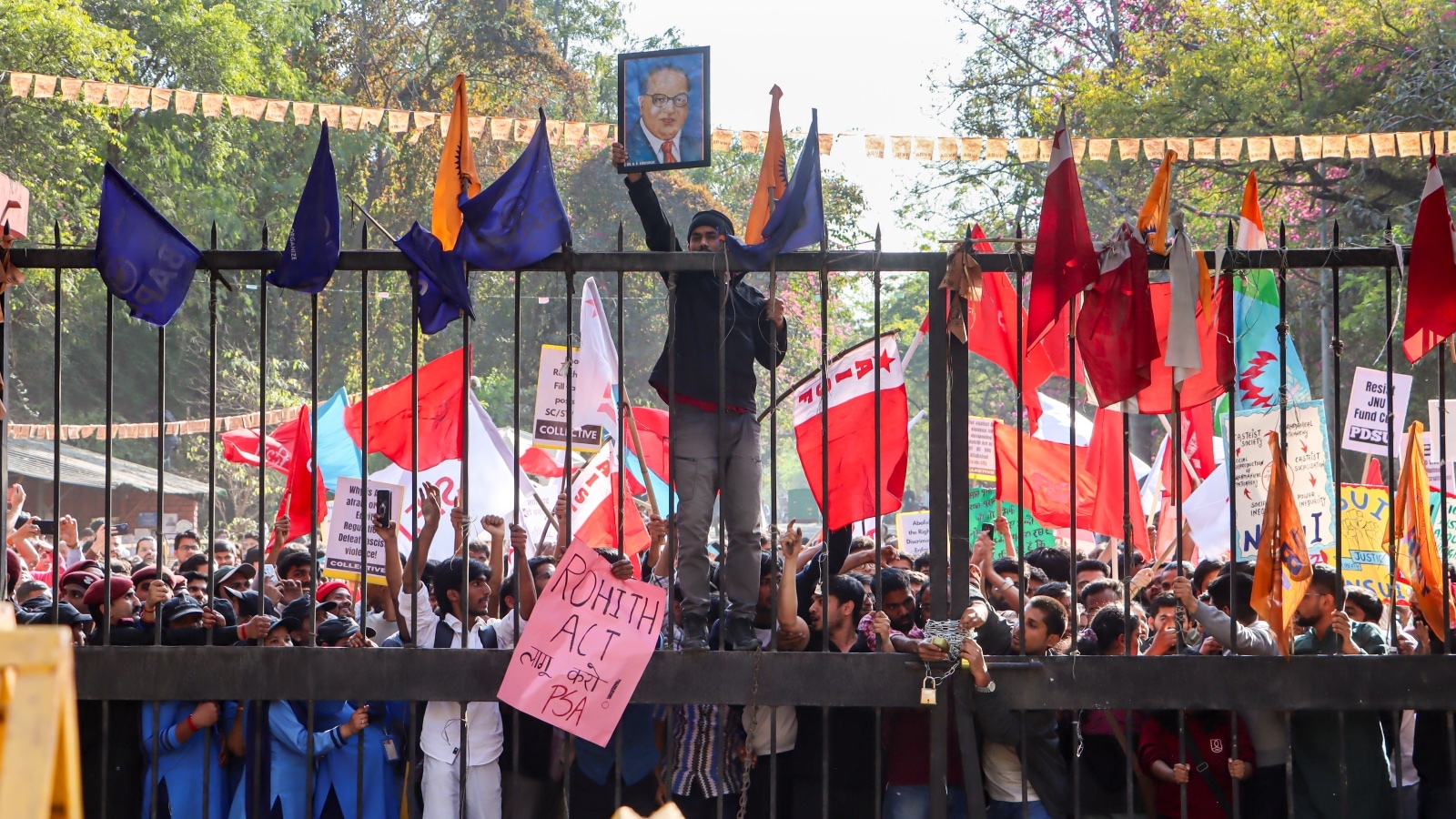
After a planned protest march towards the Ministry of Education by Jawaharlal Nehru University (JNU) students on Thursday afternoon ended in clashes with the police and the detention of 51 protesters, including four JNU Students’ Union (JNUSU) office-bearers, the university said that the union “has refused to address the core issue” of rustication of student leaders, which is “vandalism and violence against public property inside campus”.
The statement was referring to the rustication of five JNUSU office-bearers for allegedly vandalising surveillance equipment at the Ambedkar Library earlier this month.
Late night, the protesters were booked by Vasant Kunj North police under sections 221 (voluntarily obstructing a public servant in the discharge of official duties), 121[1] (voluntarily causing hurt to deter a public servant from performing their duty), 132 (assault or use of criminal force to prevent a public servant from carrying out official work and 3[5] (common intention) of Bharatiya Nyaya Sanhita (BNS).
The JNU administration also maintained that while JNUSU was demanding implementation of University Grants Commission (UGC) regulations despite a stay by the Supreme Court, neither the Vice-Chancellor nor the Registrar had the authority to implement them.
“JNUSU until today has refused to address the core issue of their rustication, which is the issue of vandalism and violence against public property unleashed inside campus,” the university said, adding that the students were rusticated following a proctorial inquiry.
Calling JNU “a public university, hence accountable to the government, the Parliament and the Indian taxpayers,” the administration described it as “deplorable” that a “woman OBC Vice Chancellor is instead attacked on false allegations, only to divert from the issue of violence and vandalism of public property.”
The statement came hours after several students, including JNUSU members, were detained when they attempted to take out a “long march” from the campus to the Ministry of Education.
Story continues below this ad
Among other issues, they were protesting against the alleged casteist remarks made by V-C Santishree Dhulipudi Pandit during a podcast interview published on February 16. Speaking about the UGC Equity Regulations, she had said: “You cannot progress by being permanently a victim or playing the victim card. This was done for the Blacks; the same thing was brought for Dalits here.”
According to Delhi Police, the JNU administration had informed the students that no permission had been granted to hold a protest outside the campus and asked them to restrict themselves to university premises. Despite this, around 400 to 500 students gathered on Thursday afternoon and began marching toward the main gate about 3.20 pm.
Many yellow barricades were seen outside the JNU main gate, alongside deployment of police personnel.
“The barricades were damaged and the protest became violent,” the police said in a statement. Protesters allegedly hurled banners, sticks and shoes, and some went “to the extent of physically assaulting by biting” police personnel, they added. “As a result, several police personnel were injured during the protest today,” the statement said.
Story continues below this ad
Police said the protesters were stopped at the North Gate of JNU and gradually pushed back inside. “Protestors were detained, who had become violent and did not obey lawful orders,” the statement added.
The JNUSU, however, alleged excessive force and misconduct by the police. “Delhi Police has detained many JNU students. Delhi Police also disrespected Babasaheb (Dr B R Ambedkar) by destroying his portrait,” it said in a statement.
Police, however, denied the allegation. “No poster was intentionally destroyed. There was a mob and we were busy trying to control it,” a police source told The Indian Express.
The Jawaharlal Nehru University Teachers’ Association (JNUTA), meanwhile, also condemned the police action and demanded the immediate release of detained students.
Story continues below this ad
“The JNUTA strongly condemns the brutal use of force by the Delhi Police against JNU students and the detention of several of them, including two JNUSU office-bearers,” the teachers’ body said. It alleged that women students were among those injured, and that “even the laws prohibiting male policemen from acting against women were brazenly flouted”.
It also expressed concern over the whereabouts and safety of those detained. “There are several women among them and they have been taken to unconfirmed locations that are far away from the campus,” the statement said, adding that reports had emerged of detainees being “subjected to further police beatings while in custody”.
Earlier in the day, protesters had assembled at Sabarmati T Point on the campus, carrying placards and banners. Heavy security deployment was visible inside and outside the university, with the main gates strongly barricaded.
The march, organisers said, was intended to highlight what they described as “institutional neglect” in higher education. It came amid continuing tensions on campus following violence earlier this week that included alleged stone-pelting and physical altercations between JNUSU members and ABVP activists. Delhi Police has since registered an FIR against JNUSU office-bearers.
Story continues below this ad
The protests have also been driven by allegations of caste discrimination on campus and demands for stronger implementation of UGC equity regulations, enactment of a proposed “Rohith Vemula Act”, increased funding for public institutions, and the resignation of the V-C.
