

The new NCERT class 8 social science textbook, which was to be taught in the ongoing academic session in schools, had a short shelf life — of just one day.
It was released on Monday (February 23) after a long wait for students. While part one of the social science textbook was released in July last year, part two was only out this week, close to the end of the academic session. The Indian Express reported Tuesday that the new book featured a section on “corruption in the judiciary”.
The NCERT swiftly pulled the book from sale on Tuesday. Education Minister Dharmendra Pradhan said later in the week that he had directed that the book be withdrawn immediately.
Having registered a suo motu case in the matter, the Supreme Court imposed a “complete blanket ban” on further publication, reprinting or digital dissemination of the book. On Wednesday, the NCERT expressed regret for the “inappropriate textual material and error of judgement” that “have inadvertently crept” into the chapter on the role of the judiciary.
For the NCERT, which has made sweeping changes to school textbooks in recent years, this expression of regret and the book’s withdrawal, even before the court’s order, is rare.
What was the need for revising the books?
New books for all classes are being developed and released in line with the recommendations of the National Education Policy (NEP) 2020, and the National Curriculum Framework for School Education (NCFSE) 2023.
The old books were based on the 2005 curriculum framework and were first published from 2006 to 2008. Based on the new NCF, new NCERT textbooks were released for classes 1 and 2 in 2023, classes 3 and 6 in 2024, and classes 4, 5, 7, and 8 in 2025.
Story continues below this ad
Before the new books were released, the NCERT had four rounds of textbook revisions since 2014, including a round of “rationalisation” in 2022-23 in the wake of Covid-19 to reduce content load.
What were some notable revisions?
Here are a few instances of revisions and changes, as reported by The Indian Express, that have sparked controversy in recent years.
*The class 12 political science textbook published after a review in 2017 described the 2002 Gujarat riots as only the “Gujarat riots”. This was different from the old textbook, which referred to it as the “anti-Muslim riots”, The Indian Express had reported then.
*As part of the rationalisation exercise in 2022, the section on the Gujarat riots in the class 12 political science book was trimmed. Deletions included references to the National Human Rights Commission’s criticism of the Gujarat government for failing to control the violence, and a paragraph on the chronology of events with the train of karsevaks being set on fire, followed by violence against Muslims.
Story continues below this ad
“Instances, like in Gujarat, alert us to dangers involved in using religious sentiments for political purposes,” reads a line that was removed, The Indian Express reported in 2022.
*Yet another reference to the Gujarat riots was removed from the class 12 sociology book in 2022. In a section on ‘Communalism, Secularism, and the Nation-State’, sentences that were dropped include: “In fact, the two most traumatic contemporary instances of communal violence occurred under each of the major political parties. The anti-Sikh riots of Delhi in 1984 took place under a Congress regime. The unprecedented scale and spread of anti-Muslim violence in Gujarat in 2002 took place under the BJP government.”
*In a class 12 sociology textbook in 2022, references to how “untouchability” operates were dropped, including: “A Dalit is likely to be confined to traditional occupations such as agricultural labour, scavenging, or leather work, with little chance of being able to get high-paying white-collar or professional work.”
*From a class 6 social science textbook, a box describing a common stereotype about Muslims, like they are not interested in educating girls, and why this is far from the truth, was removed.
Story continues below this ad
*From a class 12 sociology book, a paragraph on how minorities are politically vulnerable was removed: “In democratic politics, it is always possible to convert a numerical majority into political power through elections. This means that religious or cultural minorities — regardless of their economic or social position — are politically vulnerable. They must face the risk that the majority community will capture political power and use the state machinery to suppress their religious or cultural institutions…”
*Sections on the Delhi Sultanate and the Mughal empire were removed from the class 7 history textbook in 2022, including pages that described the expansion of the Delhi Sultanate and the achievements of Mughal emperors.
*In 2023, from a class 12 political science textbook, a paragraph on the ban on the RSS after Mahatma Gandhi’s assassination, and Hindu extremists having disliked Mahatma Gandhi was removed: “He (Gandhi) was particularly disliked by those who wanted Hindus to take revenge or who wanted India to become a country for the Hindus, just as Pakistan was for Muslims…His steadfast pursuit of Hindu-Muslim unity provoked Hindu extremists so much that they made several attempts to assassinate Gandhiji.”
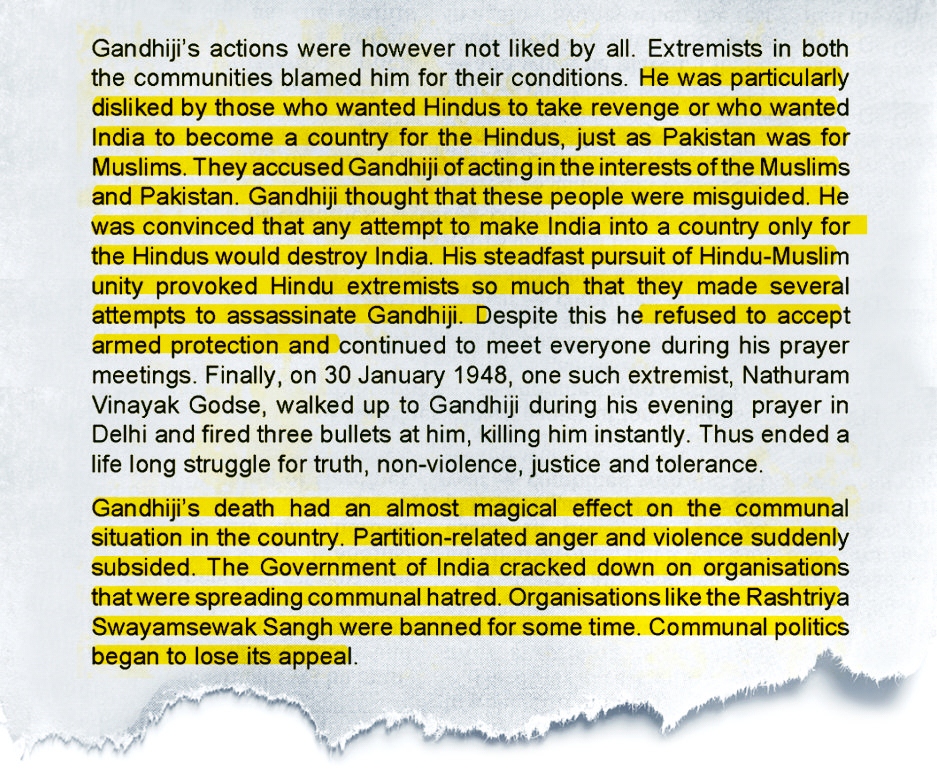 Deleted lines from the Class 12 Political Science book
*In 2024, the class 12 political science textbook did not mention the Babri Masjid by name, but called it a “three-domed structure”. While the old textbook had described the mobilisation on both sides, the communal tension, the BJP Rath Yatra, and the BJP expressing regret over the happenings at Ayodhya, these details were left out of the revised version.
Story continues below this ad
*A revised class 11 political science book released in 2024 stated that vote bank politics in India is associated with “minority appeasement” and this means political parties “disregard the principles of equality of all citizens and give priority to the interests of a minority group”. The old version had not mentioned minority appeasement.
*The new class 6 social science textbook released in 2024 refers to the Harappan civilisation as the ‘Sindhu-Sarasvati’ civilisation, unlike the old one, and makes several references to the ‘Sarasvati river’.
*Part one of the class 8 social science textbook released last year described Babur as a “brutal and ruthless conqueror, slaughtering entire populations of cities”, and Akbar’s reign as a “blend of brutality and tolerance.” The history section of the book, including the Delhi Sultanate and the Mughals, is preceded by a ‘note on history’s darker periods’.
*Referring to “darker” periods of history when war, abuse, fanaticism, and bloodshed dominate the landscape, the note explains that it is important to study darker developments dispassionately without blaming anyone living today for them.
Story continues below this ad
*In the chapter on the colonial era and the resistance to the British, the book skipped mentions of Tipu Sultan, Haidar Ali, and the Anglo-Mysore Wars, which were in the old book.
*Part 2 of the class 7 social science textbook released last year has a larger section than the old book on the Ghaznavid invasions, focusing on the Mahmud of Ghazni’s “destruction and plunder”, his eagerness to “spread his version of Islam to non-Muslim parts of the world”, and the destruction of the temple at Somnath.
