

4 min readNew DelhiUpdated: Mar 3, 2026 06:19 PM IST
Canadian Prime Minister Mark Carney on Monday highlighted strong Canada-India ties, noting that 4 lakh Indian students are currently in Canada. “That is twice the number in the United States and four times the number in the United Kingdom,” he said, addressing reporters alongside Prime Minister Narendra Modi.
While announcing the Canada-India Talent and Innovation Strategy with 13 university partnerships in New Delhi on Monday, Carney said these students “deepen our ties”.

In the past couple of years, Indian students — for whom Canada is among the top destinations — have faced an unprecedented spike in visa refusals, long processing delays, and confusion over housing and post-study work rules. In that context, during Carney’s visit, the two sides discussed ways to get around this and looked towards a shift in education policy — moving away from “volume-driven student mobility to structured academic collaboration”, said MEA, Secretary (East), P Kumaran, briefing reporters at the conclusion of the Canadian PM’s visit on Monday.
Talking about the importance of international academic collaboration and building a future-ready workforce, the two leaders — as per joint statement — agreed to deepen cooperation between higher education institutions by enhancing industry aligned skills training, expanding joint and dual-degree programmes and facilitating the establishment of offshore campuses of leading Canadian institutions in India.
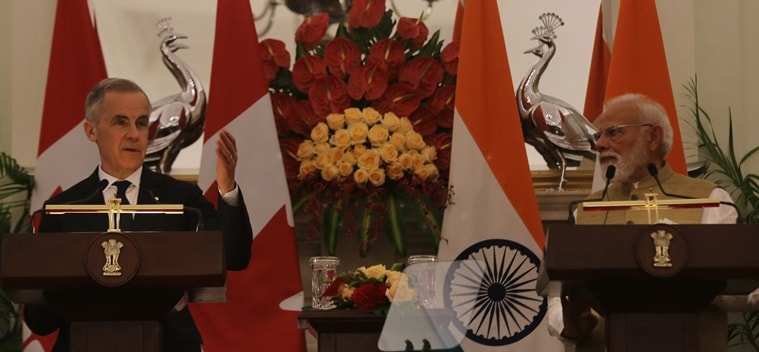 PM Narendra Modi with his Canadian counterpart Mark Carney at Hyderabad House in New Delhi on Monday. (Express photo by Anil Sharma)
Canadian Foreign Minister Anita Anand welcomed the new strategy, which will facilitate research, student exchanges, hybrid campuses, and AI centres of excellence between Canada and India. “We have vast human capital, with students and faculty already deeply connected on cutting-edge research. This agreement will reinforce collaboration through opportunities for students and researchers, drive economic growth and deepen the strong people-to-people ties that connect our two countries,” she said.
Since 2023, Canada has sharply tightened its international student regime, and Indian students, once the backbone of Canada’s overseas enrolments, have been the most affected. Data from Immigration, Refugees and Citizenship Canada showed a sharp fall in study permit approvals through 2024 and 2025 following the introduction of national caps and stricter verification measures. Indian students were the worst affected.
Government data stated that refusal rates for Indian study permit applications rose to about 74% in August 2025, compared with roughly 32% two years earlier. At the same time, application volumes from India collapsed, as repeated refusals, processing delays, and shifting rules discouraged prospective students.
Story continues below this ad
This coincided with a period of diplomatic strain between New Delhi and Ottawa after 2023, creating an atmosphere in which immigration and visa processing became politically more sensitive.
Kumaran said, “There has been a broad popular pressure on politics in Canada that too many foreign students put pressure on infrastructure, job market and other citizen services. So, they seem to have moved in a direction where there are restrictions on the number of students they are willing to take in the future.”
Our aim is to take the benefit of high-quality Canadian education institutions, find ways to partner with them — hybrid campuses, offshore campuses, he said, adding that alternate approaches are being tried. “Canada is currently undertaking reforms in its visa and immigration policy,” Kumaran said.
The two countries also signed an MoU on Cultural Cooperation, expanding collaboration in the arts, heritage, audiovisual media, music, and creative industries. With an aim to empower Indigenous and Tribal communities in both countries, they welcomed Bharat Tribal Festival (BTF) 2026 as an example of an important platform to promote global exchanges in entrepreneurship, cultural preservation, and sustainable livelihoods.
Story continues below this ad
Meanwhile, Modi and Carney also welcomed the recent Canada-India Track II Strategic Dialogue, which brought together policymakers, experts, business leaders, and civil society to explore pathways for translating the diplomatic reset into concrete cooperation across issues such as economic resilience, energy security, and people-to-people exchanges.


© The Indian Express Pvt Ltd
