

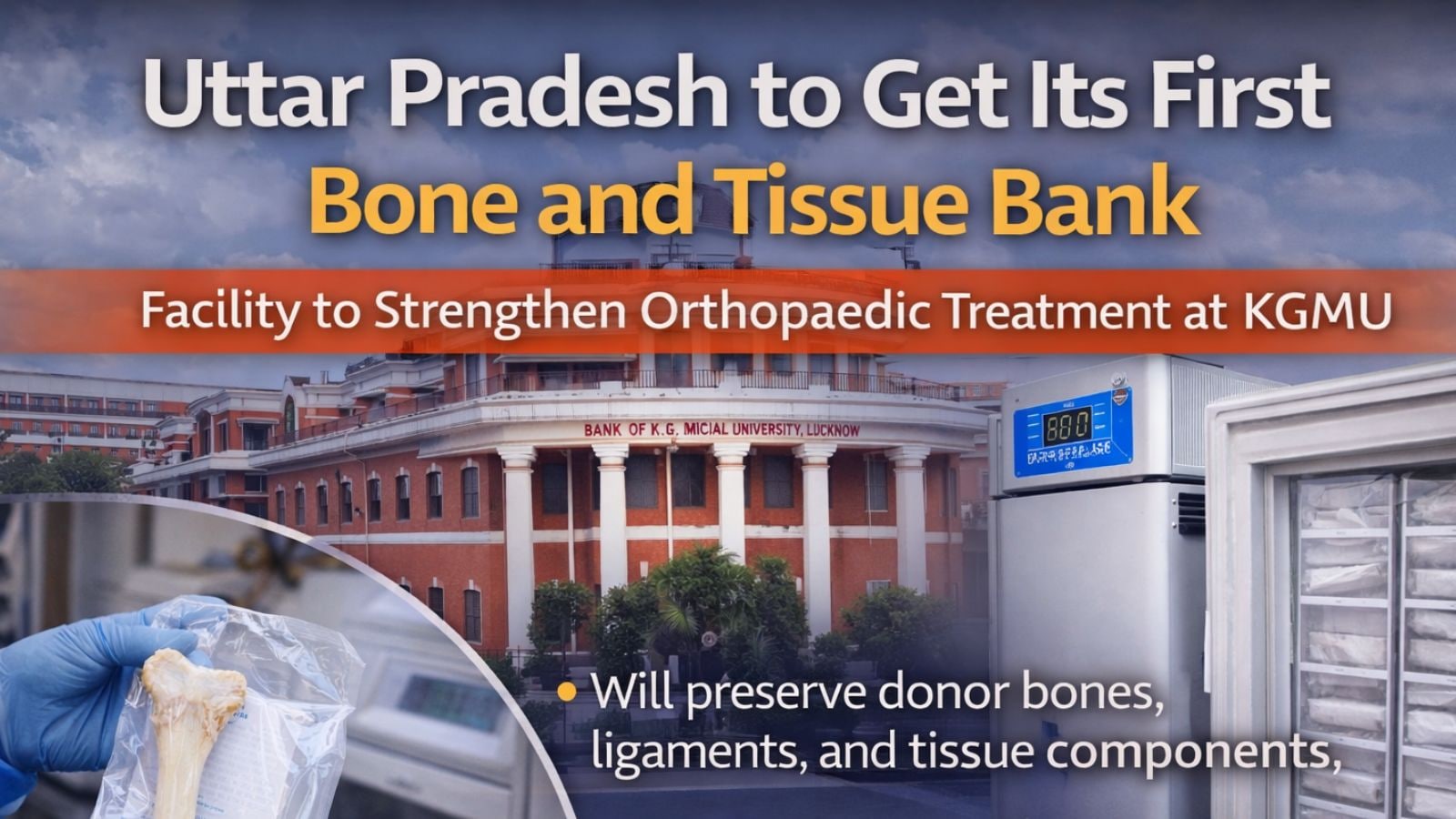
King George’s Medical University (KGMU) is set to establish Uttar Pradesh’s first Bone and Tissue Bank, a significant step that is expected to strengthen orthopaedic treatment and help patients undergoing complex surgeries.
The facility is likely to become operational within the next one to two months once final approval is received from the authorities.
Sources at KGMU said that most of the groundwork for the facility has already been completed, with the required infrastructure and equipment already installed. The university is currently awaiting the final nod from the Director General of Medical Education (DGME) before formally launching the service.
Doctors at the university said the bone bank will play a crucial role in treating patients suffering from severe bone loss due to accidents, tumours, infections and revision joint replacement surgeries, where the patient’s own bone may not be sufficient for reconstruction.
According to Dr Ashish Kumar from the Department of Orthopaedic Surgery at KGMU, bone grafting is an essential part of many orthopaedic procedures. “In several cases, especially during complex trauma surgeries or revision joint replacements, a large amount of bone graft is required. It is often not possible to obtain sufficient bone from the patient’s own body, and, therefore, donor bone becomes necessary,” he explained.
The bone bank is also expected to significantly help surgeons dealing with revision joint replacement surgeries, which are becoming increasingly common. During revision surgeries, surgeons often face major bone loss around the implant, making donor bone grafts crucial for rebuilding the affected area.
How will it work?
The proposed bone bank will primarily preserve donor bone components such as femoral heads removed during hip replacement surgeries. These bones, after undergoing strict donor screening and processing, will be preserved under specialised conditions so they can later be used for reconstructive surgeries.
Story continues below this ad
The facility will be capable of preserving bones as well as ligaments, tendons and other tissue components at -80°C in specialised freezers. Experts said that such preservation allows the tissues to remain viable for extended periods, making them readily available when required for surgical procedures.
Doctors added that preserved bone material can be processed and stored in multiple forms, including bone chips, powder and whole structural grafts, depending on the needs of a particular surgery.
Why bone grafts are important in orthopaedic surgery
Doctors explained that bone grafts are widely used in orthopaedics to fill bone defects, support implants, stabilise joints or reconstruct bone lost due to tumours or trauma. While synthetic substitutes such as calcium-based graft materials are available, they are generally used for smaller defects and can be costly when large bone reconstruction is required.
Structural bone grafts are particularly useful when surgeons need to reconstruct damaged bone segments or provide support in procedures such as knee reconstruction or revision joint replacement.
Story continues below this ad
To ensure safety, the donor bone will undergo rigorous medical screening and sterilisation protocols. According to doctors, the sterilisation process can be completed within 24 hours, ensuring that the tissues are safe and ready for use in surgeries.
In addition, donors are monitored and re-screened during the storage period to eliminate any risk of infection or antigenicity before the grafts are used in patients.
Boost for state
At present, only a few major institutions in India operate bone banks, including AIIMS in New Delhi, Tata Memorial Hospital in Mumbai, and Ramaiah Medical College in Chennai. The proposed facility at KGMU will bring similar advanced infrastructure to UP, where such specialised services are currently limited, said officials.
Doctors also pointed out that the orthopaedic department at KGMU handles a large number of trauma and joint replacement cases, drawing patients not only from across UP but also from neighbouring states.
Story continues below this ad
The establishment of a bone bank within the university will ensure that graft material is readily available for emergency and planned surgeries, reducing delays in treatment.
The facility will also require trained technicians to handle donor bone procurement, processing, preservation and documentation, and sources informed that university has already begun preparing staff for these specialised responsibilities.
