

UPSC Essentialsbrings to you its initiative of subject-wise quizzes. These quizzes are designed to help you revise some of the most important topics from the static part of the syllabus. Attempt today’s subject quiz on theEconomyto check your progress.
🚨Click Hereto read the UPSC Essentials magazine forFebruary2026.Share your views and suggestions in the comment box or at manas.srivastava@indianexpress.com🚨
1. Paints
2. Automobiles
3. Cosmetics
4. Chemicals
(d) 1, 2, 3 and 4
Relevance: Questions testing the industrial uses of petroleum and its derivatives are common in UPSC Prelims under Economy and Geography.
Explanation:
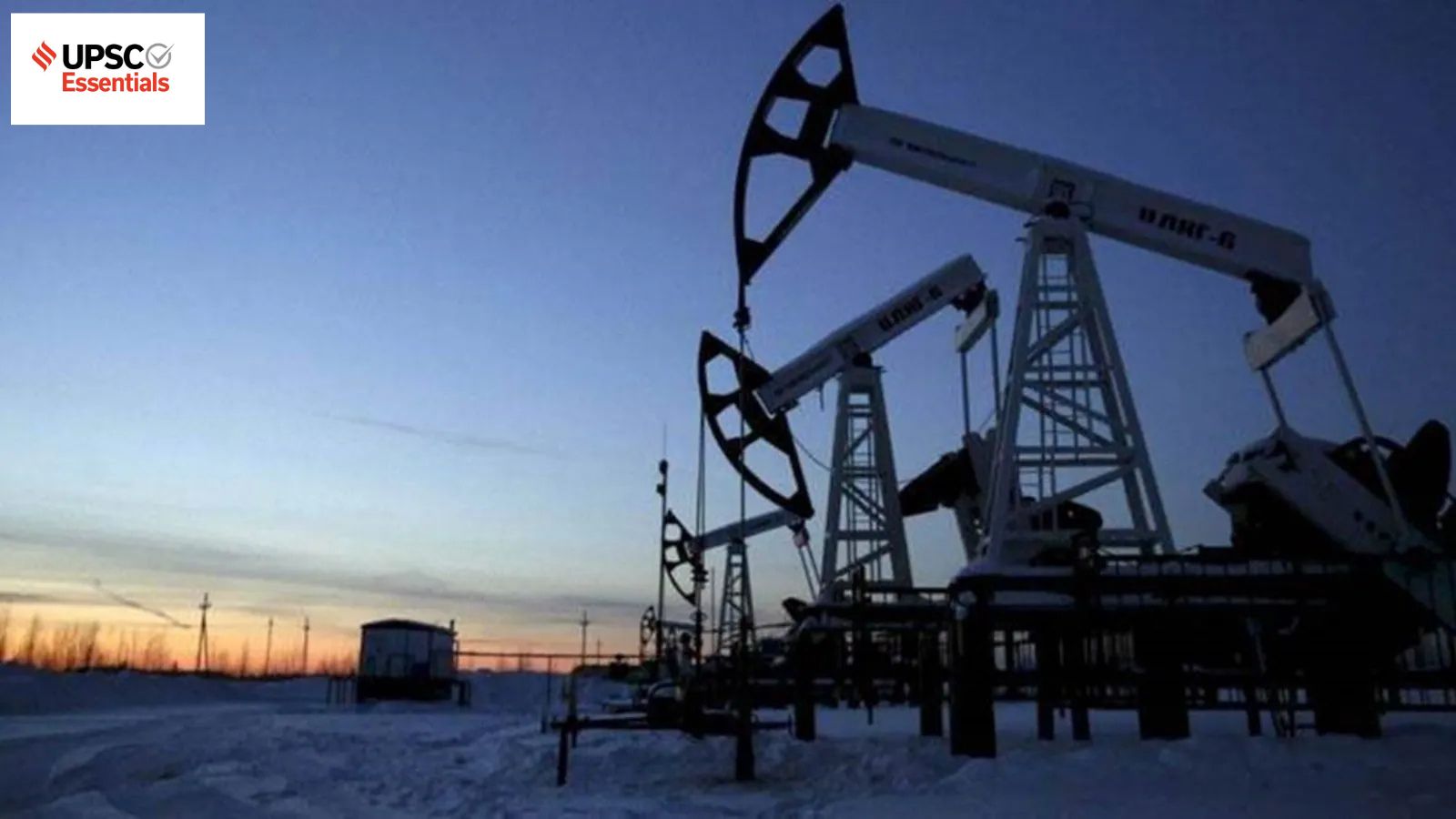
—Crude is an important raw material and fuel for a host of industries such as automobiles, paints, chemicals, cosmetics, aviation, and oil refining, among others. Every $1 increase in oil price is estimated to inflate the oil import bill by up to $2 billion on an annualised basis.
Therefore, option (d) is the correct answer.
QUESTION 2
Banks can provide a guarantee for proprietary trading when it is secured by:
1. Cash
2. Government securities
3. Land holdings
4. Corporate shares
(a) 1 and 2 only
(b) 1 only
(c) 2, 3 and 4
(d) 1, 2, 3 and 4
Story continues below this ad
Relevance: Regulations governing banks’ participation in financial markets and proprietary trading are periodically issued by the Reserve Bank of India, making them relevant for questions on financial sector regulation. They are also important in the broader context of financial stability and regulation of banking activities in India.
Explanation:
—The RBI also said that lenders cannot provide money to these intermediaries for buying securities on their account, including for proprietary trading or investments — except in certain cases, such as market making in debt and equity as well as warehousing of debt securities.
—The RBI has also said that banks can provide a guarantee for proprietary trading as long as it is fully secured by cash, cash equivalents, and government securities. However, at least 50% of the collateral must be in the form of cash.
—These norms are set to be effective from April 1.
Therefore, option (a) is the correct answer.
QUESTION 3
The countervailing duties are defined as:
Story continues below this ad
(a) additional customs duties imposed to counter currency depreciation effects
(b) export taxes imposed by an exporting country to discourage exports
(c) taxes imposed on domestic producers to balance international trade
(d) import taxes imposed by an importing country to offset foreign government subsidies on goods
Story continues below this ad
Relevance: Trade-remedy measures such as countervailing duties are important instruments used by countries to address unfair trade practices in international commerce. Questions on such measures frequently appear in the context of global trade regulations under the World Trade Organization and India’s trade policy framework.
Explanation:
—The US’ decision to impose preliminary countervailing duties (CVD) of 126% on solar imports from India comes at a critical juncture. The country’s solar module manufacturing capacity has expanded rapidly and now exceeds 140 gigawatts (GW) per annum. This could potentially exert pricing pressure on domestic OEMs and impact profitability of solar module manufacturers.
—Countervailing duties (CVDs) are import taxes imposed by an importing country to offset foreign government subsidies on goods.
Therefore, option (d) is the correct answer.
QUESTION 4
Consider the following statements:
1. More than half of India’s LNG imports pass through the strait of Hormuz.
2. India maintains strategic LPG reserves like crude.
Which of the statements given above is/are correct?
(a) 1 only
(b) 2 only
(c) Both 1 and 2
(d) Neither 1 nor 2
Story continues below this ad
Relevance: Maritime chokepoints such as the Strait of Hormuz are crucial for global energy trade and directly affect India’s energy security. Questions on energy imports, strategic reserves, and supply vulnerabilities are frequently asked in UPSC Prelims under the Economy–Geography interface.
Explanation:
—The Strait of Hormuz, the world’s most important oil transit chokepoint, is a narrow waterway between Iran and Oman that connects the Persian Gulf with the Gulf of Oman and the Arabian Sea.
—Around 60% of India’s LNG imports pass through the strait and, like LPG, there are no structural buffers in place. Hence, statement 1 is correct.
—India is the world’s third largest consumer of crude oil with an import dependency level of over 88%. The majority of the country’s gas consumption is also met through imports, and oil and gas supplies from West Asia are critical for India. LPG imports are the “bigger vulnerability” for India, as the country imports 80–85% of its LPG needs, with the majority sourced from Gulf suppliers and almost entirely transiting Hormuz.
Story continues below this ad
—In the case of liquefied petroleum gas (LPG) and liquefied natural gas (LNG) imports, where India’s dependence on the Strait of Hormuz is relatively higher than oil, the challenge could be greater — securing supplies while also paying a higher price for imports.
—And unlike crude, India does not maintain strategic LPG reserves of comparable scale, making LPG flows more logistically sensitive in a disruption scenario as India has “thinner structural buffers” when it comes to LPG. Hence, statement 2 is not correct.
Therefore, option (a) is the correct answer.
QUESTION 5
The Ministry of Statistics and Programme Implementation (MoSPI) will release GDP data for October-December 2025 as per the new series with the base year:
(a) 2024-25
(b) 2022-23
(c) 2020-21
(d) 2017-18
Relevance: Base year revisions of GDP are periodically undertaken by the Ministry of Statistics and Programme Implementation to better reflect structural changes in the economy and improve data accuracy. Questions on GDP methodology, base year changes, and statistical institutions can appear in UPSC Prelims.
Explanation:
Story continues below this ad
—MoSPI will release GDP data for October-December 2025 as per the new series with 2022-23 as the base year, along with the Second Advance Estimate for 2025-26. The First Advance Estimate, released in January as per the old series, pegged full-year growth at 7.4%. GDP data for the first two quarters of 2025-26 will also be revised.
—Finally, annual and quarterly GDP data as per the new series will also be released for 2022-23, 2023-24, and 2024-25. This will help policymakers and economists understand how India’s recent growth trajectory has evolved as per the new series. However, it will take almost a year to get a ‘back series’ that shows GDP data for years before 2022-23 as per the new GDP series, with the MoSPI official quoted above saying the back series is expected to be released by December 2026.
Therefore, option (b) is the correct answer.
Previous Daily Subject-Wise-Quiz
Daily Subject-wise quiz — History, Culture, and Social Issues (Week 147)
Daily subject-wise quiz — Polity and Governance (Week 152)
Daily subject-wise quiz — Science and Technology (Week 152)
Daily subject-wise quiz — Economy (Week 151)
Daily subject-wise quiz — Environment and Geography (Week 151)
Daily subject-wise quiz – International Relations (Week 151)
Story continues below this ad
Subscribeto ourUPSC newsletterand stay updated with the news cues from the past week.
Stay updatedwith the latestUPSC articlesby joining ourTelegram channel–IndianExpressUPSC Hub, and follow us onInstagramandX.
