

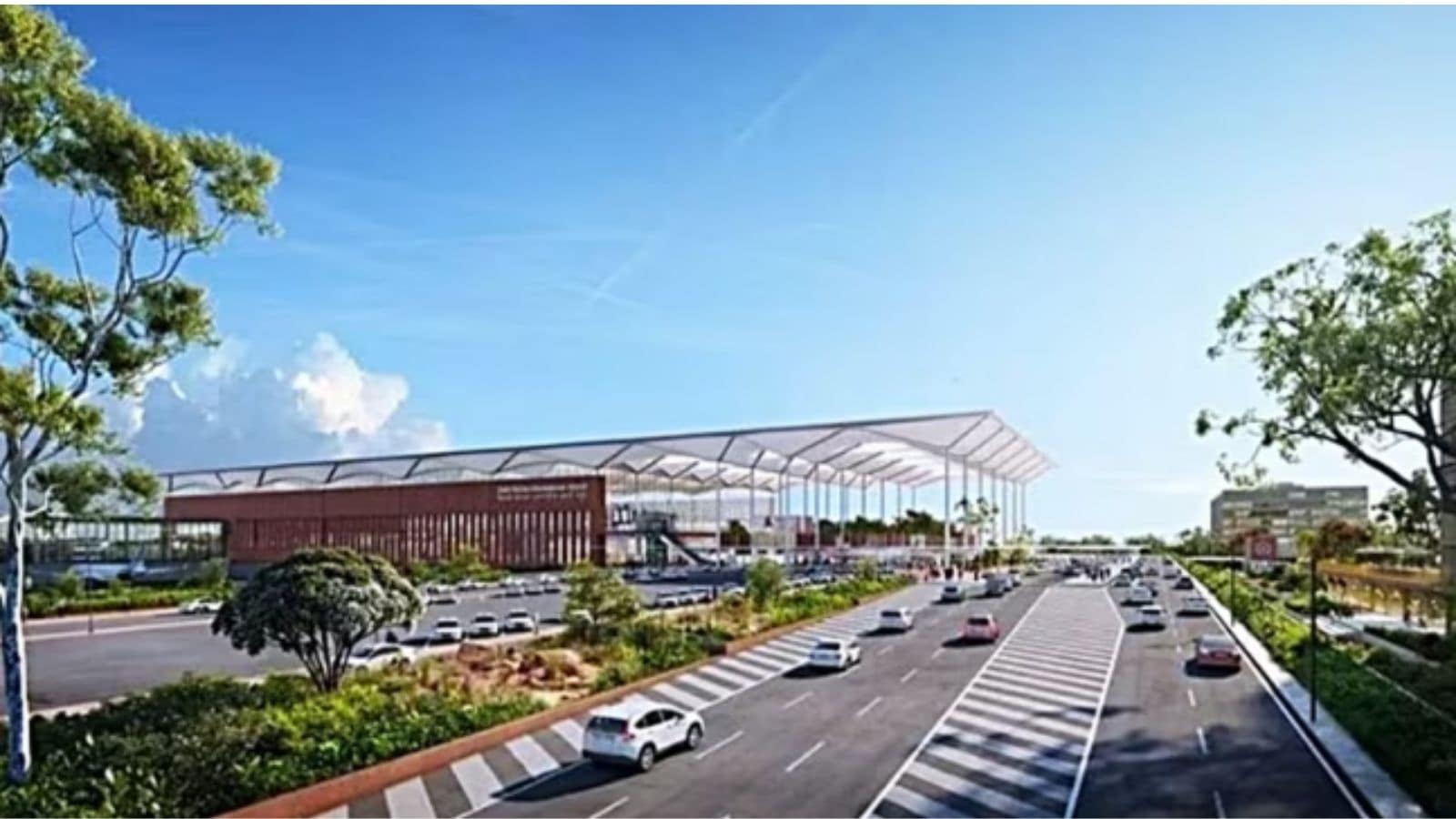
The Union Cabinet Tuesday approved an elevated road project to connect the upcoming Noida International Airport in Jewar directly with Faridabad, via the Faridabad-Ballabgarh-Sohna spur of the Delhi-Mumbai Expressway. The decision was announced by Railways and Information Technology Minister Ashwini Vaishnaw.
To be built at a cost of Rs 3,631-crore, this 7.8-km-long elevated corridor will intersect key corridors like the Eastern Peripheral Expressway, Yamuna Expressway, and Dedicated Freight Corridor.
The elevated road will also integrate with the upcoming Faridabad-Jewar Greenfield Expressway, being developed by the National Highways Authority of India (NHAI), via the expressway spur, further enhancing connectivity to the airport.
The greenfield project, approved earlier under the Bharatmala programme at a cost of around Rs 2,414 crore, starts from Sector 65 in Ballabhgarh (Faridabad) and ends near Dayanatpur village close to the airport.
Once completed, it will reduce road distance from nearly 90 km to about 31 km. The project is designed as a six-lane access-controlled corridor, expandable to eight lanes in the future, and passes through 18 villages across Haryana and Uttar Pradesh.
Connectivity push and real estate outlook
Improved road access to Jewar airport is expected to significantly cut travel time between Faridabad and the airport — from nearly two hours currently to about 20 minutes — potentially strengthening the city’s integration with NCR’s emerging growth corridors.
Along with road infrastructure, the proposed Gurgaon-Faridabad-Greater Noida rapid rail corridor is also expected to improve cross-city connectivity.
Story continues below this ad
Real estate analysts say such infrastructure upgrades could drive demand for residential, commercial, logistics and hospitality projects along the corridor, particularly in Greater Faridabad, Ballabhgarh and sectors located near the Delhi–Mumbai Expressway.
According to Anarock data for H1 2024, combined sales across Ghaziabad, Faridabad, Delhi, and Bhiwadi stood at 6,205 units. Of these, more than 715 units were in the luxury segment while 3,570 units were in the mid-to-premium segments.
Industry observers say major infrastructure developments — including the Delhi-Mumbai Expressway, the Faridabad-Noida-Ghaziabad Expressway and metro connectivity — could support property value growth of 35-50% in the coming years by improving regional accessibility.
Developers such as BPTP, Omaxe, and NeoLiv, with land holdings in the area, are positioned to meet rising demand for amenity-rich, community-oriented housing in well-connected locations, their officials said.
Story continues below this ad
Faridabad’s relatively lower property prices compared to Gurgaon and Noida, combined with airport proximity, could make it an attractive alternative for buyers and investors seeking appreciation tied to infrastructure timelines, they added.
Industry voices
Rajat Bakolia, CEO of Newstone, said the Faridabad-Jewar connectivity projects could mark an important phase for the city’s property market.
“The commencement of the Greenfield Expressway connecting Faridabad with the upcoming Noida International Airport is set to be a defining moment for the city’s real estate trajectory. Improved connectivity is often the single biggest catalyst for property growth, and this corridor will significantly reduce travel time by integrating Faridabad with major expressways and emerging economic hubs across NCR,” he said.
Mohit Malhotra, Founder & CEO of NeoLiv, said Faridabad “is entering a decisive phase of urban transformation”, with the latest infrastructure projects “significantly strengthening regional connectivity” and potentially “unlocking new economic opportunities for the city”.
Story continues below this ad
“As per infrastructure updates and market observations, the expressway will strengthen logistics access, enhance residential demand, and unlock new development pockets across sectors near Ballabhgarh and Shahpur. We expect Faridabad to gradually transform from an industrial city into a well-connected residential and investment destination,” he said.
Malhotra added that the proposed rapid rail corridor could further reshape connectivity across NCR by enabling faster and more predictable cross-city travel. “It positions Faridabad, Gurgaon and Noida as closely interconnected urban centres, with commuting becoming more seamless. As rapid rail networks advance, we foresee a more end-user-focused market where connectivity, planning and delivery standards shape long-term value,” he said.
He also said Faridabad could soon be seen as the third mega city of NCR and a strong first-choice for families seeking space, luxury community and large organised green surroundings without losing access to commercial hubs.
NeoLiv recently signed a management agreement for 62 acres in Sectors 98 and 99A in Faridabad, near the DMIC, aiming to develop a master-planned community with premium villas, retail, theme-based elements, and a high-end clubhouse.
Story continues below this ad
Manik Malik, CEO and President of BPTP, said the Namo Bharat corridor would strengthen integrated mobility across NCR.
“By enabling faster, multi-modal connectivity between Gurgaon, Faridabad, Noida and Greater Noida, it lays the foundation for more inclusive and accessible urban growth. Such large-scale infrastructure investments serve as strong enablers for residential and economic development, linking population centres with key employment and commercial hubs,” he said.
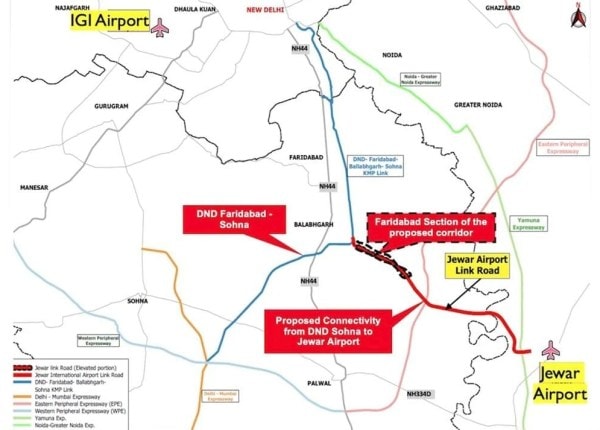
JEWAR AIRPORT-DELHI CONNECTIVITY: AT A GLANCE
The project:Cabinet approves a new greenfield link connecting Jewar International Airport to the Faridabad-Ballabgarh-Sohna spur of the Delhi-Mumbai Expressway
Project cost:Revised budget approved at Rs 3,631 crore
Key infrastructure:Features a 7.8-km elevated corridor directly linking the airport to the expressway
Story continues below this ad
Urban alignment: 7.8 km of the project route passes through notified urban limits under the Faridabad Master Plan 2031
Major intersections: The corridor will cross three major transit arteries: the Eastern Peripheral Expressway, Yamuna Expressway, and the Dedicated Freight Corridor
