A college student asks ChatGPT to break down a complex economics concept. A programmer pastes in a block of code and asks why it won’t run. A manager needs help drafting an awkward email.
A brief pause, and the answers roll out. Behind each of these seemingly effortless responses are billions of complex mathematical calculations done at blinding speed inside data centres: giant physical structures that power the virtual world of artificial intelligence.

Heading west on the Noida-Greater Noida Expressway, the city fades. The chaotic sprawl of malls and densely packed residential complexes gives way to vast stretches of open land at Knowledge Park V, an area designated to be a hub of corporate headquarters and institutional campuses. A herd of buffaloes walks leisurely past hoardings promising luxurious office spaces. Out of this landscape rises a monolith: a six-storeyed data centre.
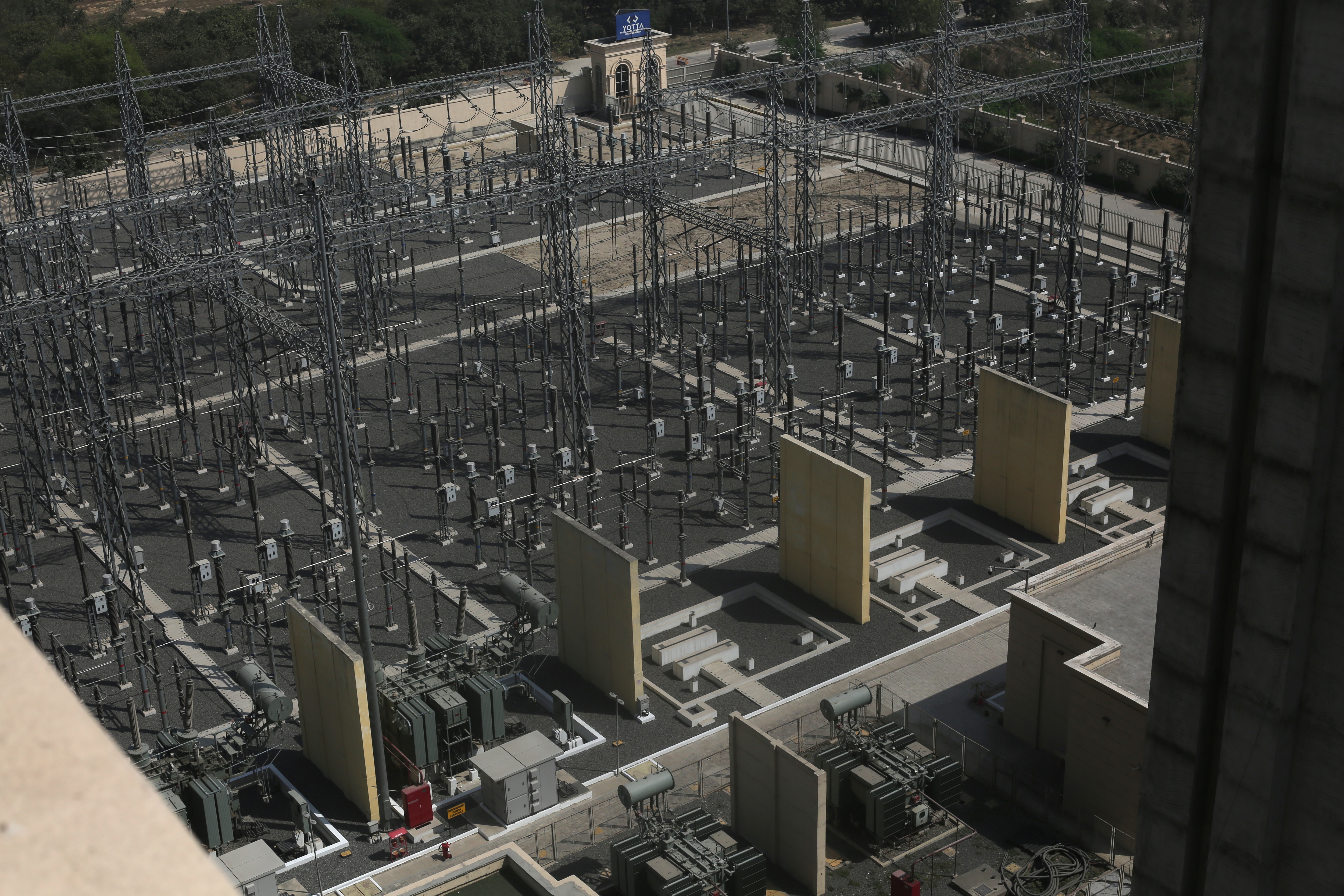 Yotta’s Greater Noida facility, which has a current capacity of 40 MW, expandable to 250 MW, houses its own 220 Kv substation. (Express Photo by Tashi Tobgyal)
Built by Yotta, a Mumbai-based AI and cloud infrastructure company, the D1 Data Centre is the first of six that the company plans to build on the 20-acre campus. Backed by the Hiranandani Group, Yotta hosts one of the largest clusters of AI computing infrastructure in India across its various data centres, including its facility in Navi Mumbai that’s described as the biggest in India.
If data is the new oil, AI data centres such as these are its refineries. As leaders of the AI industry often say, with the construction of data centres, the world could be witnessing the largest infrastructure buildout in the history of mankind.
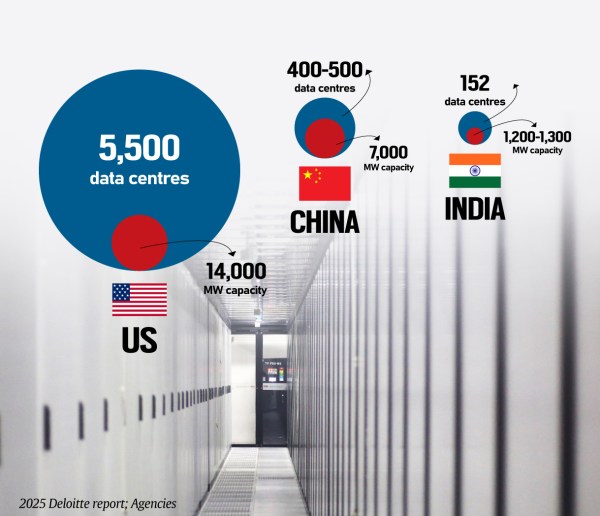
But in the global race to build these data centres, India, with 152 operational data centres and a cumulative IT load capacity of 1,200-1,300 megawatts (MW), is far behind world leaders such as the US (installed capacity of 14,000 MW in around 5,500 data centres) and China (7,000 MW).
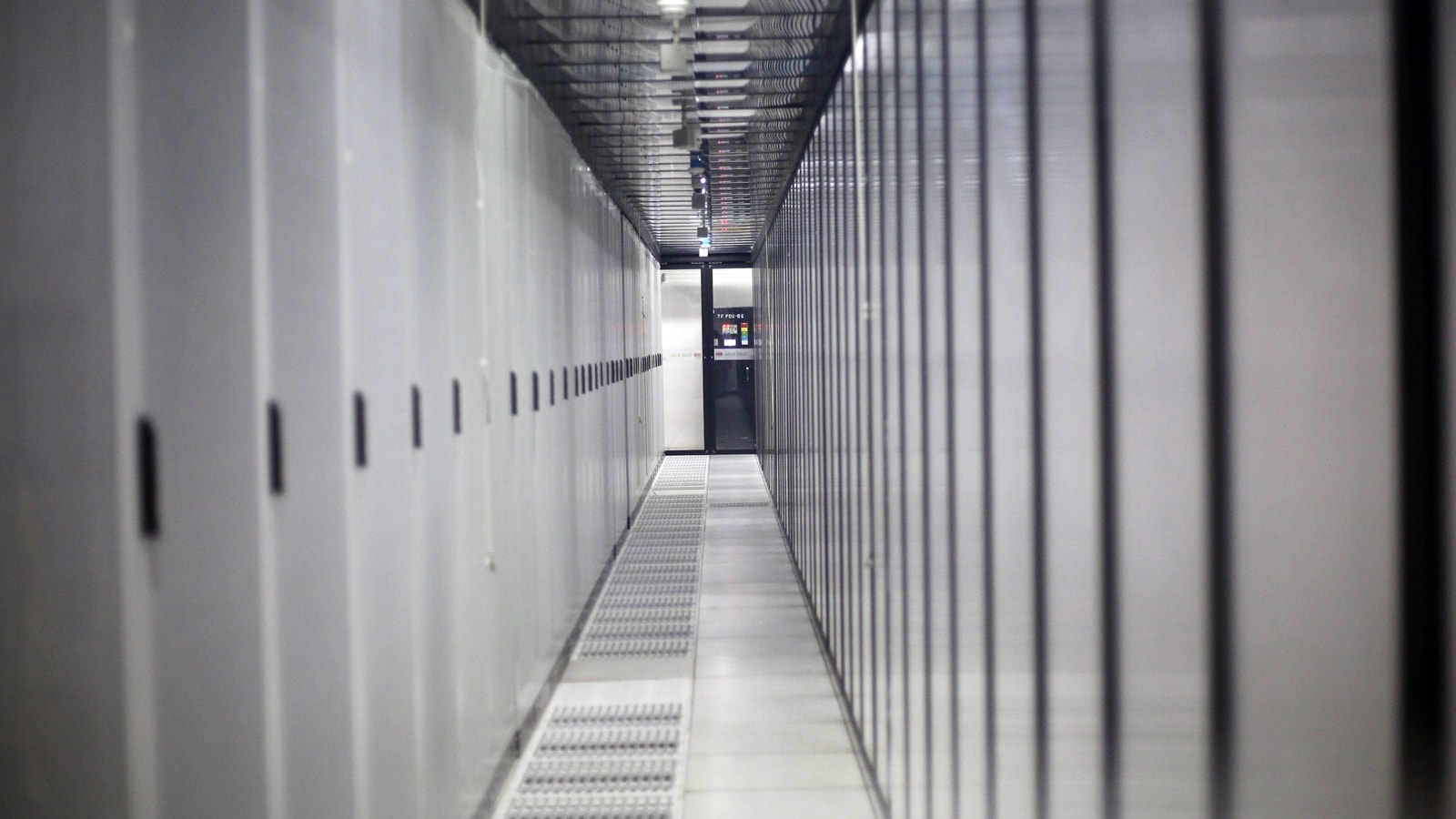
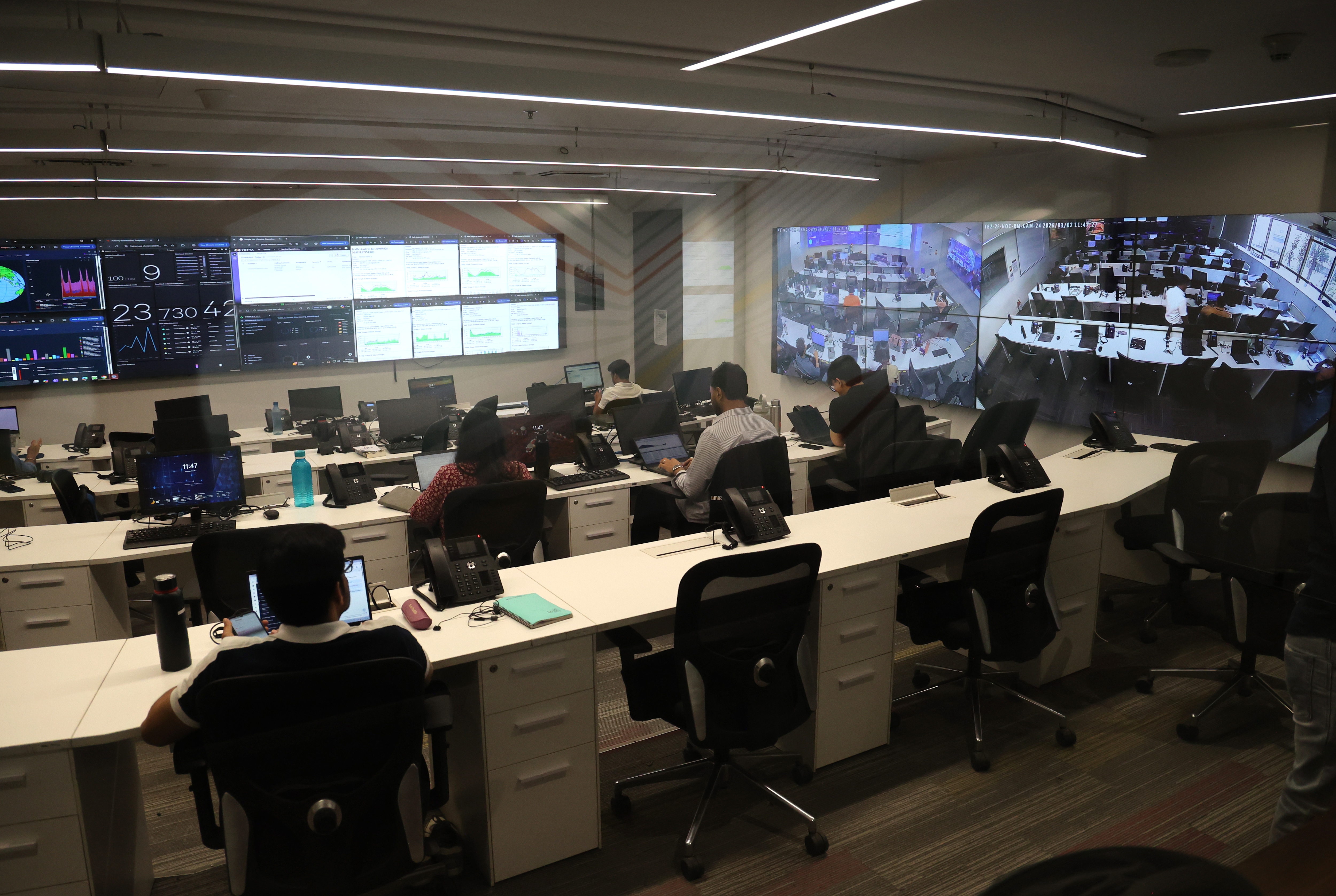 A control room in the data centre from where electricity and water supply, among other things, is monitored. (Express Photo by Tashi Tobgyal)
According to a 2025 Deloitte report, the country produces around 20% of the world’s data but maintains just 3% of the global data centre capacity — a gap the government hopes to narrow by building more domestic infrastructure and pushing for greater data localisation.
Story continues below this ad
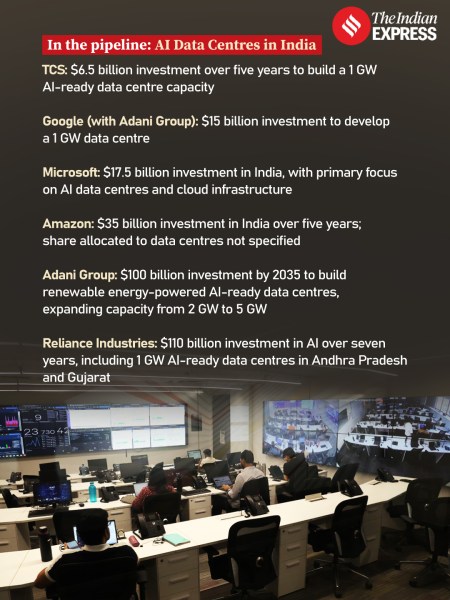
Global technology companies such as Google and Microsoft, along with Indian players, the Adani Group, Reliance Industries and Yotta, are part of that plan as they invest in massive AI computing structures across the country.
A billion calculations
The building is heavily fortified. To enter it, one must clear four security checkpoints and surrender cellphones. The perimeter is guarded by high-tech cameras and a small army of private security personnel.
The lift that takes you up is almost the size of a bedroom — “to allow for advanced equipment to be taken up and down”, explains the company tour guide.
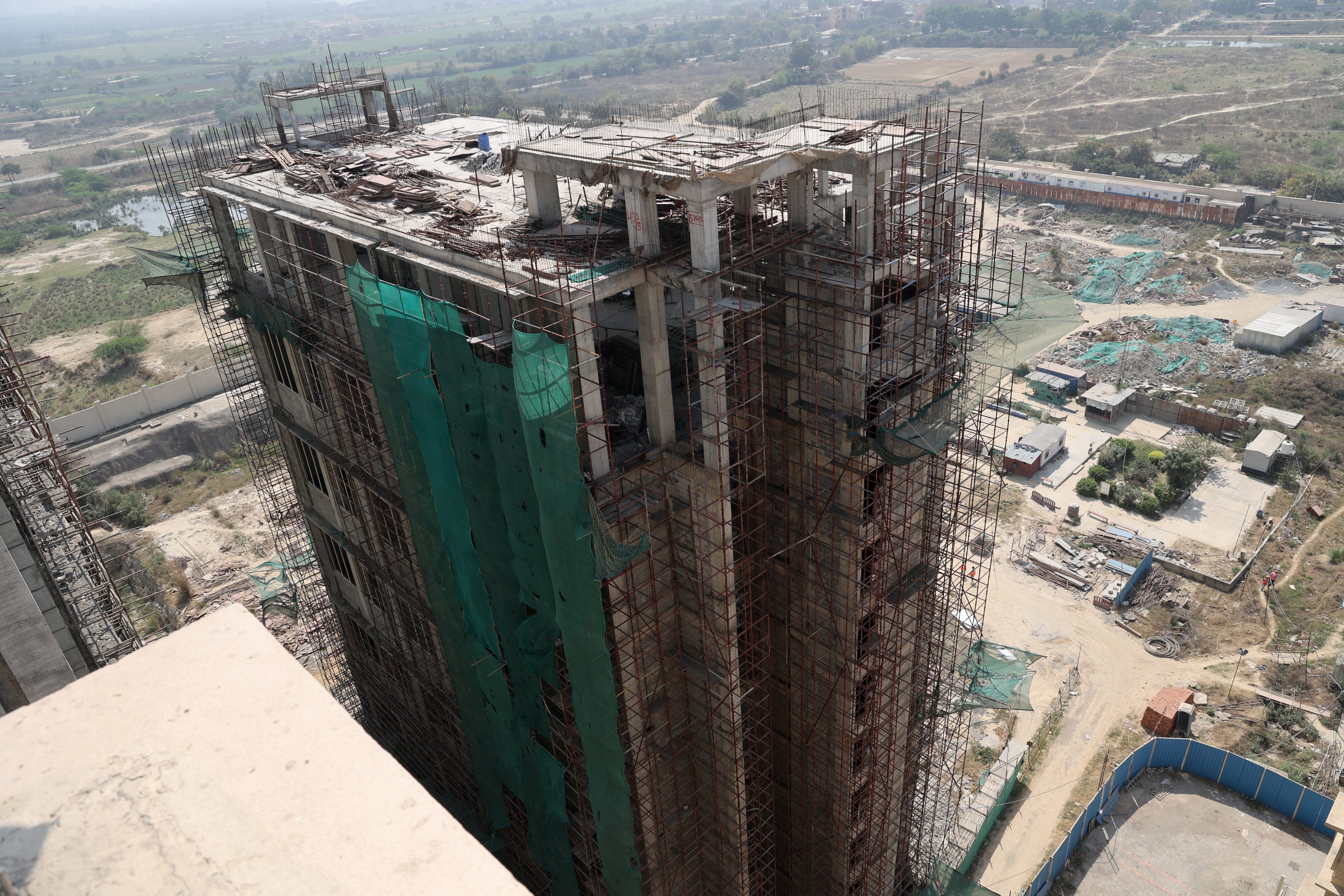 Yotta’s second data centre is coming up adjacent to its D1 Data Centre in Greater Noida. (Express Photo by Tashi Tobgyal)
Inside, on the fifth floor of the D1 Data Centre is its core computing area. The environment is clinically controlled. Stepping into this zone requires visitors to step on an adhesive pad that strips the soles of their shoes of dust.
Story continues below this ad
It is not a space where people move freely. On any given day, those allowed inside may include customer engineers, facility operations teams, vendors, project managers, IT operations staff, service delivery engineers and, what the industry calls, “remote hands and feet” support engineers. But their presence is tightly regulated and once inside, there is little room for unsupervised movement.
Rows of white metal server racks are stacked all the way up to the ceiling, tiny lights blink steadily, and there’s a constant, mechanical hum — the sound of machines processing requests from users scattered across the world.
This is the hidden physical infrastructure that powers the AI tools we use every day.
Building AI is often described as a five-layer cake. At the base is the physical infrastructure: land, electricity and cooling systems that power data centres. Above it sits computing power, or compute, driven by Graphic Processing Units (GPUs), specialised chips that perform the intensive calculations needed to train and run AI models. The third layer is data: the vast volumes of text, images and signals used to train systems. On top of this are foundation models, the large AI systems that interpret language, images and code. Applications, where AI is deployed in consumer and enterprise products, make up the final layer.
Story continues below this ad
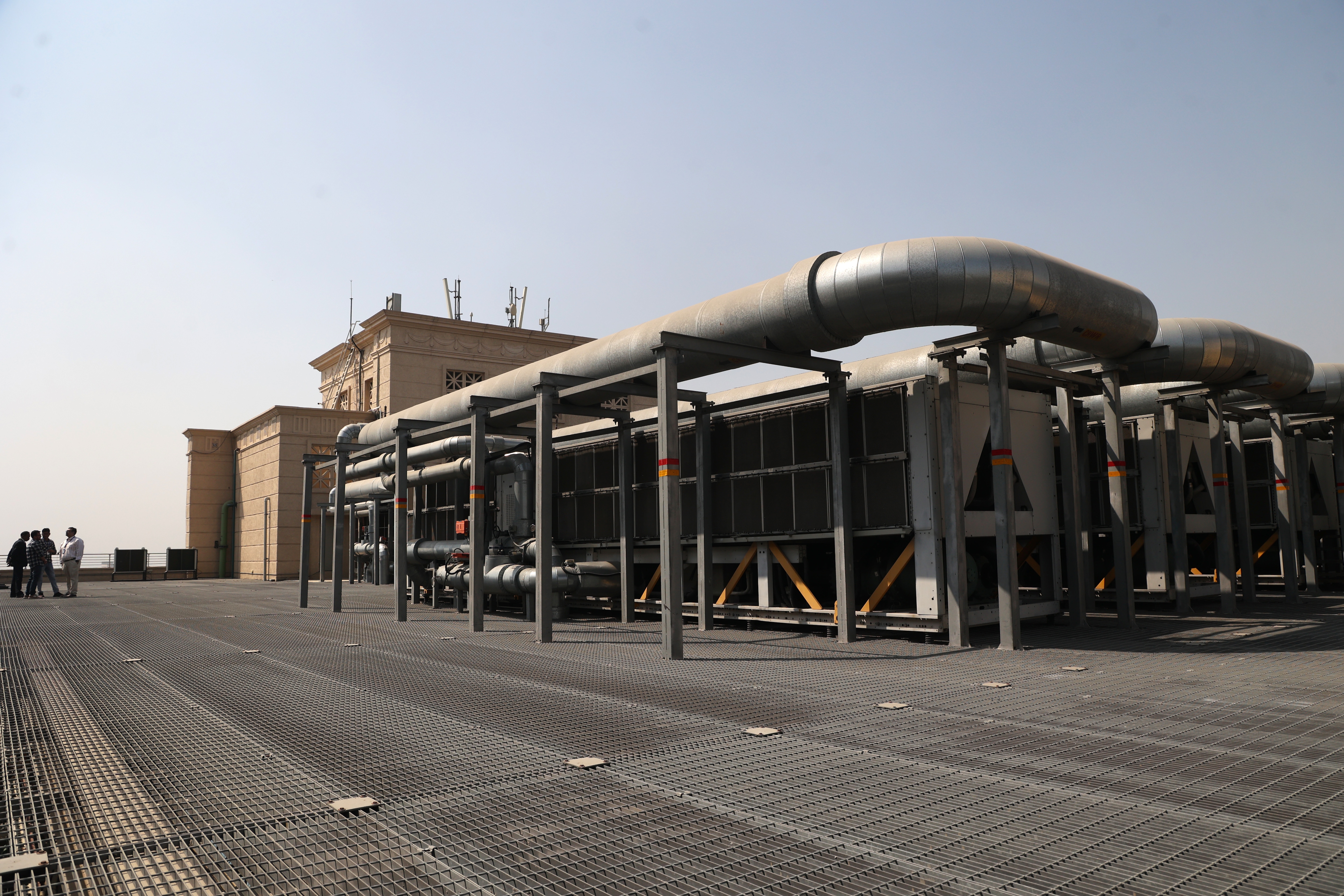 The dense clusters of GPUs required for model training generate high amounts of heat, requiring advanced cooling systems. (Express Photo by Tashi Tobgyal)
“When we train an AI model like ChatGPT, we feed it enormous amounts of data. GPUs process this data, learning patterns, relationships, and language structures. Once the AI is trained, those same GPUs help the model answer questions in real time. So every time someone interacts with an AI system, somewhere in a data centre, GPUs are working at lightning speed to generate that response,” explains Sunil Gupta, MD and CEO of Yotta Data Services. Gupta, who has been working on data centres since the turn of this century, left NTT Global Data Services, another major data centre player, to co-found Yotta in 2019.
During the recent AI Summit, Yotta announced a deal with NVIDIA to deploy 20,000 of the company’s most advanced GPUs at its Greater Noida data centre.
The computing area is divided into alternating hot and cold aisles. In the cold aisles, where the fronts of the server racks face each other, thick water pipelines, visible beneath the raised floorboard, actively chill the air. Inside the locked racks, behind mesh doors, thousands of tiny blinking lights and thick bundles of fibre-optic cables are the only visible signs of the mammoth computing power inside. Step to the back of these rows, and the heat hits you like a physical wall.
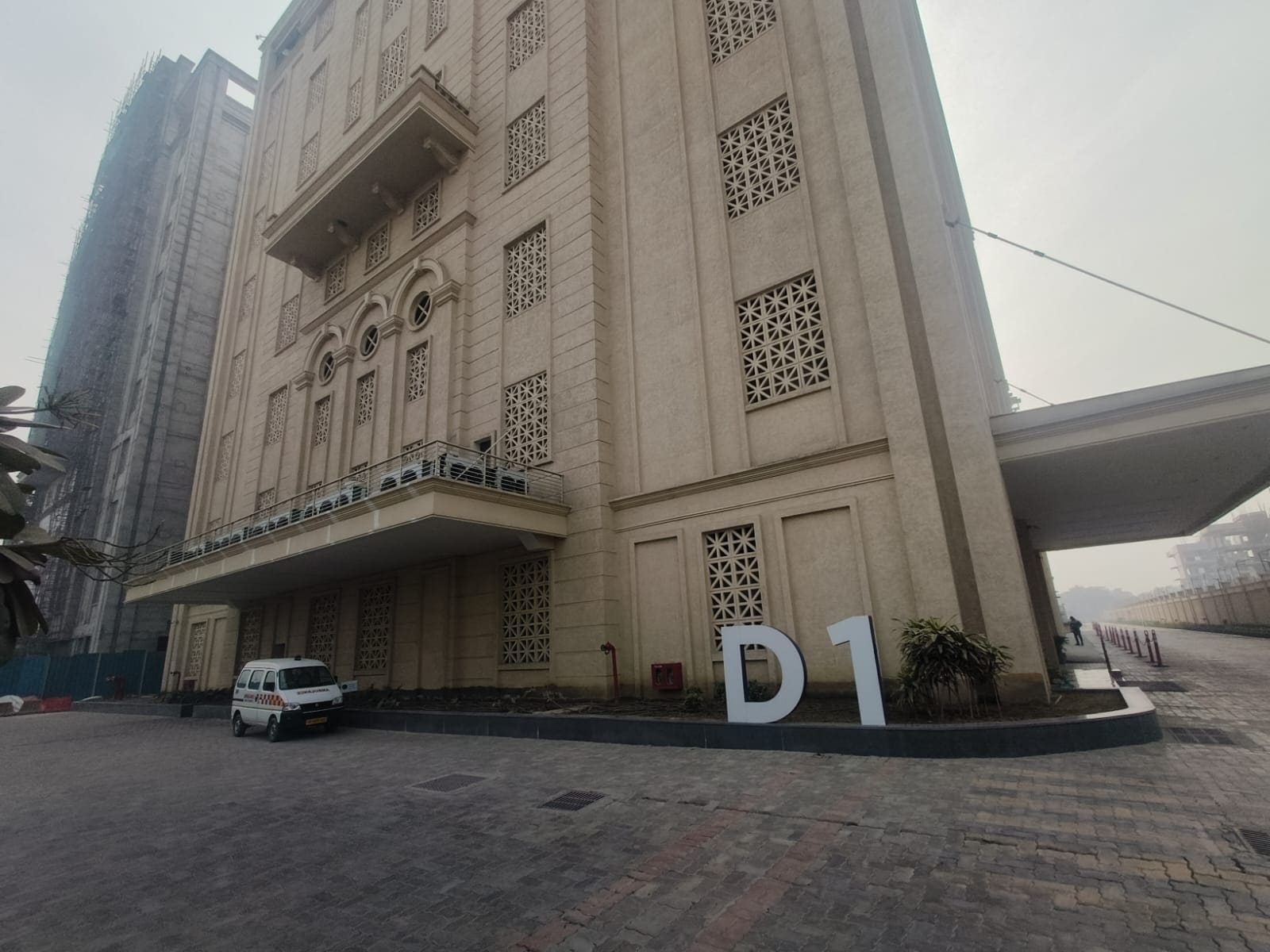 The six-storey D1 Data Centre is the first of six data centres that Yotta plans to build on the 20-acre campus. (Express Photo by Devansh Mittal)
Not all data centres are created equal. While older facilities were essentially massive digital filing cabinets designed to store and move information, the newer breed of AI data centres is built specifically to train and execute complex AI models. “In contrast, an AI data centre is purpose-built to enable machines to learn, reason and analyse, powered by high-performance GPUs. These GPU-accelerated machines can crunch massive amounts of data in parallel to training and running Gen AI models,” says Ashish Arora, CEO of Nxtra by Airtel, which runs 14 large data centres across the country.
Story continues below this ad
In terms of computing infrastructure, older data centres hosted Central Processing Units (CPUs), which are essentially designed to process tasks one after another (sequentially). Instead, the GPUs that run AI models process many tasks in parallel at once.
But this power comes at a cost. GPUs generate far more heat, requiring advanced cooling systems, stronger racks that can support heavier equipment, and significantly larger amounts of electricity.
To guarantee uninterrupted uptime, Yotta’s Greater Noida facility, which has a capacity of 40 MW, expandable to 250 MW, is plugged into two separate external substations. The campus also houses its own 220 Kv substation that’s capable of keeping the massive server farms running for up to 48 hours if the external grid collapses.
“Considering the needs of the data centre park, the UP government has built a separate substation for it, apart from providing dual access to the power grid,” says Tarun Kumar, who heads the electronics desk at Invest UP, the investment promotion agency of the UP government.
Story continues below this ad
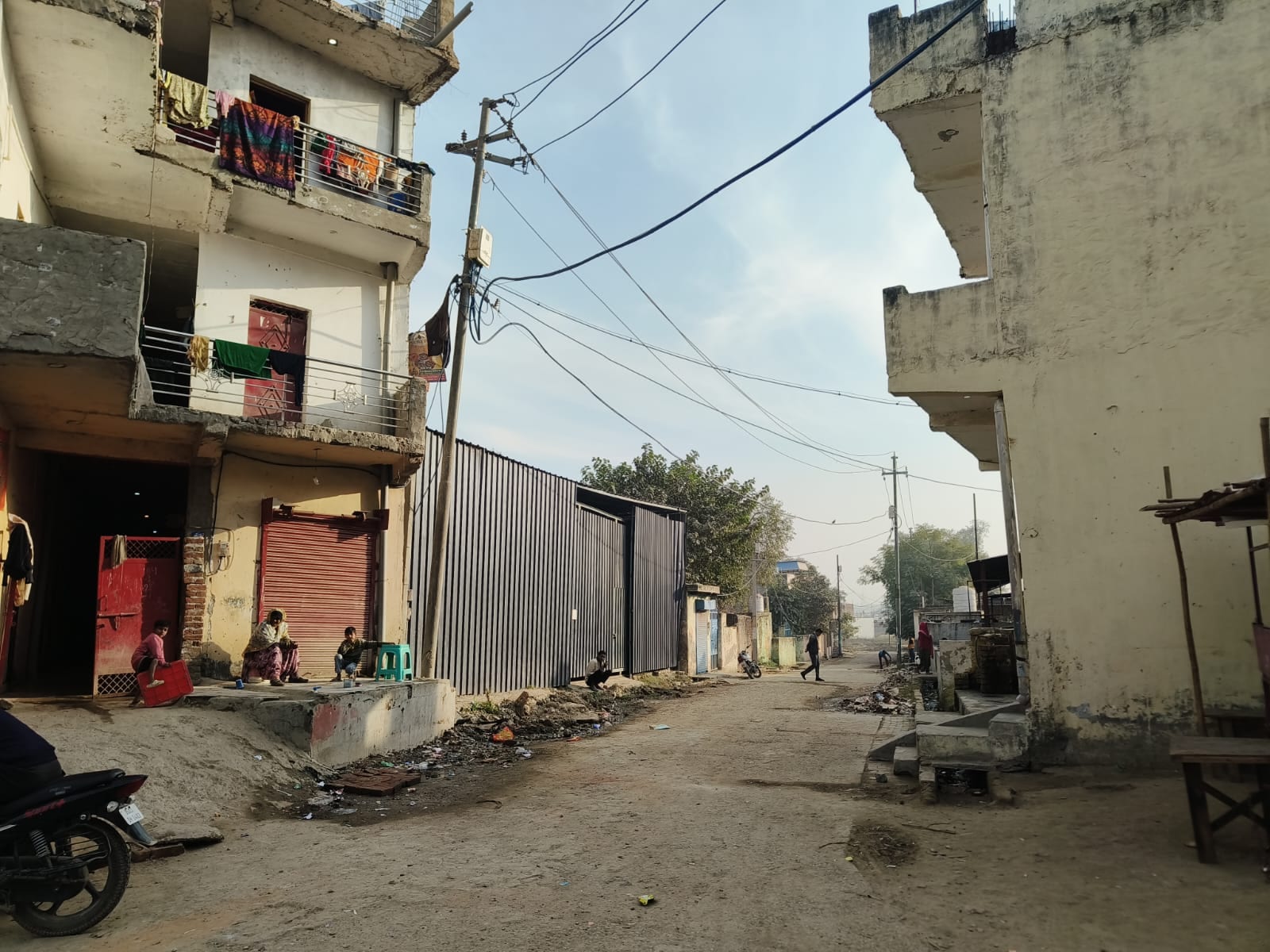 The data centre sits on land that was originally part of Tusiana, a Greater Noida village of around 2,000-odd inhabitants. (Express Photo by Devansh Mittal)
The big questions
While India was slow to ramp up AI computing capacity, the government has since made up its mind and is now betting on data centres. States too have moved in lockstep with the Centre to attract this infrastructure, offering sops such as cheaper power and land, as well as easier approvals.
Mumbai accounts for 49% of the country’s data centre capacity of 1,300 MW, followed by Chennai at 18%. The two coastal cities dominate India’s data-centre landscape largely because they sit on the country’s main submarine cable landing points, from where global internet traffic enters the country.
Yet, questions loom: on the wisdom of launching into a massive infrastructure buildout with unproven job creation capacity, on whether a resource-scarce country should invest in these electricity and water guzzlers, and on the unstoppable appetite for hyperscaling — that more computing power through GPUs will lead to better and more sophisticated AI models.
Story continues below this ad
“We are trying to lock ourselves in a paradigm that leading scholars like Yann Lecun have called saturated: that more and more scale will only get you more predictive power in terms of LLMs, not closer to reasoning and understanding,” says Sandeep Mertia, Assistant Professor at New Jersey-based Stevens Institute of Technology.
According to a 2025 S&P report, the rapid data centre growth in India will see electricity demand for these facilities more than tripling from 0.8% in 2024 to about 2.6% in 2030, leading to increased dependence on fossil fuels.
In a recent Idea Exchange session at The Indian Express, Karen Hao, journalist and author of Empire of AI, pointed out that in Mumbai, two coal plants, owned by Adani and Tata, have applied for an extension because of the new energy loads that data centres will bring to the city.
While Yotta claims that its Greater Noida facility gets all its power from renewable energy, other companies say they have set mandates for getting their power from renewables. “We are committed to achieving net-zero emissions across our operations by 2030, and across our value chain by 2040,” says Alok Bajpai, MD, India, NTT Global Data Centres, which has one of the largest installed capacities in the country.
Story continues below this ad
Water is another major requirement. The dense clusters of GPUs required for model training generate high amounts of heat. In her October report, Anwesha Sen, who works on technology and policy at the Bengaluru-based Takshashila Institution, estimated that running a 1 MW data centre requires roughly 25.5 million litres of water annually — a significant demand when many Indian cities such as Bengaluru, Chennai, and Delhi are already water-stressed.
Companies, however, claim that they use recycled water from sewage treatment plants and that there is a push to adopt advanced, water-less technologies.
Astha Kapoor, co-founder of Aapti Institute, a Bangalore-based technology policy organisation, is sceptical about job-creation claims by the industry. “There is no cost benefit analysis of how much water, energy and land we have to give for what kind of jobs it creates and what kind of benefits we get from it,” Kapoor says, adding that once constructed, there are very few jobs inside data centres.
Despite these hurdles, experts believe there’s no walking back from here. Anjani Kumar, partner at Deloitte, who advises companies on data centre investments, says, “Just as countries invest in roads, airports and power plants, they must invest in digital infrastructure. Everything that we do, what the government does, what the citizens, NGOs and enterprises do, will be AI-driven. The only way they will be able to do those workloads is if they have the infrastructure. If India does not build this infrastructure, it will have to depend on other countries.”
Dwaipayan Banerjee, Associate Professor of Science, Technology and Society at MIT, however, sees it another way. “By building these data centres, we are just creating new forms of dependency on a few big companies,” he says.
Two worlds, real and virtual
The top floor of the facility is out of bounds for visitors. It has been rented out to a hyperscaler, say company officials while refusing to reveal the name of the client. Hyperscalers are technology companies such as Amazon, Microsoft and Google companies that run the world’s largest cloud and AI infrastructure networks.
Labourers are at work on an adjacent building, Yotta’s second data centre which, company officials say, is slated to be rented out entirely to a hyperscaler for its AI needs.
The facility sits on land that was originally part of Tusiana, a Greater Noida village of around 2,000-odd inhabitants. Drains in the village are choked with garbage and villagers complain that nearby factories dump their construction debris and waste on their land.
Dinesh Bhatti, who runs a ration shop in the village, has another grievance. “The government acquired our land at cheap prices, promising us factories and offices where we will get jobs. But these companies have no jobs for us. Even the labourers constructing these buildings were not recruited from our village,” he says.
Sitting inside his shop in Tusiana, Saurabh, 24, says he knows what AI is, but doesn’t know that the building near their village plays a part in it. “How would we know? We have never gone inside.”
***