

5 min readNew DelhiUpdated: Mar 18, 2026 10:22 PM IST
UN report Russia Ukraine war: A report from the United Nations-appointed Independent International Commission of Inquiry on Ukraine has found Russian authorities committing “systematic crimes against humanity”, stating that since the invasion, over 15,000 civilians were killed and 41,000 injured.
The commission was established by the United Nations Human Rights Council through a resolution adopted on March 4, 2022, and has been tasked with investigating alleged human rights violations, breaches of international humanitarian law, and related crimes arising from the Russian Federation’s aggression against Ukraine.

The commission further documented a “pattern of deportations, sexual violence against women and girls when breaking into civilian houses by Russian authorities”.
The report underscored the “evacuation” of Ukrainian youth, in which the commission verified at least 1,205 cases of child transfers, noting that 80 per cent of these children have not yet been returned to their families.
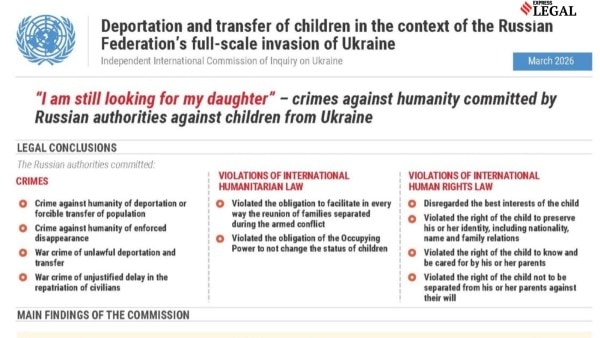
“In the present report, the commission concluded that Russian authorities have committed the crimes against humanity of deportation and forcible transfer, as well as of enforced disappearance, both targeting children. It has also found evidence of war crimes and other violations of international humanitarian law and international human rights law,” the report released in March this year highlighted.
‘Deportation, transfer of children’
- The report records that Russian authorities have deported or transferred thousands of children from Ukraine, with the commission verifying at least 1,205 cases.
- These relocations were presented by Russian authorities as “evacuations”, but the commission found that they were not temporary and therefore do not meet the requirements of international humanitarian law.
- It further noted that the consent of parents, legal guardians, or Ukrainian authorities was not obtained, and such removals, therefore, cannot be legally characterised as evacuations.
- The commission observed that, in such circumstances, the removal of children may amount to abduction and enforced disappearance under international law.
- The report highlights that the deportation, transfer, and prolonged separation of children from their families have caused severe psychological trauma.
- Notably, around 80 per cent of the children in the cases documented by the commission have not yet been returned.
- Russian authorities were also found to have failed to establish an effective system to facilitate reunification, with the burden of tracing families often falling on children and caregivers themselves.
- In one account cited by the commission, a mother searching for her daughter said: “I am still looking for my daughter… I am terribly afraid of what she might think of me and how she survives there.”
‘Violations of fair trial guarantees’
- The commission also examined criminal trials conducted by courts in the Russian Federation and in Russian-occupied territories of Ukraine, finding that they failed to comply with fundamental fair trial guarantees.
- Those prosecuted included men and women aged between 18 and 74, as well as minors, with most accused being men.
- The report states that the proceedings were marked by a lack of judicial independence, bias, and pre-determined outcomes, with courts often disregarding defence arguments.
- The commission also mentioned the experience of a person who was tried and convicted in a Russian court.
- She recalled her trial and stated, “This was a theatre of farce, where we were mere observers. It was a one-sided game. We couldn’t even speak. All petitions raised by our lawyers were dismissed.
- The Commission further found that Russian authorities systematically relied on fabricated evidence, including confessions obtained through torture or ill-treatment.
- In several cases, official records reflected inconsistencies, including discrepancies in arrest dates and periods of undocumented detention.
- Trials were also frequently conducted behind closed doors, with some accused denied access to legal representation or forced to waive such rights under pressure.
‘Sexual, gender-based violence’
- The report also documents patterns of sexual and gender-based violence committed in areas under Russian control.
- Such acts were reported against women and girls during raids on civilian homes, as well as against men and women in detention.
- In one incident cited, two girls aged 13 and 15 were abducted in November 2022 in Mykolaiv Oblast and subjected to sexual violence, physical assault, and unlawful confinement over several days.
- The commission noted that such violence has led to long-term physical injuries, psychological trauma, and social consequences, including stigma and displacement.
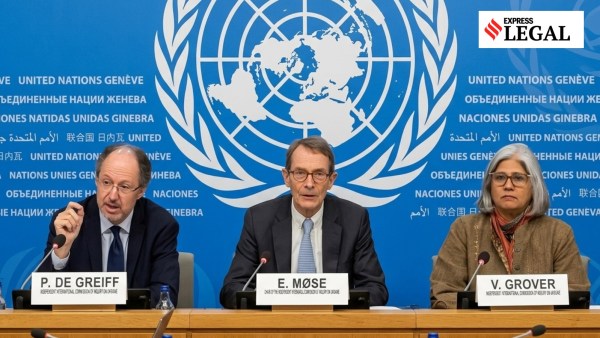 The Human Rights Council established an Independent International Commission of Inquiry panel comprised Norwegian judge Erik Møse (Chair), Colombian academic and human rights activist Pablo de Greiff and human rights lawyer Vrinda Grover. (Image enhanced using AI; Source: APT)
Independent International Commission of Inquiry on Ukraine
- The Human Rights Council established an Independent International Commission of Inquiry panel, comprising Norwegian judge Erik Møse (Chair), Colombian academic and human rights activist Pablo de Greiff and Indian human rights lawyer Vrinda Grover.
- The commission prepared a conference room paper in response to the serious and ongoing violations affecting children since 2022.
- The study was based on 232 interviews with parents, legal guardians, children, relatives, institutional staff, experts, organisations, journalists, and authorities.
- The commission also examined over 2,000 documents, including lists of affected institutions, deported children, and identity documents and reviewed 41 official documents from Russian or affiliated authorities.
With inputs from Sumit Kumar Singh, who is an intern with The Indian Express



© IE Online Media Services Pvt Ltd
