

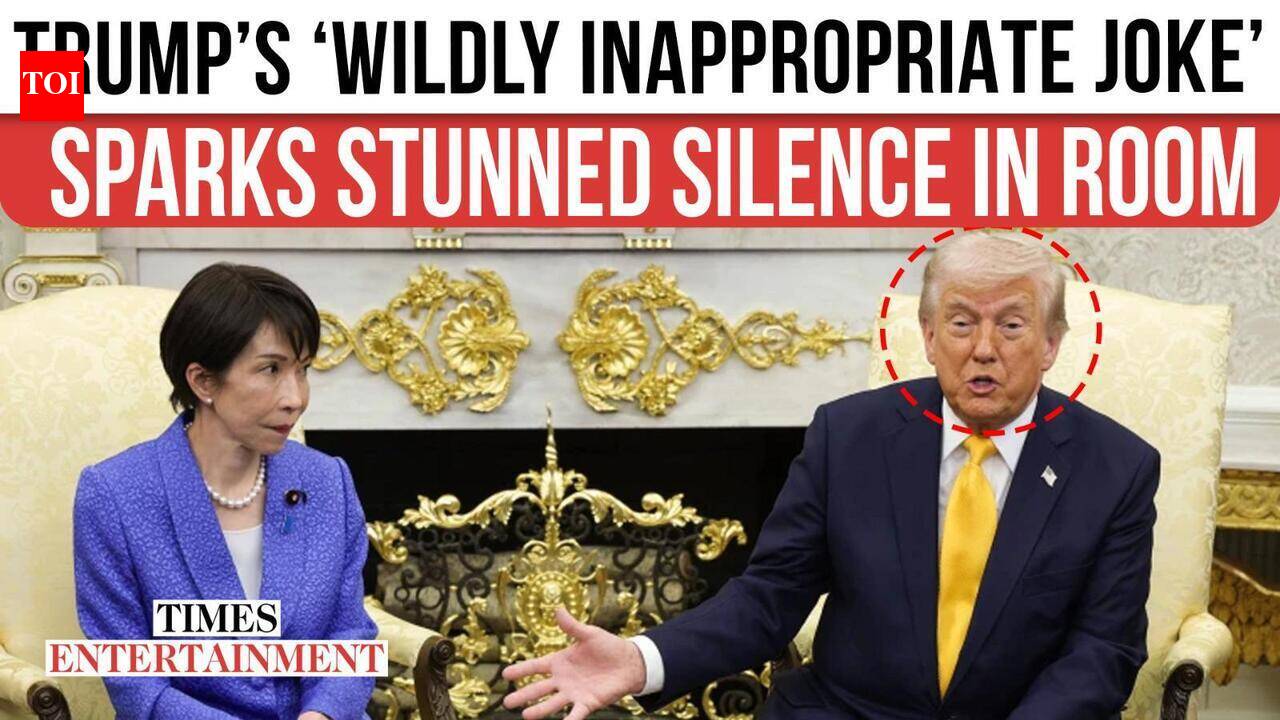
US president Donald Trump’s meeting with Japan’s prime minister Sanae Takaichi on Thursday, supposed to be a routine diplomatic affair turned tense after an exchange over American strikes on Iran during a press interaction at the Oval Office.The awkward moment unfolded when a Japanese reporter asked “Why didn’t you tell US allies about the war before attacking Iran?”. In his response, Trump referenced Pearl Harbor, drawing a visible reaction and shifting the tone of what had begun as a standard diplomatic engagement.
Trump responded by saying the strikes were kept secret to maintain an element of surprise. The US president went on to say, “We didn’t tell anybody about it because we wanted a surprise. Who knows better about surprise than Japan? Why didn’t you tell me about Pearl Harbor, OK?” Takaichi did not respond to the comment, but her reaction was telling and quickly spread across social media. She widened her eyes, leaned back in her chair, and her composed smile slipped away.She chose not to respond to the remark and maintained a polite demeanor toward Trump. At one point, she even praised him, calling him the only person who “can achieve peace across the world.”
Poll
Do you think sensitive historical references should be avoided in diplomatic talks?
Pearl Harbor (1941)
The Attack on Pearl Harbor took place on December 7, 1941, when Japan launched a surprise air strike on the US naval base at Pearl Harbor. More than 350 aircraft from the Imperial Japanese Navy attacked in two waves, targeting battleships, airfields and military facilities. The assault lasted about 90 minutes and caused heavy damage, destroying or damaging eight battleships and nearly 200 aircraft, many of which were hit on the ground. A total of 2,403 Americans were killed and 1,178 were injured. The attack led the United States to enter World War II the following day.Officials present at the meeting described Trump’s comment as a joke. There is no indication that it was part of any formal discussion. The White House has not issued a separate statement on the remark.The meeting focused on ties between the United States and Japan. The two countries are close allies and cooperate on economic, defence, and regional security issues, despite having been on opposite sides during World War II.During the talks, the leaders discussed defence cooperation, trade and security concerns in the Indo-Pacific region. Japan remains an important partner for the US in dealing with challenges involving China and North Korea.References to Pearl Harbor can be sensitive in diplomatic settings because of its historical impact. At the same time, the US and Japan have built a strong alliance since World War II. Leaders from both countries have, over the years, acknowledged the past while focusing on cooperation.
High stakes amid Iran conflict
The uncomfortable moment also came amid growing global tensions. US strikes on Iran have drawn Washington further into the conflict, and Trump is now seeking backing from allies, including Japan. “We’re undertaking this operation, and once it’s finished, the world will be much safer,” he said, adding that Japan’s prime minister shares his view.He has also called on Japan to deploy warships to the Strait of Hormuz, a vital route for global oil shipments that has been virtually shut by Iran since the beginning of the conflict.However, Japan faces a delicate situation. It has traditionally maintained good relations with both Israel and Arab countries and has often positioned itself as neutral. Additionally, its pacifist constitution, established after World War II, restricts military activities overseas, making any decision to send forces abroad politically challenging.(With input from agencies)
