

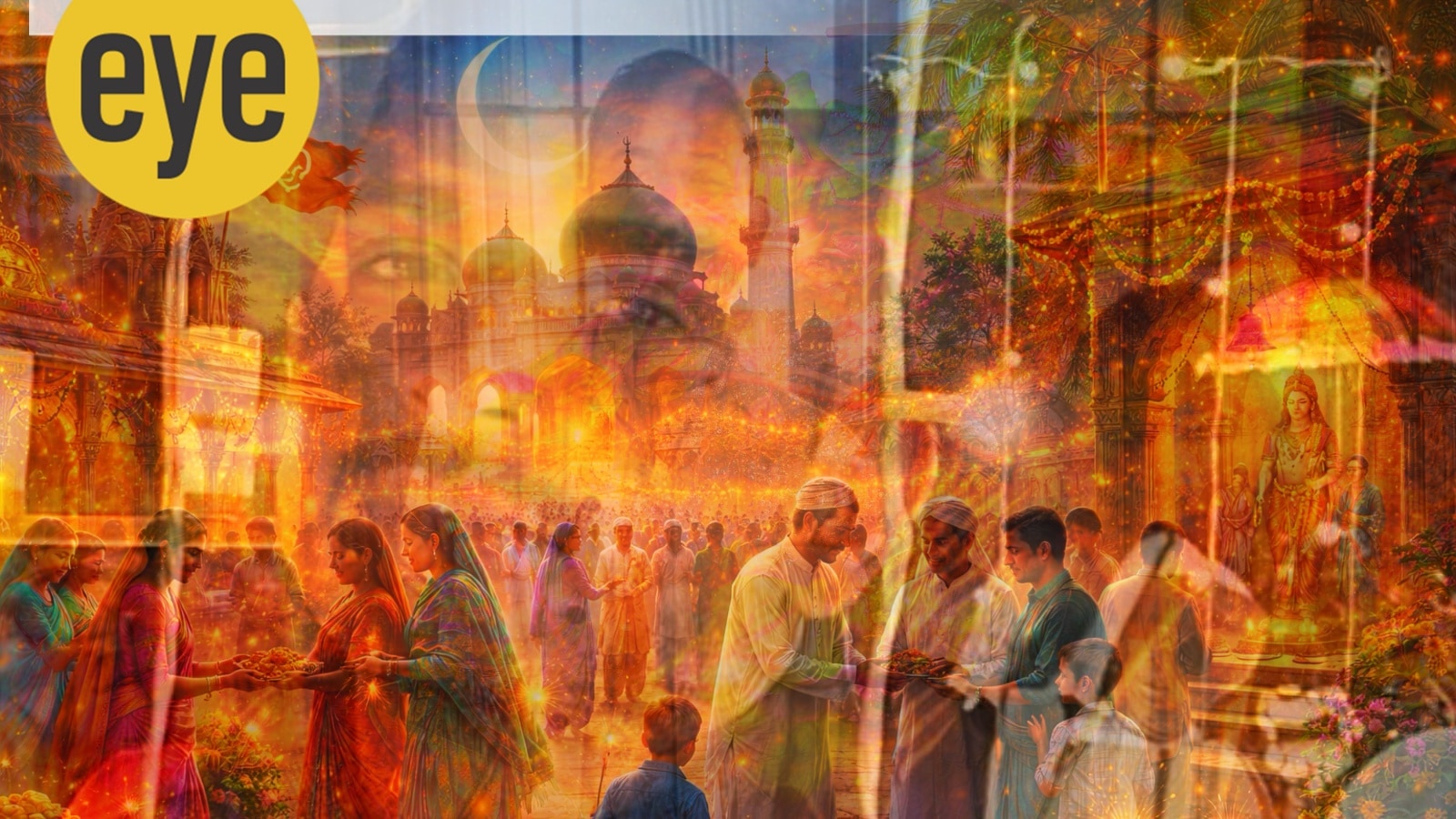
Sunday morning arrives softer than usual. The streets still carry the sweetness of yesterday. Somewhere a child is still clutching a crumpled envelope of Eidi. Somewhere a kitchen still smells faintly of roasted vermicelli and cardamom. Somewhere a mosque courtyard, which yesterday shimmered with white kurtas and whispered prayers, now rests in a hush that feels less like silence and more like satisfaction. Eid has just passed. The crescent has completed its quiet command. And as I sit with my tea on this gentle Sunday, it strikes me that the week we have just lived through may be one of the most extraordinary reminders of what this country truly is.
In the span of days, India welcomed the Hindu New Year through Ugadi, Gudi Padwa, Cheti Chand and Chaitra Shukladi. Then came Eid ul-Fitr, the moonlit culmination of Ramadan’s long discipline. And just days from now arrives Ram Navami, the celebration of the birth of Ram, the enduring emblem of dharma. Three sacred rhythms rising within a single week, like three notes that seem separate until suddenly they settle into the same raga.

It is easy, in a noisy world, to miss the quiet miracle of such moments. But this past week, India did what it has done for centuries: it turned plurality into poetry.
The Hindu New Year arrived first, fluttering into the air with the saffron shimmer of Gudi Padwa flags and the fragrant freshness of Ugadi kitchens. In homes across the country, families prepared the traditional chutney of neem and jaggery — bitter leaf and molten sweetness mingling in a bowl that tastes uncannily like life itself. Every spoonful carries philosophy. Bitterness will arrive. Sweetness will follow. Tang and fire will take their turns. The message is not that life will be easy but that it will be entire.
Ancient tradition tells us that creation itself began in the month of Chaitra. Every New Year in the Hindu calendar therefore carries a cosmic echo — a quiet reminder that the universe itself believes in renewal. That every ending is merely the earth inhaling before another beginning.
Then, just as those saffron mornings settled, the sky demanded our attention. Across rooftops and terraces, eyes lifted toward the horizon searching for the slender silver sliver of the moon. When it appeared, soft as a sigh, Eid arrived.
Ramadan had already done its deep work by then. For 30 days the faithful had fasted from dawn to dusk, not merely to discipline appetite but to deepen empathy. Hunger humbles. Silence sharpens. Patience polishes the heart. By the time Eid arrives, the feast feels less like indulgence and more like gratitude.
Story continues below this ad
Yesterday the mosques filled with prayer. Streets echoed with greetings. Kitchens simmered with sevaiyan scented by milk and memory. Children collected their Eidi with the serious delight only children can muster. Doors opened wider than usual. Old grievances softened. The phrase “Eid Mubarak” travelled through neighbourhoods like a blessing carried by breath.
And now, on this quiet Sunday morning, the city exhales.
Soon another celebration will arrive. Ram Navami waits just ahead, carrying the story of Ram — the prince who chose principle over power, exile over ease, duty over desire. His life continues to ask a question that refuses to grow old: what does righteousness look like in an unruly world?
When we step back and look at this past week, the pattern becomes impossible to ignore. Ugadi whispered: begin again. Ramadan insisted: purify intention. Eid celebrated: share joy. And Ram Navami will remind us: stand for dharma.
Story continues below this ad
Different rituals. Different scriptures. Yet the same spiritual architecture — renewal, restraint, righteousness.
This is the deeper genius of India, a civilisation that has spent millennia practicing the difficult art of coexistence. Faiths arrived here like caravans from distant deserts, bringing their prayers, philosophies and possibilities. Instead of colliding, they conversed. Instead of erasing each other, they enriched the soil they shared.
Out of these encounters grew languages that carry the cadence of many cultures. None more beautifully than Urdu.
Urdu was born in the bazaars and barracks of Hindustan, where soldiers, merchants and mystics mingled their tongues until something new began to sing. Persian elegance, Arabic resonance and Hindavi earthiness braided themselves into a language that refuses to belong to any single faith.
Story continues below this ad
Few poets understood that shared inheritance more powerfully than Muhammad Iqbal. His poetry still rings with a restless invitation to look beyond narrow identities and seek a wider horizon.
He wrote: ‘Manzil se aage badh kar manzil talaash kar/ Mil jaaye tujhko dariya to samandar talaash kar’ (Seek a destination beyond the destination.
If you find a river, search for the sea.
It is hard not to read those lines as a metaphor for India itself. This country has never been content with a single river of identity. It has always searched for the sea — a vast cultural ocean where many rivers meet.
Iqbal also warned against rituals that remain beautiful but hollow:
Story continues below this ad
‘Sajdon se tere kya hua, sadiyan guzar gayin/ Duniya teri badal de woh sajda talaash kar’ (Centuries have passed in prostration.Seek the prayer that transforms the world).
The week we have just witnessed feels like precisely that prayer — not merely spoken but lived.
Urdu itself offers another reminder of India’s composite culture. Some of its most luminous poets were Hindus who chose Urdu as the language of their imagination. Among them was Firaq Gorakhpuri, born Raghupati Sahay, whose verse captured the secret of Hindustan with breathtaking simplicity:
‘Sarzameen-e-Hind par aqwaam-e-aalam ke Firaq/ Qafile baste gaye, Hindostan banta gaya’ (On the soil of Hind, peoples from across the world arrived;
caravans kept settling — and thus Hindustan came into being).
It is less a couplet than a cultural chronicle.
Story continues below this ad
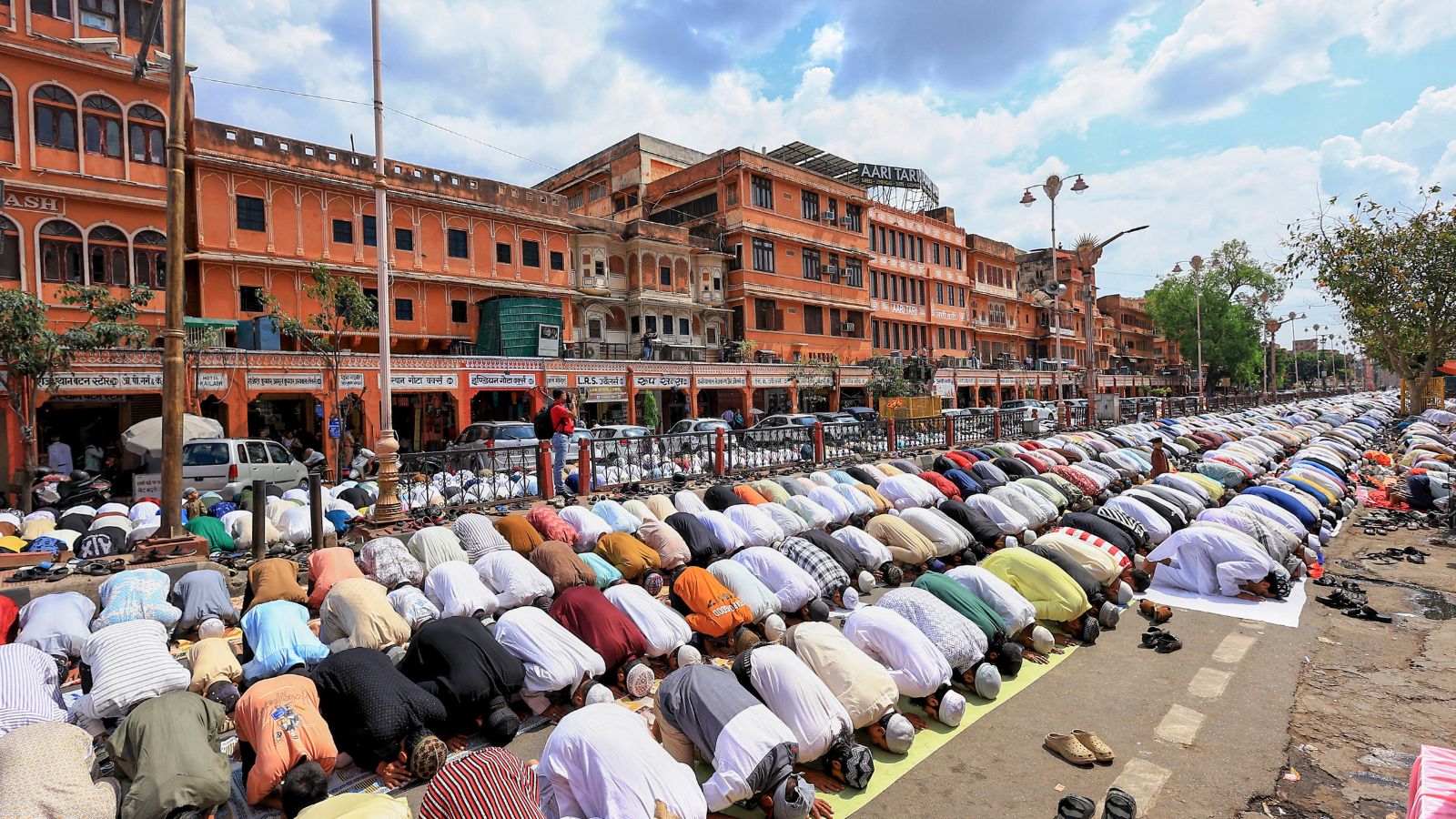 People offer prayers ahead of the Eid Al-Fitr festival celebrations, at Jama Masjid, in Jaipur, Rajasthan, Friday, March 20, 2026. (PTI Photo)
Another remarkable voice was Brij Narayan Chakbast, a Kashmiri Pandit whose Urdu poetry carried both tenderness and tenacity:
‘Hum ko mita sake ye zamane mein dam nahin/ Hum se zamana khud hai, zamane se hum nahin’ (No era has the strength to erase us; the age itself emerges from us — we do not emerge from the age).
These poets remind us that language in India has always been a bridge rather than a border.
In a century where many societies retreat into suspicion and slogans, India still experiments — imperfectly, noisily, stubbornly — with pluralism as daily practice. Walk through any neighbourhood and you may see a Hindu family tasting sevaiyan after Eid, hear temple bells as the azaan drifts through dusk, watch children who care more about cricket than categories.
Story continues below this ad
These gestures may seem small, but they carry the quiet courage of coexistence.
Iqbal understood how easily hatred can spread in anxious times. Yet he believed humanity possesses the wisdom to extinguish it:
‘Har shakhs jal raha hai adawat ki aag mein/ Us aag ko bujha de woh paani talaash kar’ (Everyone burns in the fire of hatred. Seek the water that can extinguish it).
Perhaps that is the deeper meaning of the week we have just lived through. The saffron flag of the New Year fluttered. The crescent moon of Eid glowed. Soon the conch shell of Ram Navami will sound.
Three symbols against the same sky.
Story continues below this ad
Different faiths. Different festivals. Yet beneath them flows the same river of hope, carrying millions of lives toward the same sea of shared humanity.
And as this Sunday morning unfolds — the day after Eid, the city calmer, kinder, still scented by celebration — one cannot help but feel that the poets were right.
Civilisations do not flourish through fear. They flourish through fellowship.
If you find a river, Iqbal urged, search for the sea.
For centuries now, India has been sailing toward that sea — carried by the currents of culture, the cadence of poetry, and the quiet courage of coexistence.
