

Mains Examination: General Studies-III: Challenges to internal security through communication networks, role of media and social networking sites in internal security challenges, basics of cyber security; money-laundering and its prevention.
What’s the ongoing story: Blocking device IDs involved in cases of digital arrest, introducing safety features similar to those on Skype, and strengthening technology to detect and block harmful APKs, the file formats used in Android systems.
Key Points to Ponder:
— What is digital arrest?
— How do digital arrest scams work?
— What are its repercussions?
— What are the efforts taken by the government to counter digital arrest?
— Why are Indians more vulnerable to digital arrest?
Key Takeaways:
— These are some of the key measures WhatsApp has been asked to implement by a high-level Inter-Departmental Committee (IDC) constituted by the Union Home Ministry to tackle the threat of digital arrest, including the impersonation of law enforcement officers to perpetrate the scam, The Indian Express has learnt.
— Sources said that the Meta-owned messaging service has agreed to implement these measures and is already in the process of putting in place some of them. It is learnt that the interaction with representatives of WhatsApp took place earlier this month during the third meeting of the IDC, which was constituted in December 2025.
Story continues below this ad
— According to the official, the representatives of WhatsApp conveyed that the platform is introducing several safety features similar to those on Skype, which is Microsoft’s video-calling platform: more information on callers, warning signals for suspicious accounts and better detection of scam networks. WhatsApp has been asked to present a proposal on these measures within 30 days, the official said.
— In typical digital arrest scams, fraudsters impersonate law enforcement officers on video calls with victims, claim that they are being investigated for serious crimes and coerce them to transfer large sums to various bank accounts to avoid arrest.
Do You Know:
— Notably, “digital arrest” has not been explicitly defined in any law. Although fraudulent online activities are addressed under the Information Technology Act, 2000 and organised criminal activity under the Bharatiya Nyaya Sanhita (BNS), 2023, neither law explicitly defines “cybercrimes”, causing ambiguity in the enforcement of regulatory response.
— As per Section 63 of the Bharatiya Nagarik Suraksha Sanhita (BNSS) 2023, summons may be served electronically, but only if the communication is encrypted and carries the court’s seal, image, and authorised digital signature. While such digitisation streamlines procedural delivery, the BNSS retains a clear emphasis on embodied due process that all forms of arrest require physical custody, the arresting officer must display proper identification, and an arrest memo must be prepared contemporaneously.
Story continues below this ad
— Indian Cyber Crime Coordination Centre (I4C) has been instituted as an attached office to the Ministry of Home Affairs, so as to coordinate a comprehensive, national response to all cybercrime complaints. With respect to matters of digital arrest complaints, it has blocked over 1,700 Skype IDs, 59,000 WhatsApp accounts, 6.69 lakh SIM cards, and 1,32,000 IMEIs in 2024 alone.
Other Important Articles Covering the same topic:
📍UPSC Knowledge Nugget of the day: Digital Arrest
📍How India strengthens its digital-fraud resilience
Previous year UPSC Prelims Question Covering similar theme:
(1) In India, it is legally mandatory for which of the following to report on cyber security incidents? (UPSC CSE 2017)
1. Service providers
2. Data centres
3. Body corporate
Select the correct answer using the code given below:
(a) 1 only
(b) 1 and 2 only
(c) 3 only
(d) 1, 2 and 3
POLITICS
Bengal SIR appeals: Poll panel sets up 19 appellate tribunals
Syllabus:
Preliminary Examination: Current events of national and international importance
Mains Examination: General Studies-II: Statutory, regulatory and various quasi-judicial bodies
Story continues below this ad
What’s the ongoing story: The Election Commission on Friday set up 19 appellate tribunals for hearing appeals against the orders passed by judicial officers who are currently deciding on the eligibility of 60.06 lakh electors of West Bengal.
Key Points to Ponder:
— What are the constitutional provisions related to the Tribunals?
— Know about the Tribunals Reforms Act, 2021.
— What is appellate tribunal?
— How are tribunals different from court?
— Why is the objective of forming an appellate tribunal?
— What are quasi-judicial bodies?
— What are the issues related to SIR in Bengal?
— Why did the Supreme Court direct the ECI to constitute a tribunal in the case of West Bengal?
— What is the purpose of SIR?
Key Takeaways:
— Acting on orders of the Supreme Court and recommendations of Calcutta High Court Chief Justice Sujoy Paul, the EC set up the appellate authority, naming 19 former judges as the single-member tribunals for the 23 districts. While most of the judges were named for a single district, three were assigned multiple districts.
— The appeals can be filed either on the EC’s ECINET website or physically at the offices of the District Magistrates or Sub-Divisional Magistrates or Sub-Divisional Officers, who are to digitise and upload the appeals on the ECINET platform, the EC said.
Story continues below this ad
— The EC’s decision comes at a time when judicial officers appointed on orders of the Supreme Court on February 20 are deciding on whether 60.06 lakh electors flagged during the Special Intensive Revision (SIR) of electoral rolls can remain on the rolls or not.
— The SC had ordered that as and when the judicial officers decide, supplementary lists of electors are to be published. This even as the EC has announced elections in West Bengal on April 23 and April 29.
Do You Know:
— According to PRS India, tribunals are institutions established for discharging judicial or quasi-judicial duties. The objective may be to reduce case load of the judiciary or to bring in subject expertise for technical matters.
— The Supreme Court has ruled that tribunals, being quasi-judicial bodies, should have the same level of independence from the executive as the judiciary.
Story continues below this ad
— The tribunal system has developed as a parallel to the traditional court system over the last eighty years. The Income Tax Appellate Tribunal was created in 1941 to reduce pendency of cases in courts.
— After the insertion of Articles 323A and 323B, several tribunals such as the Central Administrative Tribunal as well as sector specific tribunals were set up from the 1980s to 2010s. The Finance Act, 2017 consolidated several tribunals. In 2021, a Bill has been introduced that abolishes nine tribunals and transfers the matters to courts.
Other Important Articles Covering the same topic:
📍Explained: The discord between Supreme Court and the Centre over tribunals, why it matters
Previous year UPSC Mains Question Covering similar theme:
How far do you agree with the view that tribunals curtail the jurisdiction of ordinary courts? In view of the above, discuss the constitutional validity and competency of the tribunals in India? (UPSC CSE 2018)
EXPLAINED
Why weight-loss drugs are cheaper starting today
Syllabus:
Preliminary Examination: Current events of national and international importance
Story continues below this ad
Mains Examination: General Studies-II: Issues relating to development and management of Social Sector/Services relating to Health, Education, Human Resources
What’s the ongoing story: Several generic versions of the popular weight loss drug semaglutide are likely to become available Saturday (March 21) onwards, following the expiry of Novo Nordisk’s patent today. Several of India’s top drug manufacturers will launch their products, with as many as 50 brands likely to become available
Key Points to Ponder:
— What are generic medicines?
— What is semaglutide?
— What is obesity?
— What are the reasons for increasing obesity in India?
— How do these weight loss drugs work?
— What are the concerns related to type 2 diabetes and obesity in India?
— What are the recent WHO guidelines on these obesity drugs?
Key Takeaways:
Story continues below this ad
— Several companies have already announced the brands they will launch on Saturday. Take, for example, Natco Pharmaceuticals, which will launch ‘Semanat’ and ‘Semafull’ in 2mg, 4mg, and 8mg doses. The drug will cost R1,290 per month for the lowest dose and R1,750 for the highest one, according to the company….
— The generic versions of semaglutide are likely to become available in the market from Saturday onwards. These would be available at the local pharmaceutical stores, which may take a few days depending on supply.
— The lower dose version of semaglutide is meant for the treatment of type-2 diabetes, along with lifestyle interventions such as diet and exercise.
— The higher dose version is meant for those who are obese with a BMI of over 30 or those who are overweight with a BMI of over 27 but have other obesity-related co-morbid conditions such as diabetes, hypertension, or high cholesterol levels.
— The drug is usually prescribed for those who are struggling to lose weight, even with lifestyle modification, with doctors warning that these interventions need to continue even when a person starts taking semaglutide.
— An estimated 254 million people are living with obesity in India, according to the India study. This number increases to 351 million if abdominal obesity is considered. Abdominal obesity is the accumulation of fat around the waist, which is known to increase the risk of obesity-related conditions more than generalised fat.
— The number of adult men living with obesity or being overweight increased from 1.53 crores in 1990 to 8.12 crores in 2021, which is projected to increase to 21.8 crores by 2050, according to a Lancet study. When it comes to adult women who are overweight or obese, the numbers increased from 2.14 crore in 1990 to 9.8 crore in 2021, and are projected to go up to 23.17 crores by 2050.
— Concerningly, the number of children who are obese or overweight is also increasing, with the number of overweight or obese boys going up from 0.46 crore in 1990 to 1.33 crore in 2021, which is projected to go up to 1.6 crore in 2050.
— Obesity is now considered to be “a lifelong, chronic disease that requires holistic care including these therapies, surgeries, and other lifestyle interventions,” according to the recent recommendations from the World Health Organisation, which said these new therapies can be used long-term for the treatment of obesity in adults.
— The guidelines also urged governments to work towards creating health systems geared towards life-long treatment of obesity by creating systems screening, early diagnosis, referral, maintaining patient registries, and regular follow-up to check progress. This is essentially the model followed for all other chronic diseases.
— The new definition for obesity also does away with a simple BMI measurement. A Lancet Commission recently defined pre-clinical and clinical obesity. This considers preclinical obesity as just a physical attribute, but not an illness.
Do You Know:
— One of the key reasons driving the obesity epidemic is the increase in consumption of processed foods high in salt, sugar and fat. “Between 2009 and 2019, the largest annual growth in ultra-processed food and beverage sales per capita was observed in Cameroon, India, and Vietnam,” the study said.
— There is a shift in dietary choices away from traditional foods and physical inactivity. The traditional food was low on animal products, salt, refined oils, sugars and flours and the new dietary habits are high in energy but low in nutrients – refined carbohydrates, high fat, meat products, and processed foods.
— Increasing urbanisation has also led to reduced physical activity, longer commute times, and desk-bound jobs. The spillover effect of this is a rise in work-related stress, poor sleep, and mental health disorders, all of which are linked to obesity.
Other Important Articles Covering the same topic:
📍Knowledge Nugget: What must you read on ‘Obesity’ for UPSC exams?
UPSC Prelims PYQ Question Covering similar theme:
(2) Which of the following statements regarding insulin harmone is correct? (UPSC CAPF 2018)
(a) Insulin is a protein hormone which is not produced in human body.
(b) Insulin is a steriod hormone which is produced in human body.
(c) Insulin is a cholesterol-driven hormone given to human
(d) Insulin is a protein hormone which is produced in human body.
As US weighs Iran oil relief, the possibility for India
Syllabus:
Preliminary Examination: Current events of national and international importance
Mains Examination: General Studies-II: Effect of policies and politics of developed and developing countries on India’s interests, Indian diaspora
What’s the ongoing story: As the war in West Asia crimps the global supply of oil and sends its prices soaring, the US Saturday removed sanctions on the purchase of Iranian oil at sea for 30 days. The waiver will bring some 140 million barrels of oil to global markets and help relieve pressure on energy supply, Treasury Secretary Scott Bessent posted on X.
Key Points to Ponder:
— How is the war in West Asia impacting energy security around the world?
— What is the impact on India?
— What are the steps taken by the Indian government to absorb the shock from this crisis?
— How has India’s oil imports dependency on countries changed in recent years?
— How is the blockage of ship passage through the Strait of Hormuz, a cause of concern for most countries?
Key Takeaways:
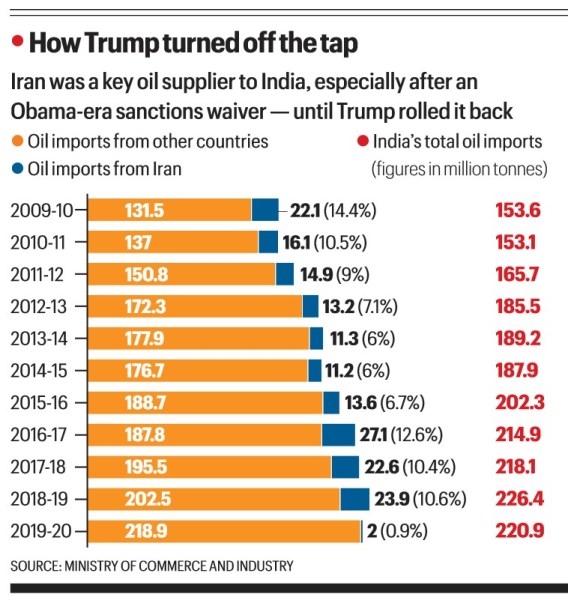
— India could very well be among the major beneficiaries of this temporary sanctions waiver. Iran was once a major oil supplier for India. But New Delhi halted these imports after the first Donald Trump administration imposed heavy sanctions on Tehran and removed the sanction waivers enjoyed by major Iranian crude buyers.
— For years now, over 90% of Iranian oil exports have been going to one country — China. Technically, this move by the US will not really increase the global oil supply — Iranian oil was already part of it with China’s purchases — but will enable other countries also to buy Tehran’s oil.
— The US decision comes after it announced a similar month-long universal waiver on sanctioned Russian crude already in tankers at sea.
— In response to the US and Israel’s offensive that began on February 28, Iran effectively choked vessel movements through the Strait of Hormuz. The passage accounts for one-fifth of global oil and liquefied natural gas (LNG) flows. Its effective closure, along with attacks on energy infrastructure in the region by all sides, have caused a surge in global oil prices.
— While some oil volumes are being evacuated from West Asia through a couple of other alternative routes that bypass the Strait, a bulk of the supply through the narrow waterway has effectively gone offline.
— Currently, Iranian crude availability is high, with an estimated 170 million barrels on the water, including floating storage and cargoes in transit, as per Kpler data.
— While part of these volumes is committed, a portion remains unsold, representing potential incremental supply if sanctions ease or enforcement weakens, Ritolia said. The analyst said that Indian refiners retain the ability to re-integrate Iranian barrels with minimal operational adjustments at their refineries, given their prior experience in processing Iranian oil and the presence of established trading setups.
— Key considerations for Indian refiners to tap into Iranian barrels, if made available, would primarily include the scope and durability of sanctions relief, pricing structure, and the availability of payment, insurance, and logistics mechanisms.
— India has not imported any oil from Iran since May 2019, after the expiration of the sanctions waiver that the US had provided to major buyers of Iranian oil. Not complying with American sanctions would have made Indian oil companies vulnerable to secondary sanctions from Washington.
— Prior to that, India had been a regular buyer of Iranian oil, even during previous sanctions periods of the pre-Trump era, when import volumes of Iranian crude declined, but were still not insignificant.
— During the peak sanctions period — 2012 to 2015 — India was buying Iranian oil through a mutually-agreed payment mechanism. Under that system, Indian refiners paid 45% of the oil payments in rupees into an account held by Iranian banks in India, and Iran used that money to buy Indian goods. The remainder of the payments were deferred until sanctions were lifted. The sanctions were formally lifted as part of the Iran nuclear deal, after which pending oil payments by Indian refiners were cleared.
Do You Know:
— The war in West Asia has affected India’s overall energy imports, be it crude oil, liquefied natural gas (LNG), or liquefied petroleum gas (LPG). But the country’s overall supply challenge in the case of LPG — used as kitchen fuel by crores of Indian households — is far more acute than oil and LNG.
— At the heart of the problem is extreme reliance on the critical chokepoint of the Strait of Hormuz, where maritime traffic has effectively come to a halt since the conflict began two weeks back. While the Strait of Hormuz — the narrow waterway between Iran and Oman that connects the Persian Gulf with the Gulf of Oman and the Arabian Sea — is critical for India’s oil, LNG, and LPG imports, the country’s dependency on the passage for LPG supplies is particularly high.
— India’s annual LPG consumption is currently estimated at around 33 million tonnes, of which domestic production is around 13 million tonnes, or around 40%. This means that India’s import dependency for LPG supplies is around 60%. Now, in the case of crude oil, the reliance on imports is much higher at over 88%.
Other Important Articles Covering the same topic:
📍Iran War has hit all segments of India’s oil, gas imports. Why is stress most visible in LPG sector?
Previous year UPSC Prelims Question Covering similar theme:
(3) The term ‘West Texas Intermediate’, sometimes found in news, refers to a grade of (UPSC CSE 2020)
(a) Crude oil
(b) Bullion
(c) Rare earth elements
(d) Uranium
ECONOMY
NTPC looking at imported PWR tech for its nuclear fleet, in talks with players in France, Russia & US
Syllabus:
Preliminary Examination: Current events of national and international importance.
Mains Examination: General Studies-III: Infrastructure: Energy, Ports, Roads, Airports, Railways etc
What’s the ongoing story: State-run power major NTPC is looking at imported Pressurised Water Reactors (PWR) technology for its planned nuclear fleet. The company is in talks with various players across France, Russia and the US, said K Shanmugha Sundaram, Chairman of NTPC Parmanu Urja Nigam Ltd (NPUNL), a subsidiary of NTPC.
Key Points to Ponder:
— What is Pressurised Water Reactors (PWR) technology?
— How is it different from Pressurised Heavy Water Reactors (PHWR)?
— What are the advantages and disadvantages of nuclear energy?
— Read about the Sustainable Harnessing and Advancement of Nuclear Energy for Transforming India (SHANTI) Act
— What is India’s three-stage nuclear programme?
— What is the Nuclear Energy Mission?
Key Takeaways:
— Speaking at the Bharat Electricity Summit 2026, Sundaram said NTPC’s planned 30 gigawatt electrical (GWe) capacity will be a mix of both indigenous Pressurised Heavy Water Reactors (PHWR) and imported PWRs. NTPC, a Central Public Sector Enterprise under the Ministry of Power, formed NPUNL in January 2025 and plans to build 30 GWe of nuclear power by 2047.
— On the Centre’s target of 100 GWe of nuclear power by 2047, he said around 70-75% of the capacity will be provided by the government sector while the rest will be provided by private players. The chairman said the target is not difficult to achieve if finance is available.
— While PHWRs use natural uranium as fuel and heavy water as both coolant and moderator, PWRs are light water reactors (LWR) that use enriched uranium as fuel and ordinary water as the moderator as well as the coolant.
— LWRs entail a simpler design and engineering compared to heavy water reactors given that they use normal water as both coolant and moderator. So, they have some degree of overlap with the technology used by regular thermal power units (coal-fired and gas-based power plants), typically involving lower construction cost and make up most of the global installed nuclear capacity. LWRs are also considered more thermal efficient. They use normal water and need enriched uranium as fuel.
— Since access to enriched uranium is not a constraint in the West, LWRs are used extensively by the US, Russia and France. They now form the backbone of most global reactor fleets. On the contrary, PHWRs are prized for fuel flexibility and the ability to operate on natural uranium, an advantage in India’s resource-constrained context but a relative handicap in export markets shaped and dominated by the LWR technology.
Do You Know:
— India has set an ambitious target to increase nuclear capacity to 22,800 MW by 2031-32 and 100 GW by 2047. A diversified energy portfolio is a strategic necessity for India’s development and energy independence.
— In the union budget of 2025-2026, the government launched ‘Nuclear Energy Mission (NEM) for Viksit Bharat’ with a target of achieving 100 GW nuclear capacity by 2047. It has been envisioned with the purpose of achieving energy independence, and helping India to meet its climate targets by developing indigenous capabilities, public-private partnership, and Small Modular Reactors (SMRs). A budget of Rs 20,000 crores has been allocated to develop SMRs.
— SMRs are essentially advanced small nuclear reactors that have a power capacity of 30MWe to 300 MWe (megawatt electrical) per unit. The relatively simpler and modular design of SMRs—enabling their components to be assembled in a factory instead of being constructed on-site—lowers costs and allows flexible deployment, making them a much more attractive proposition in recent years.
Other Important Articles Covering the same topic:
📍The opening up of its nuclear value chain will aid India’s efforts to achieve energy security
📍Knowledge Nugget: India’s three-stage nuclear programme — A must-know for UPSC exams
Previous year UPSC Prelims Question Covering similar theme:
(4) India is an important member of the International Thermonuclear Experimental Reactor’. If this experiment succeeds, what is the immediate advantage for India? (UPSC CSE 2016)
(a) It can use thorium in place of uranium for power generation
(b) It can attain a global role in satellite navigation
(c) It can drastically improve the efficiency of its fission reactors in power generation
(d) It can build fusion reactors for power generation
THE IDEAS PAGE
Our water challenge is stark. Here are four ways to reimagine the solution
Syllabus:
Preliminary Examination: Current events of national and international importance
Mains Examination: General Studies-II: Government policies and interventions for development in various sectors and issues arising out of their design and implementation
What’s the ongoing story: Parameswaran Iyer, Richard Damania, and Arunabha Ghosh wrote: There is a strange contradiction at the heart of India’s relationship with water. We revere it in our rituals, celebrate it in our music, and consider it holy in our rivers. Yet, we also waste it with abandon, pollute it with impunity, and price it as though it were infinite.
Key Points to Ponder:
— What is the state of the water crisis in India?
— When is World Water Day celebrated?
— What are the reasons for this?
— What is green water?
— Read about government schemes related to water management
— Read about the National Green Water Mission
— The Green Revolution made India food-secure, but it also made the farm sector water-insecure. Comment.
Key Takeaways:
— On World Water Day (22nd March), and in the context of increasing pressure on finite resources in a resource-constrained world, it is time to look for new water solutions for India.
— India holds 18 per cent of the world’s population but only 4 per cent of its freshwater. Per capita availability dropped from 1,816 cubic metres in 2001 to roughly 1,486 in 2021. By 2050, we will approach the scarcity threshold of 1,000 cubic metres.
— In a rapidly growing and urbanising country, demand is already beginning to outstrip the sustainable supply of water. These are binding constraints on growth, investment, and human wellbeing.
— Compounding this situation is a climate reckoning. The Indian monsoon no longer behaves as it once did. In 55 per cent of our tehsils, rainfall has increased by more than 10 per cent over the past decade compared to the previous three, but this also comes with challenges: Heavy showers within a few hours overwhelm drainage systems designed for a different normal.
— Meanwhile, 11 per cent of tehsils, concentrated in the Indo-Gangetic plains, have seen critical declines during the June-July sowing window. Between 2019 and 2023, extreme climate events cost India about Rs 5 lakh crore. More than 80 per cent of India’s population now lives in districts vulnerable to hydro-meteorological disasters.
— Water is both a problem to be managed and a resource to be optimised. If we strengthen its governance, it can become a catalyst for economic transformation across every sector. Here’s how we can move from treating water as a free resource to recognising it as a strategic national asset.
— First, broaden our understanding of where water actually resides. India’s water policy has traditionally focused on blue water — rivers, lakes, and aquifers — while paying less attention to the vast reservoir of green water stored in our soils. This is the moisture held in soil that plants use for growth.
— Healthy soil organic carbon is the cheapest and most effective water storage system available to us. When we degrade soils through chemical-intensive farming, we lose this moisture memory. Transitioning to regenerative practices — mulching, no-till farming, cover cropping — is necessary to manage it. So is the need for protecting upstream natural forest cover, which acts as a reservoir for downstream farms.
— Second, confront the distortions embedded in agriculture. The Green Revolution made India food-secure, but it also made the farm sector water-insecure. Agriculture consumes nearly 90 per cent of water in India, yet crop water productivity stands at just $0.52 per cubic metre — a third of China’s
— Third, launch a National Circular Water Economy Mission to treat used water as a resource, not waste. Only 28 per cent of urban used water is treated today; reuse remains negligible. But a treated used-water economy could unlock a market worth Rs 3.2 lakh crore by 2047, recover biogas and fertilisers, and create over 1 lakh new jobs.
— Fourth, reimagine cities as sponges rather than concrete sinks. India’s built-up area has increased by nearly a third since 2005, creating impervious surfaces that block groundwater recharge and magnify flood risks. Cities need blue-green infrastructure — wetlands, urban forests, permeable surfaces — integrated into urban design to absorb stormwater, slow runoff, and recharge the aquifers we will rely on when the rains stop.
— Finally, reform water governance: Move towards decision-making that implements transparent water accounting, and ensures enforceable regulation. India’s world-class digital public infrastructure can enable real-time water accounting and bulk water trading.
— With supply chains weaponised and natural resources fast becoming geopolitical tools, water remains the one resource we cannot plan poorly for — it is finite. This is the right time to leverage it as an opportunity. Our collective response could determine not just India’s environmental future, but the very shape of India’s economic destiny.
Other Important Articles Covering the same topic:
📍Why adjusting water governance to climate change has become imperative
Previous year UPSC Prelims Question Covering similar theme:
(5) With reference to ‘Water Credit’, consider the following statements: (UPSC CSE 2021)
1. It puts microfinance tools to work in the water and sanitation sector.
2. It is a global initiative launched under the aegis of the World Health Organization and the World Bank.
3. It aims to enable the poor people to meet their water needs without depending on subsidies.
Which of the statements given above are correct?
(a) 1 and 2 only
(b) 2 and 3 only
(c) 1 and 3 only
(d) 1, 2 and 3
Previous year UPSC Mains Question Covering similar theme:
What are the salient features of the Jal Shakti Abhiyan launched by the Government of India for water conservation and water security? (UPSC CSE 2020)
| ALSO IN NEWS | |
| It’s time to bring fathers into fold of parental leave | Sneha Banerjee writes: There has been a gradual legal expansion of maternity leave in India to include mothers who are not birth-givers. This judgment notes that “the object of maternity benefit is not associated with the process of childbirth but with the process of motherhood”.
Male government employees are entitled to 15 days of paternity leave, which they can take within six months of their child’s birth or adoption. The court has recommended widening the net and “recognising paternity leave as a social security benefit”. |
| HC asks Rlys to pay Rs 8 lakh for loss of foetus in mother’s death | The Lucknow bench of the Allahabad High Court modified a Railway Claims Tribunal judgment and ordered the railways to pay an additional compensation of Rs 8 lakh for the loss of an eight- or nine-month foetus who died along with the mother in an accident while boarding a train in 2018. In February last year, the tribunal had ordered the railways to pay Rs 8 lakh for the death of the pregnant woman. |
| PRELIMS ANSWER KEY |
| 1. (d) 2. (d) 3. (a) 4. (d) 5. (c) |
Subscribe to our UPSC newsletter. Stay updated with the latest UPSC articles by joining our Telegram channel – IndianExpress UPSC Hub, and follow us on Instagram and X.
🚨 Click Here to read the UPSC Essentials magazine for March 2026. Share your views and suggestions in the comment box or at manas.srivastava@indianexpress.com🚨
