

(With the UPSC Civil Services Preliminary Examination 2026 scheduled for May 24, the countdown has truly begun. This is the phase when aspirants must start taking the Civil Services Aptitude Test (CSAT) seriously, even though it is only qualifying in nature, as it has surprised many candidates in recent years. CSAT is a qualifying paper requiring a minimum of 33% marks, as per official UPSC guidelines.
To bring clarity to preparation, UPSC Essentials by The Indian Express continues its series “UPSC CSAT Simplified.” In the first part, expert Dr Mansoor Agha Siddiqui decoded the nature and structure of the CSAT paper (click here), while the second part focused on tackling comprehension (click here), a section that often consumes valuable exam time. The third part discussed logical reasoning and analytical ability, building a strong conceptual base (click here). In this fourth part, he turns to General Mental Ability questions, a crucial yet often underestimated area for aspirants aiming to clear CSAT with confidence.)

About our expert:For UPSC aspirants grappling with the challenges of CSAT,Dr. Mansoor Agha Siddiquibrings decades of experience to the conversation. With over three decades of guiding students through aptitude and assessment tests such as GMAT, IIM-CAT, GRE, SAT, LSAT, CUET and others, he has worked extensively with the design and demands of aptitude-based examinations. His expertise also includes mentoring UPSC aspirants across multiple areas, including CSAT, making his insights particularly relevant for candidates preparing for this crucial paper.
Subject 3: General Mental Ability
An area which has been separated from the General Studies paper of the old pattern, General Mental Ability is now a part of CSAT Paper II. General Mental Ability (GMA) verifies a candidate’s cognitive skills. From a student’s perspective GMA, as a subject, does not require any formal learning of subject-specific rules but an exposure of possible question types and finding your own way to handle tricky questions, where you tend to make mistakes and subsequently not repeating the same mistakes, can help you get an impeccable score.
The questions check the common sense clubbed with the basic mathematics skills that one is exposed to till class X, a competency that will impact job performance irrespective of the cadre one selects. GMA can test a candidate for Verbal and Non-Verbal Reasoning skills.
Questions can be based on coding-decoding, ages, relations, Venn diagrams, sets, dices, direction sense, abstract figures, logical number/alphabetical/ diagrammatic sequences, etc. So, the way to gain proficiency at GMA is to get a wide exposure of all possible question types and have a perfectionist attitude. If you get a single question wrong, then that question is important for you as it possibly has something that you need to learn. But then isn’t this the strategy for any and all tested areas?
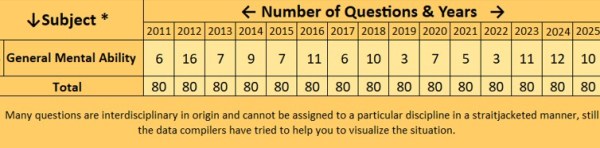
Let us analyse a few General Mental Ability questions:
Directions to Question no.1: In the following question, there is some relationship between the figures. From the answer figures, pick out the figures which most appropriately completes the sequence.
Question 1:
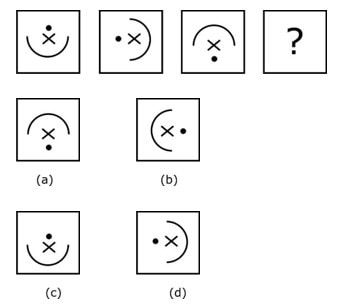
1. Answer: (b)
Story continues below this ad
Explanation: In each subsequent figure the design rotates through 90o in anticlockwise direction.
Directions for Question no. 2: Study the following information and answer the given question:
In a certain code language –
‘school is far from here’ is written as ‘to ga di ba ni’.
‘here is the school bus’ is written as ‘ru to ni di zi’.
‘come from school’ is written as ‘ga ni mo’.
Story continues below this ad
‘is the bus late’ is written as ‘ru zi fa to’.
Question 2: What may the code ‘ru mo di’ stand for in the given code language?
(a) the bus here
(b) come from here
(c) come the late
(d) come the here
2. Answer: (d)
Explanation: School = ni, is = to, far = ba, from = ga, here = di, come = mo, late = fa, the bus = ru zi
Question 3: M is the son of P; Q is the grand-daughter of O who is the husband of P. How is M related to O?
(a) Son
(b) Daughter
(c) Mother
(d) Father
3. Answer: (a)
Story continues below this ad
Explanation: Given that O is the husband of P and M is the son of P, and Q is the grand-daughter of O who is the husband of P. So, O and P are parents of M.
Therefore, M is the son of O.
So, the answer is (a).
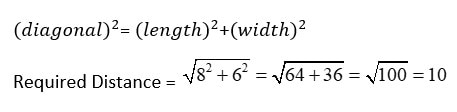
Question 4: Prateek traveled in an absolutely barren desert with a plain surface from a point A to B, a distance of 12km. He turned right and traveled 8 km and reached point C. From that point he took a right turn and traveled 6 km, and reached point D. How far away is he from the starting point?
(a) 10 km
(b) 12 km
(c) 13 km
(d) 14 km
4. Answer: (a)
Explanation:
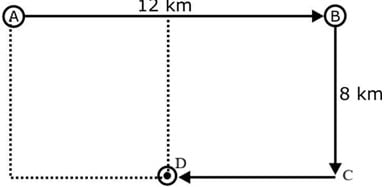
The required distance is a diagonal of the rectange with sides 6 km and 8 km. So, we can use the Pythagoras Theorem:
Next Article in CSAT Simplified: How to tackle basic numeracy and data interpretation questions for UPSC exam
Share your views and suggestions in the comment box or at manas.srivastava@indianexpress.com
Story continues below this ad
Subscribe to ourUPSC newsletter.Stay updated with the latest UPSC articles by joining our Telegram channel –IndianExpressUPSC Hub, and follow us onInstagramand X.
🚨Click Hereto read the UPSC Essentials magazine for March 2026.🚨
