

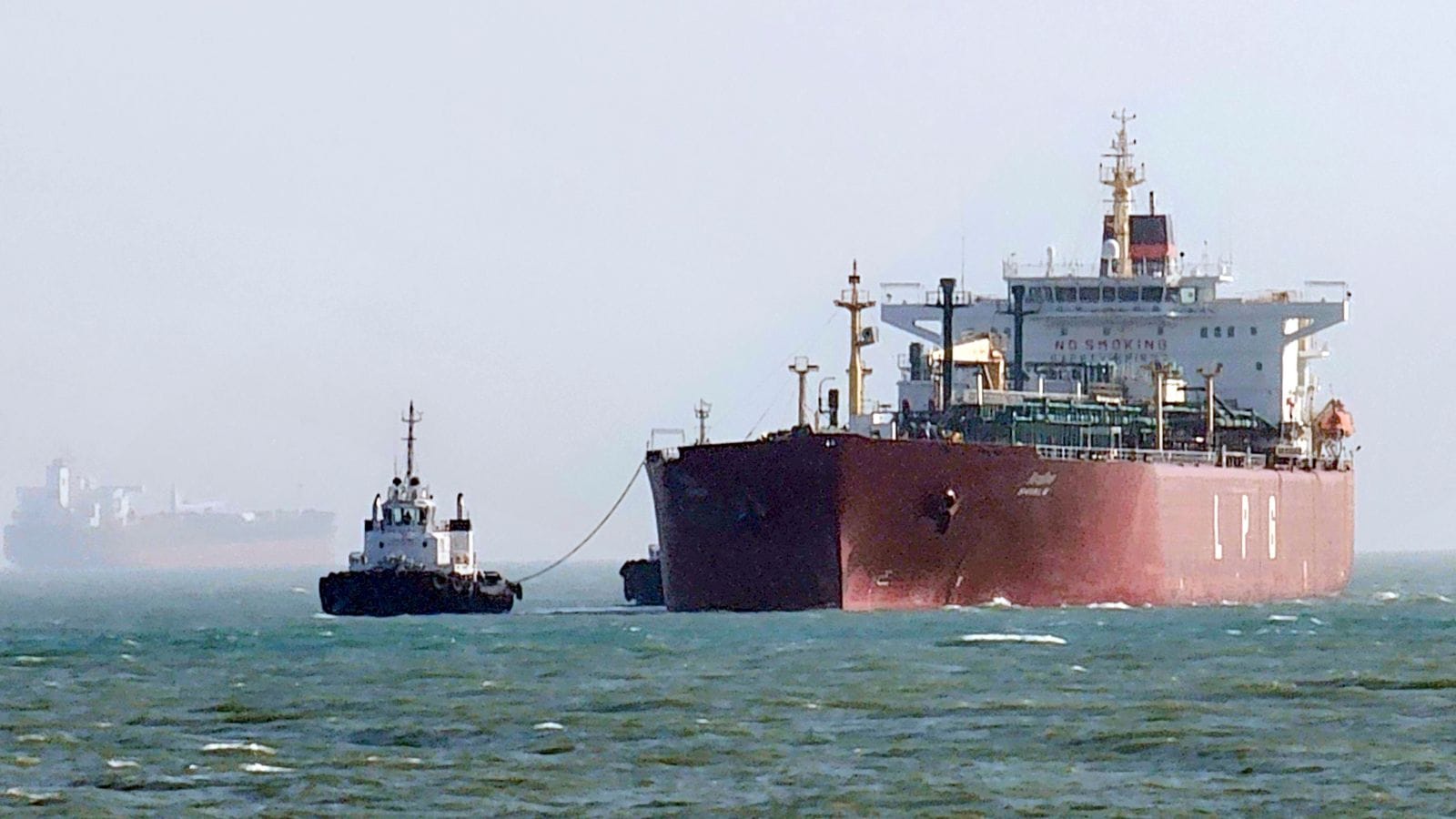
Two India-flagged liquefied petroleum gas (LPG) tankers that had been anchored in the Persian Gulf are on the move and have crossed over to the east of the Strait of Hormuz on Monday using a route—through Iran’s territorial waters—that industry experts believe allows Tehran to run a checkpoint and regulate vessel movements through the maritime chokepoint. According to ship tracking data, the two Indian LPG tankers—Pine Gas and Jag Vasant—sailed through the waters between Iran’s Larak and Qeshm islands on Monday afternoon.
Both tankers, sailing close to one another, were broadcasting that they were Indian ships, possibly to avoid any confusion regarding their flag and identity among the Iranian authorities keeping a close watch on the Strait of Hormuz—the narrow waterway between Iran and Oman that connections the Persian Gulf to the Gulf of Oman—that is a critical chokepoint for global energy flows from West Asia. While Iran had claimed that the Strait was closed only for vessels linked to the US, Israel, and their allies, a few vessels of evidently neutral countries also came under attack. This led to most trading houses, insurers, and vessels becoming loath to transit the Strait in the extremely high-risk environment.

India has been engaged with Iran at the diplomatic level for safe passage of Indian ships through the Strait of Hormuz, which earlier helped two LPG tankers—Shivalik and Nanda Devi—to transit the strait a few days back. In an interview to the Financial Times last week, Foreign Minister S Jaishankar said that there was no “blanket arrangement” with Iran for India-flagged ships, “every ship movement is an individual happening”, he added, while saying that he remained engaged in talks with Tehran. Iran’s Foreign Minister Seyed Abbas Araghchi had told CBS that Iran was “open” to countries that want to discuss “safe passage of their vessels”. Notably, as was the case with Shivalik and Nanda Devi, the transit of Jag Vasant and Pine Gas came close on the heels of a conversation between Prime Minister Narendra Modi and Iran’s President Masoud Pezeshkian.
According to Shipping Ministry Special Secretary Rajesh Kumar Sinha, the two tankers were moving and were estimated to be cumulatively carrying over 92,000 tonnes of LPG, or over a day’s worth of India’s pre-West Asia war consumption. The country’s current LPG consumption is lower amid a supply crunch due to the war. According to information provided by the Shipping Ministry, the two vessels together have 60 Indian seafarers onboard, and are expected to reach Indian ports between March 26 and 28.
Both Jag Vasant—owned and operated by Mumbai-based Great Eastern Shipping Company—and Pine Gas—owned and operated by Mumbai-based Seven Islands Shipping—were chartered by public sector refiners. As per vessel tracking data, both the LPG tankers are estimated to have started for India between Sunday night and Monday morning. They had initially left their loading ports in the Persian Gulf on March 2-3, but had then been anchored in the region as the West Asia war escalated.
The effective closure of the Strait of Hormuz has created a major headache for India, which depends on imports to meet a bulk of its energy needs. Around 40% of India’s crude oil imports, over 50% of its LNG imports, and a whopping 90% of its LPG imports transited the Strait, making the chokepoint particularly critical for India’s LPG supplies. India’s annual LPG consumption stands at a little over 33 million tonnes, with an import dependency level of 60%. With 90% of India’s LPG imports coming from West Asia, the Strait of Hormuz effectively sees the movement of around 54% of India’s LPG consumption.
As of Sunday, India had 22 merchant vessels with 611 seafarers stuck in the Persian Gulf, with a majority being oil and gas tankers. They cumulatively held 3.2 lakh tonnes of liquefied petroleum gas (LPG), 2 lakh tonnes of LNG, and 16 lakh tonnes of crude oil destined for India. Once Jag Vasant and Pine Gas exit pass through the Strait of Hormuz, the number of Indian vessels in the Persian Gulf would be 20. The Ministry of External Affairs (MEA) has been maintaining that India continues to be in constant contact with all relevant governments at various political and diplomatic levels and is making efforts to ensure that Indian vessels can achieve safe and unhindered transit to maintain the country’s energy security.
Story continues below this ad
Even as the effective halt in transits through the Strait of Hormuz continues to be in place, there are strong indications that Tehran is selectively allowing some traffic to transit the Strait’s fraught waters by providing negotiated safe passages based on its talks with other governments and stakeholders, according to industry watchers and vessel tracking data. Rather unusual routes through Iran’s territorial waters taken by vessels that recently transited the Strait of Hormuz are a major signal of Tehran regulating the flow of maritime traffic through the Strait, which accounts for one-fifth of global crude oil and liquefied natural gas (LNG) flows.
A number of vessels that have managed to trickle out of the Persian Gulf over the past few days went through the waters between Qeshm island (on Larak’s east) and Larak island to take a longer, circuitous path before crossing the Strait of Hormuz, as against the shorter and straighter conventional path through the middle of the Strait, ship tracking data shows. Jag Vasant and Pine Gas used the same corridor, the data shows. Nanda Devi and Shivalik were also estimated to have taken the same route, as did vessels from other countries including Pakistan, Turkey, and Greece. According to observers, this type of an unusual routing through Iran’s territorial waters suggests that the vessels had received Tehran’s nod to exit the Persian Gulf.
Iran’s Ministry of Foreign Affairs said that the country has adopted a “responsible approach” by implementing “a series of precautionary measures” to prevent the “additional risks on ships and seafarers in the Persian Gulf, the Strait of Hormuz, and the Sea of Oman”. “Accordingly, and as repeatedly emphasized, the Strait of Hormuz is not closed, and maritime traffic through it has not been suspended. Navigation in the Strait continues, subject to compliance with the aforementioned necessary measures and considerations arising from the wartime situation,” it said in a statement.
“Non-hostile vessels, or those belonging to or affiliated with other countries, provided that they do not participate in or cooperate with acts of aggression against Iran and comply with the declared safety and security regulations and measures, may, in coordination with the competent Iranian authorities, benefit from safe passage through the Strait of Hormuz,” it added, while maintaining that vessels linked to the US, Israel, and their allies “do not qualify as engaging in normal and non-hostile passage”.
Story continues below this ad
“The Ministry of Foreign Affairs of the Islamic Republic of Iran once again emphasizes that any arrangements, initiatives, or mechanisms related to the safety and security of navigation in the Persian Gulf, the Strait of Hormuz, and the Sea of Oman must be undertaken with full respect for the rights and interests of the Islamic Republic of Iran, in coordination with its competent authorities, and with due regard to the realities arising from the aggression and the situation of conflict,” the statement read.
