

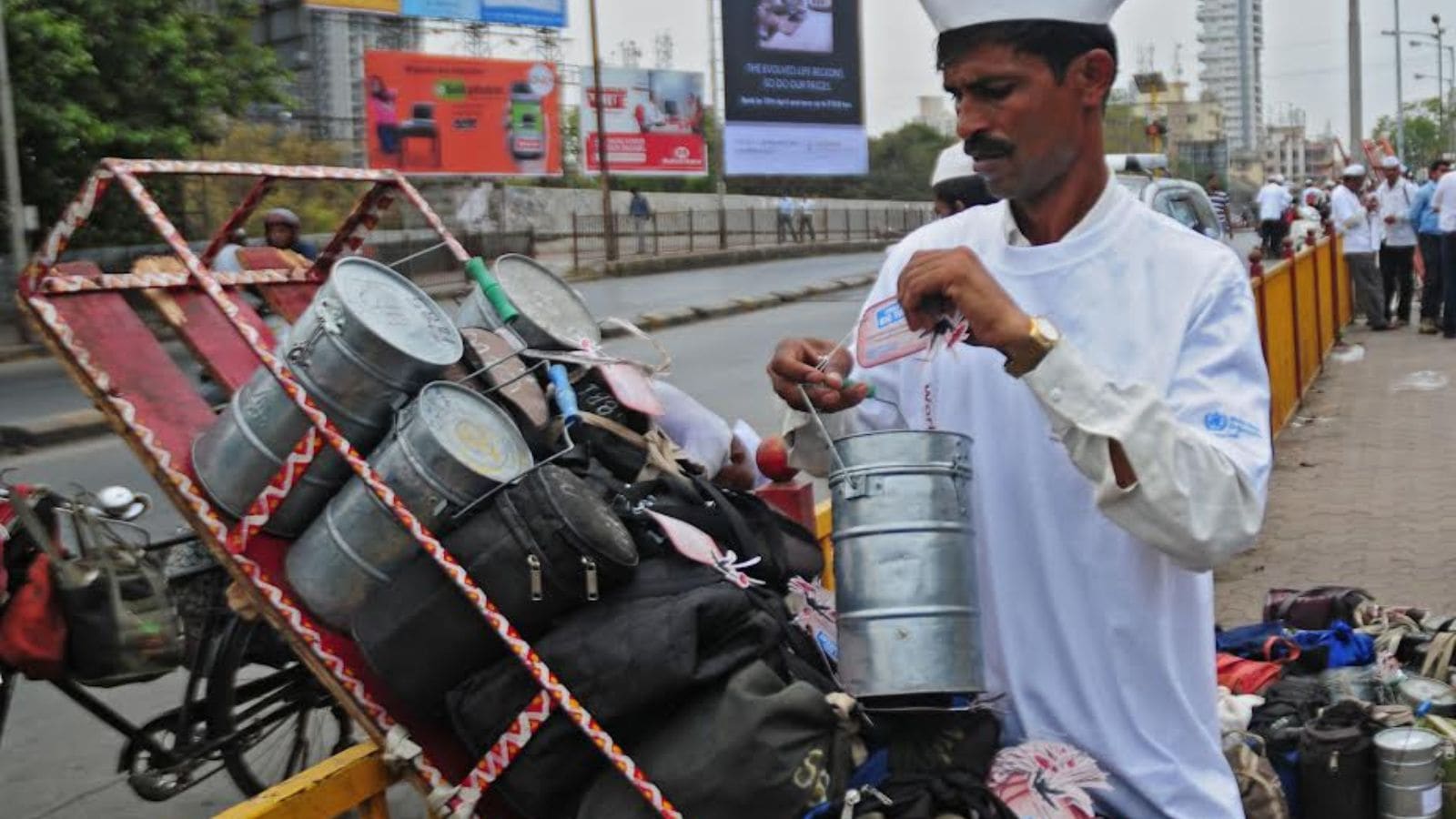
Mumbai’s robust tiffin service — a vast, decentralised network of home-style meal providers that has kept the city fed long before delivery aggregators entered the scene — is quietly coming under pressure. A recent shortage of LPG cylinders is unsettling this ecosystem. Across neighbourhoods, kitchens are being forced to adapt: trimming menus, raising prices, or, in some cases, shutting shop altogether.
In Sakinaka, 33-year-old Chirag Purohit has gone back in time. With LPG cylinders unavailable, Purohit, who has been running Yummy Tiffins since 2009, has turned to wood and coal-fired ‘sigdis’ to keep his kitchen running. “Apart from roti-sabzi, we also made high-protein rice bowls, but we’ve had to stop those,” he said. Orders have dropped from 500 dabbas a day to about 300. “Cooking on sigdis takes much longer.” His catering business has taken a hit too. “You can’t make Chinese dishes or snacks that require proper frying on wood or coal.”

In Bhandup, Omkar Ajit Patkar, 29, who runs Bhojanyan Tiffin Service, says he is on the brink of shutting down. “We haven’t received a single LPG cylinder in the last two weeks.”
Rationing three cylinders until they ran out, he is now relying on two electric coil stoves. “It takes more than double the time compared to cooking on gas.” He has stopped taking orders via Swiggy and Zomato, limiting himself to pre-orders, and his menu — once ranging from biryani to multiple meal options — has been reduced to roti, one vegetarian dish, one non-vegetarian dish and dal-rice. Even his roti-making machine, which could produce hundreds of chapatis an hour, runs on LPG. “I pay Rs 25,000 a month for the kitchen space and have seven staff. With just two electric stoves, it’s not practical to continue.” Paradoxically, demand has not dipped. “In fact, we’re seeing more demand because many restaurants are shutting down.”
 In Bhandup, Omkar Ajit Patkar, 29, who runs Bhojanyan Tiffin Service, says he is on the brink of shutting down. “We haven’t received a single LPG cylinder in the last two weeks. (Express File Photo by Pradeep Kocharekar)
In Jogeshwari, Laxmi Tiffin Service shut down midweek after their second cylinder ran out. “We tried to get it refilled but couldn’t,” said 30-year-old Akash Adhivand, who serves around 70 meals daily at Rs 100 per dabba, catering to students, working professionals and families. “Gas agencies have offered little clarity beyond saying the situation may improve in a few days.”
In Worli Koliwada, the crisis is showing up in numbers. For Nitin Morgaonkar, 42, who runs Aaicha Dabba Tiffin Service, the cost of a 14-kg cylinder has shot up from Rs 920 to between Rs 2,500 and Rs 3,000. A basic roti-sabzi meal, once priced at Rs 120, now costs Rs 135; with delivery, it comes to Rs 175. Margins have shrunk by nearly 30 per cent.
The biggest casualty has been his roti supply business, where five women together made around 2,000 chapatis a day for bulk sale. “I feel terrible that I’ve taken away work from these women, but I had no choice.”
Story continues below this ad
Tiffin services with access to piped gas, such as Mulund’s Gogo Tiffins, Kandivali’s Ghar Ki Rasoi and Malad’s Tattvam Foods, have largely remained insulated. In Thane’s Vartak Nagar, the owner of Bhumi Tiffins, which recently expanded from a home setup to a commercial kitchen, has a contingency plan ready. “If I run out, I’ll shift back to cooking from home, where I have piped gas.”
LPG quota hiked but tiffin service operators have no clarity
Meanwhile, with effect from Monday, the Centre has increased the supply of commercial LPG to all States by 20%, taking the total allocation to 50% of pre-crisis levels. In a letter issued on March 21, the Union Ministry of Petroleum and Natural Gas said the additional 20% allocation should be prioritised for key sectors, including restaurants, dhabas, hotels, industrial canteens, food processing and dairy units, subsidised canteens or outlets run by State governments or local bodies, community kitchens, and 5 kg free trade LPG cylinders for migrant labourers, along with measures to prevent diversion.
Explaining the new directive, Pranav Rungta, VP, National Restaurant Association of India (NRAI) said: “The Central government had earlier capped the supply of commercial LPG cylinders at 30% of the average past usage, leaving it to the States to decide on allocation. Most States, barring a few including Maharashtra, did not include restaurants in their distribution plans, leading to significant disruption and a rise in black market activity.”
“NRAI had written to the Centre seeking intervention. The recent allocation of 20% has come with a clear directive that this incremental supply be prioritised for restaurants and allied industries. It was done to allay the concerns of the industry which was on the verge of collapse, and to prevent black marketing and profiteering,” added Rungta.
Story continues below this ad
However, those in the tiffin service business say they are still in the dark about when the cylinders will reach them or any such directive.
“I called the gas agency on Saturday and was told it would take another five to six days before we get a cylinder. When I called again on Monday, there was still no clarity,” said Purohit.
Patkar said the increased allocation has not changed the situation for operators like him yet. Patekar, who supplies tiffins to hospitals, added that he received a letter stating he falls under essential services and has submitted it to the gas agency, but has yet to hear back.
The directive also said that all commercial and industrial LPG consumers are required to register with Oil Marketing Companies (OMCs) before becoming eligible for allocation from the overall 50% quota. OMCs will register such consumers and maintain records of their sector of operation, end-use of LPG, and annual LPG requirement in their respective databases. Additionally, all commercial and industrial LPG consumers must apply for Piped Natural Gas (PNG) with the City Gas Distribution (CGD) entity in their respective cities, wherever applicable. They must also take necessary steps to be ready to receive PNG before becoming eligible for allocation from the 50% LPG quota.
Story continues below this ad
“I read about it somewhere, but wasn’t sure. My agency hasn’t told me anything. They would have definitely communicated if this were the case,” said a tiffin service operator.
It is worth noting that many small tiffin operators do not hold licences for commercial cylinders and have been relying on the black market for supply, where they do not expect prices to ease. “Once people get used to paying more, it stays that way. Have you seen petrol prices fall?” asked one operator.
